
“Then the Lord said to Moses, ‘Go in to Pharaoh and say to him: This is what the Lord, the God of the Hebrews, says: Let my people go, so that they may worship me. But if you refuse to let them go and keep holding them, then the Lord’s hand will bring a severe plague against your livestock in the field – the horses, donkeys, camels, herds, and flocks. But the Lord will make a distinction between the livestock of Israel and the livestock of Egypt, so that nothing of all that the Israelites own will die.'” (CSB – Read the chapter)
I’ve recently gotten to see one of Jesus’ parables played out right in front of me. In the parable of the wheat and the tares, a man plants a field but then an enemy comes at night and sows a bunch of weeds in the field. The man’s response to his servants’ inquiry about whether he wants them to try to pull the weeds is to tell them to let them all grow up together, and he’ll sort them out at the harvest time. He doesn’t want to risk damaging any of the wheat. A field of wheat near my house was growing with lots of big patches of weeds. The farmer just left them there until the harvest. The idea, of course, is that God lets evil exist alongside righteousness until the end at which point He’ll sort and separate. God is patient with evil. But when it gets bad enough, God can be surgical in dealing with it. He demonstrates this ability here in the fifth plague. This one is a bit more uncomfortable than the ones before it, but it’s not quite as bad as it sounds. Let’s talk about what’s going on here.
When I was growing up, being vegetarian was a thing that was popular among a handful of teenage girls and a few celebrities, but that was about it. There weren’t any vegetarian-only restaurants except perhaps in the most progressive of city environments. And vegan wasn’t really a thing at all. Today, there is an anti-meat movement powerful enough for major fast food chains like Burger King to put fake meat burgers on their menu and for various news agencies to write breathless reviews of the exciting possibilities of lab-created meat. (And can we at least appreciate the…delicious…irony of movements against lab-altered vegetables and for lab-created meat being supported by the same people. Science is apparently great on the grill, but unsatisfactory on the salad bar.)
All of that is to say that passages like this one may be pretty tough for a growing number of folks in the modern world to stomach and not because the outcome of this fifth plague meant the potential starvation of untold thousands of people.
The next plague here that God brings against the people of Egypt is a plague on the livestock of the land. More specifically, He strikes them with a pestilence that kills an indeterminate but sizable number of them (more on that in just a second). The fifth plague fits nicely in the larger pattern of these judgments. Indeed, while I am completely committed to the fact that these plagues were all historical, supernatural in nature, and unfolded pretty much like the text describes (more on that in just a second too), there is a literary form to them that sees them all connected to each other in some interesting ways.
For example, the first set of three plagues all take place on the day Moses announces or otherwise initiates them. This second set of three all have about a day’s worth of delay before they take effect. In each sequence of three (the tenth and final plague is a whole different animal), the first two are announced, but the third is not. The first of each trio features Moses being instructed to get up early to go tell Pharaoh about what’s coming. The middle plague of each set focuses on the people’s ability to eat (the frogs were noted specifically to be all up in their cooking business, this one destroys a ton of livestock, and the eighth plague is the locusts). None of this literary symmetry takes away from the historical nature of the plagues, but it does offer a reminder that there is a rhythm to the things God does. Our lives are best lived in harmony with it.
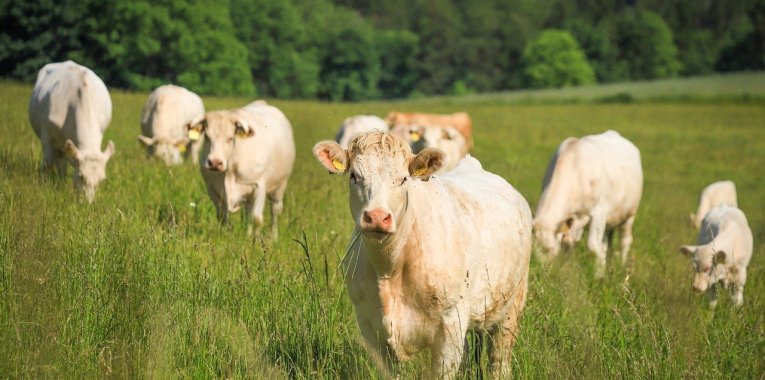
Like the plague of flies, Moses tells Pharaoh that this one is going to be surgical. The coming pestilence will only affect Egyptian livestock. And indeed, when the plague strikes, all the Egyptian livestock die while none of the Israelite livestock in the land of Goshen are affected. Moses specifically notes for us that Pharaoh investigated whether this was true and discovered that, yes, it really is. The God of the Hebrews really was powerful enough to attack Egyptian livestock while leaving the livestock of His people completely unscathed.
There are a couple of things we need to clarify here. One is about helping us understand what exactly is going on here. The other is about making the whole story just a little bit easier to stomach. First, why the livestock? Was this just about punishing the people with starvation to get at Pharaoh? Almost certainly not. The various gods of Egypt were represented by animals. There were gods who were presented as cows and sheep and goats and horses and camels – all the livestock mentioned here. This plague wasn’t merely a matter of hurting the people. This plague was about demonstrating God’s power over the various Egyptian deities. God was symbolically destroying them. This, like all the other plagues, was more about the spiritual conflict between God and Pharaoh than it was about the physical outcome. And rest assured, although we see this through an intensely natural lens, and although the people certainly experienced the physical effects of the plague, they would have seen this through a spiritual lens. Everyone then would have understood this as a conflict between the God of Israel and the gods of Egypt. And the gods of Egypt were losing.
The second thing here is this. The text here says that all the livestock died. That sounds awful. And a huge waste of life. The trouble is that subsequent plagues both affect livestock. This means that not all of the livestock actually died in this plague. Now, it could be that all of the livestock died and that there was enough time between the various plagues that the Egyptians acquired more livestock that could be affected. But it is more likely that not all of the livestock actually died. Does this mean the text is just wrong? The short answer is no. The longer answer is that this plague description, like so many other descriptions of God’s activity in the Old Testament, is sensationalized in a way that is hard for us to understand. We think very literally and linearly. Ancient people were comfortable with hyperbole and dramatic statements that weren’t literally true, but which captured the heart and experience of the event. It may have felt like all of the livestock died, but it wasn’t really all of them. Besides, in a normal time of pestilence, the disease doesn’t kill every victim. Because of how genetics works, some of the animals would be immune or otherwise survive the plague.
Now, do either of those things make this story easier? Perhaps a little, but maybe not enough. These are tough stories. There’s just no way around that. God’s judgment is uncomfortable for us to behold because it is always a reminder that we could be liable for it too. This is yet again a reminder that without Christ, we are without hope. Let us throw ourselves on His mercy with gratitude for His grace.
 The Nexus
One thought on “Digging in Deeper: Exodus 9:1-4”