
“For those of you who were baptized into Christ have been clothed with Christ. There is no Jew or Greek, slave or free, male and female; since you are all one in Christ Jesus. And if you belong to Christ, then you are Abraham’s seed, heirs according to the promise.” (CSB – Read the chapter)
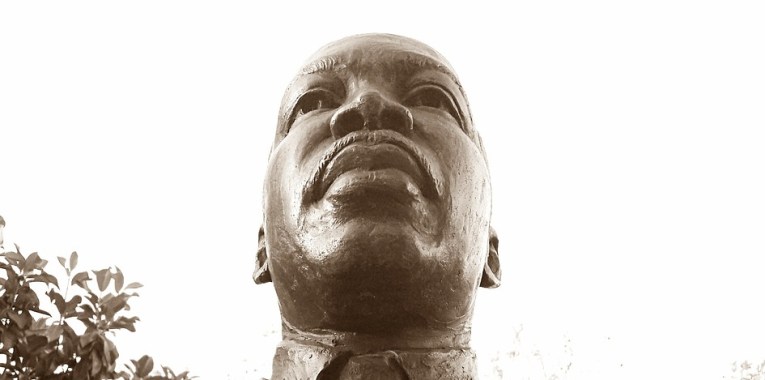
Today is Martin Luther King, Jr. Day. If you are a student or work for a state or federal employer, or a bank, or any one of a number of other places, I hope you get to enjoy your day off. Other than one of our Founding Fathers or Abraham Lincoln, it is hard to imagine another American from our entire history who is more celebrated than King. He’s the only person in our history who has a day named after him. Washington and Lincoln used to have their own days, but those got rolled into President’s Day more generally which is really too bad because all of our Presidents are not equally worth celebrating, but that’s for another time. That all being said, King is rightly given his own day because of the absolutely invaluable contribution he made to our nation. We would not be who we are without his tireless labor to advance the cause of Civil Rights for all people, but especially black people in a day when racism ruled in the hearts of far too many people. Let’s reflect for just a minute on King’s vision, what gave it substance, and how we’re doing with achieving it today.
Martin Luther King, Jr. envisioned a day when all people would be judged based on the content of their character and not the color of their skin. There were a whole lot of people who shared that vision in his day and worked toward it with incredible courage and humility. King was the superlatively gifted communicator who became the face of the movement. He was a modern prophet, calling the American people to become a better version of ourselves with the explicit power and foundation of the Gospel as his guiding light. Nothing King said makes sense apart from the Christian worldview and the moral vision commended to us in the Scriptures. He was calling for the kind of world that Paul was calling for here in his letter to the Galatian churches. Modern efforts to separate King from the Christian faith are dishonest, foolish, and nonsensical. All similar efforts to advance the causes of anti-racism, civil rights, equality, and justice for all people that have not been rooted in the Christian worldview have failed or become the heralds of the very thing they profess to hate but from a different direction.
Along the way he endured an untold number of threats against his family and against his own life. He was falsely imprisoned on more than one occasion. One such instance in Birmingham, AL resulted in his “Letter from a Birmingham Jail,” which is one of the most important documents of the Civil Rights era. Ultimately, he was assassinated for his efforts. This, though had the effect of turning him into a martyr and allowing his vision to become metastasized across the nation. It is as the symbol he became because of his death that has allowed him to accomplish far more in death than he perhaps could have imagined seeing come to pass in life.
Today, we have made remarkable progress toward becoming the kind of nation King envisioned our being. We have made amazing strides toward becoming the kind of nation our founding documents described us as being in the beginning, but which offered promises that were delayed far more than was right. Structural and institutionalized racism are not nearly the problems they once were. Racism itself is understood broadly to be a moral evil that should have no traction in anyone’s heart. To call someone a racist in the 1960s and before was merely to state a fact. Today, such a charge is to ascribe to someone one of the most virulent moral crimes a person can commit. The “N-word,” which I’m not even comfortable committing to digital print, is the one word that is forbidden in public. And in a day when public cursing is becoming more accepted (to our own shame), to have any one that is off limits is pretty impressive.
Now, are we perfect in any of these regards? Absolutely not. And, I write all of that from the standpoint of someone who checks pretty much all of the cultural power boxes and who has never experienced any kind of meaningful persecution in my life. The cultural experience of black people is starkly different from what I have lived. Black fathers have different conversations about life and the world with their sons than I ever will with mine because of lingering assumptions and biases that still must be opposed and eliminated. And yet, we are not where we once were. King’s labor was not in vain.
And yet, there is a movement growing in our culture today that stands opposed to King and his moral vision and is slowly but steadily transforming us into a nation that paradigmatically opposed to the one he called us to become. This is the critical theory movement. Attempting to do a full reflection on the foundation and problems with critical theory goes well beyond the scope of what I want to try to do this morning. If you need an explainer on critical theory, you’ll have to look elsewhere. (This article is helpful for a brief introduction. If you want a much more thorough treatment, I cannot recommend enough the books The Rise and Triumph of the Modern Self by Carl Trueman and A Biblical Critical Theory by Christopher Watkin.)
The one observation I want to make here is this: King’s vision was of a nation that did not judge people based on external factors over which they did not have any meaningful control. Things like race and gender and ethnicity are aspects of who we are that are not insignificant, should not be the means by which our character and worth are assessed by the world around us. The most famous part of King’s most famous speech almost didn’t happen. It wasn’t in his text. Yet when he was really getting going, Mahalia Jackson cried out, “Tell them about the dream, Martin! Tell them about the dream!” And so he did. He said, “I have a dream…” and the nation has never been the same.
I have a dream that one day this nation will rise up and live out the true meaning of its creed: “We hold these truths to be self-evident, that all men are created equal.”
I have a dream that one day on the red hills of Georgia, the sons of former slaves and the sons of former slave owners will be able to sit down together at the table of brotherhood.
I have a dream that one day even the state of Mississippi, a state sweltering with the heat of injustice, sweltering with the heat of oppression, will be transformed into an oasis of freedom and justice.
I have a dream that my four little children will one day live in a nation where they will not be judged by the color of their skin but by the content of their character.
I have a dream today!
I have a dream that one day, down in Alabama, with its vicious racists, with its governor having his lips dripping with the words of “interposition” and “nullification” — one day right there in Alabama little black boys and black girls will be able to join hands with little white boys and white girls as sisters and brothers.
I have a dream today!
I have a dream that one day every valley shall be exalted, and every hill and mountain shall be made low, the rough places will be made plain, and the crooked places will be made straight; “and the glory of the Lord shall be revealed and all flesh shall see it together.”
Martin Luther King, Jr. “I Have a Dream”
The critical theory worldview that holds so much power in our culture today does not embrace this kind of a moral vision. In fact, it rather explicitly rejects it. It insists that people absolutely should be judged on the basis of these primarily external factors. But the judgment should be just the reverse of how it was done in the days when King called us to become something more than that as a nation. The song of intersectionality insists that those who check the most minority boxes are the ones who should be given the power in society. Meanwhile, those who check the traditional oppressor boxes (people like me), should have their power taken away. They should be made to pay for crimes they never committed. They should be considered guilty as a starting point and spend their lives atoning for factors over which they had no control.
All of this runs rather directly counter to the dream King shared with the country on that fateful day. It runs counter to the Gospel that empowered and fueled his vision. It is a vision that will not lead to life and flourishing for the most people. It is in fact anti-Gospel in its basic orientation. I believe King would have stood against critical theory just as fiercely as he opposed the racism of his own day. And he would have been right to do so. It represents the exact same problem but from a different angle. Sinful thinking and reasoning lie at its heart. This doesn’t mean it gets everything wrong, but its solutions to things that are, have been, and continue to be genuine cultural problems will not actually solve anything. They will only create new problems; problems that only the Gospel can fix. That hasn’t changed.
As you enjoy your day off today (if indeed you have one), spend some time reflecting on King’s Gospel-fueled vision. Go back and read his full “I Have a Dream Speech” or his “Letter from a Birmingham Jail.” Notice how thoroughly soaked in the Gospel those essential documents are. Compare that with where we are headed today. Pray for our nation. Pray against its ongoing fall to a new kind of racism. Pray for a fresh, Gospel-rooted moral vision and the leaders who can eloquently proclaim it. Pray for the church to be able to accomplish the work God gave us to do of advancing His kingdom, the one place where King’s vision comes to its fullest fruition. Pray for Jesus’ followers to be bold in our efforts to make more disciples who are driven by such a vision. And commit yourself to loving your neighbor more fully than you have before. Let’s work to see King’s dream continually made real.
 The Nexus
Not sure if I told you (I’m old and forgetful) but the same aunt who took me to the movie also took me to the Woolworth diner in 1971. Only 11 years after the sit ins. I was too young to comprehend it then but it was neat seeing the counter at the Smithsonian when we went a couple of years ago. My aunt has Alzheimer’s and my uncle just passed away Monday but they brought me a little culture at an early age. I’ll never forget them.
LikeLike
That’s awesome to have such good and powerful memories. I’m most grateful for all the culture my parents went out of their way to expose us to growing up. I’ve benefited mightily from it over the years.
LikeLike