
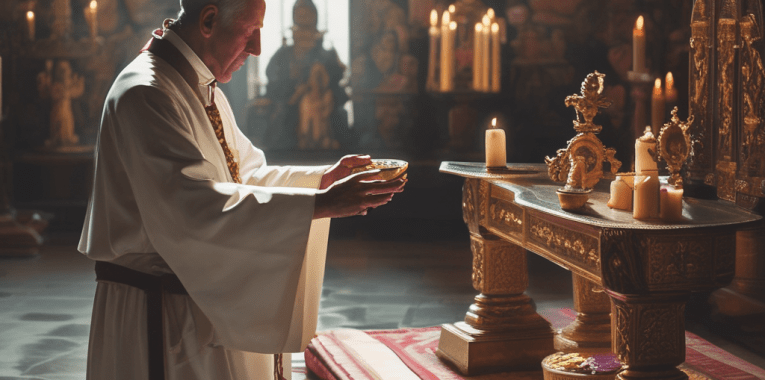
“Take the fat from the ram, the fat tail, the fat covering the entrails, the fatty lobe of the liver, the two kidneys and the fat on them, and the right thigh (since this is a ram for ordination); take one loaf of bread, one cake of bread made with oil, and one wafer from the basket of unleavened bread that is before the Lord; and put all of them in the hands of Aaron and his sons and present them as a presentation offering before the Lord. Take them from their hands and burn them on the altar on top of the burnt offerings; as a pleasing aroma before the Lord; it is a food offering to the Lord. Take the breast from the ram of Aaron’s ordination and present it as a presentation offering before the Lord; it is to be your portion. Consecrate for Aaron and his sons the breast of the presentation offering that is presented and the thigh of the contribution that is lifted up from the ram of ordination. This will belong to Aaron and his sons as a regular portion from the Israelites, for it is a contribution. It will be the Israelites contribution from their fellowship sacrifices, their contribution to the Lord.” (CSB – Read the chapter)
One of the things that is so vital to understand about the Old Testament is that all of it points to Jesus. That’s its real value. That’s its real purpose. It doesn’t tell us how to live our lives. It doesn’t tell us what we should or shouldn’t be doing. It helps us see and understand the way God worked through history in order to bring about the means of our salvation in Christ. If we understand it through any other lens, it’s not going to make the kind of sense it should. WIth this lens in mind, let’s take a look at the next part of the priestly ordination ceremony, and talk about the kind of commitment God wants us to make with Him as well as what He offers us when we do.
As with the previous parts of the ordination ceremony, without a good bit of historical and cultural context, what we see here doesn’t make a whole lot of sense. What is being described here was called a presentation offering. In other translations it is sometimes called the wave offering. Personally, I always thought that was a more entertaining title because the idea of waving something at God as a means of making an offering to Him created a funny picture in my mind. This is especially true when you consider what was being waved – a bunch of animal guts and a few pieces of bread. I want to know which one of Aaron’s sons had to hold the fatty lobe of the liver and which ones got to hold the bread. This makes my point, though: wrong thinking leads to misunderstandings of what was happening here however humorous they may happen to be. This would have been an entirely more solemn affair than that.
What the presentation or wave offering consisted of was the priests elevating their offering before the Lord. They would take whatever it was and lift it up toward Him like they were…well…offering it to Him. They were presenting it like a child might do with something she’s made to her mom and dad. It was to say, “Here, this is for you.” These presentation offerings were usually then combined with a burnt offering of some sort. The basic belief in operation here was that God was spirit. Because of that, you couldn’t give whatever it was to Him in a physical form. You had to convert it into a spiritual form (that is, smoke) in order to make it receivable by Him. The larger point here runs right along the lines of the last part of the ordination we talked about. The priests were communicating their intention to be as fully committed to God as the things they were presenting to Him.
We’ll come back to this idea in just a minute. First, there’s one other thing to talk about from a detail standpoint. The end of this passage talks about the priests receiving a portion of the Israelites’ offerings going forward. They were to receive the right breast and the right thigh. The reason for this was primarily practical. The priests had to eat. And, because their call was to serve God on the people’s behalf in such a way that prevented their pursuing other occupations that would furnish them the opportunity to earn and income for themselves and raise flocks and herds and crops of their own, God was allowing them to have a part of what the people brought to Him as their regular source of food.
What God was setting in place here was a pattern that we see picked up and reaffirmed in the New Testament. Everyone is supposed to serve and obey the Lord. That’s fundamental to being human. God is the Creator, we are the creatures. Our role is only and ever to abide by His will and direction. That being said, there are some people God raises up to serve Him in a way that goes beyond what most people are able to do on their own. They are raised up specifically to help others learn and understand how to do what God has called them to do. Their occupation, their vocation is to lead others to better follow Him.
When a person is called to this kind of a role, the dedication it requires, the attention it demands, renders them practically unable to pursue what might be termed a “normal” career that brings in a normal income. Yes, they can try to do both, but their effectiveness is limited in this kind of a situation. Sometimes this is unavoidable, and God can and does use these bivocational pastors to accomplish great things for His kingdom since the one who is in them is greater than the one who is in the world. But it remains nonetheless true that the amount of attention a bivocational pastor can give to leading a church is not going to be as extensive as a full-time pastor because of the natural limitations of time.
The question, then, becomes one of how such a person can see his needs and the needs of his family met. The answer we find outlined here and picked back up in places like 1 Corinthians 9 is that it is right and proper for those who are directly benefiting from their sacrificial labors to be a part of supporting them. Now, this kind of a situation can get complicated and messy in all kinds of ways. Let’s not try to avoid that unfortunate reality. Sometimes pastors take advantage of their situation or try to manipulate their people into giving what they can’t afford in order to finance their own lavish lifestyle. On the other side of things, sometimes churches take it upon themselves to keep their pastors poor in order to keep them humble. Both of these situations are deviations from God’s intention and design. Pastors should never take advantage of their people or seek to live at a level higher than most of their people. On the other hand, churches should never put their pastors in a situation where they can’t afford to pay their bills or hold them at an income level well below what most of the congregation enjoys. There is a balance point. I’m happy to report that my own congregation gets this balance right. We seek to live modestly while the congregation provides generously. My situation is one demonstrating the goodness of getting things right here.
In all of this, while pastors and similarly called leaders are rightly expected to display a deeper, richer level of devotion to the things of the Lord than most people, still, the commitment we are to make in following Jesus in the first place is the same across the board. And that commitment is total. We’ve touched on this recently, but it’s worth repeating here since the context demands it.
Jesus never shied away from talking about the costs and expectations of following Him. In fact, if building a large following was His highest priority, He was remarkably adept at saying things that tended to keep His group artificially small. When talking about what it took to be His disciple, Jesus used an image that would have turned the stomachs of His first hearers. He told them they needed to be prepared to deny themselves (to willfully reject what they want in favor of what God wants) and to take up their crosses (which in their minds meant have a willingness to die a horrible death as a consequence of following Him) before they could follow Him.
In other words, Jesus said that His followers needed to be prepared to be as committed to Him as the priests here were indicating they were committed to their faithfulness to God’s covenant with the people. Except that whereas the priests were putting an animal’s life on the line as a demonstration of their commitment, Jesus called us to be ready and willing to lay our own lives on the line. He made the sacrifice Himself that allows us to draw near to God in the first place. But if we are going to draw near through His work on the cross, we have to be willing to be as committed to faithfulness to the Father’s direction as He was.
This does not, of course, mean that all of us are going to die a martyr’s death as a consequence of our faithfulness. Most of us won’t likely encounter such a situation. But some folks have been and are. And we don’t know whether this will be our call or not. No one does. Some who have expected it never experienced it, while others who never imagined it suddenly found themselves in just such a crucible. The point is not the outcome, but the willful dedication to God no matter the cost.
Yet this is not something we are called to simply because. We are called to this because God has something better planned for us than whatever it is we happen to experience in this life as a result of following Him. In Christ, we are given access to His eternal kingdom and the eternal life that will allow us to properly enjoy such a reward. In the scope of eternity, the pain we might face now doesn’t even begin to compare. It’s not close. The richness of this reward combined with the nature of God in the first place makes the kind of dedication Jesus calls us to entirely reasonable to give. The only question you need to worry about is this: Is this the kind of dedication you give to Him?
 The Nexus