
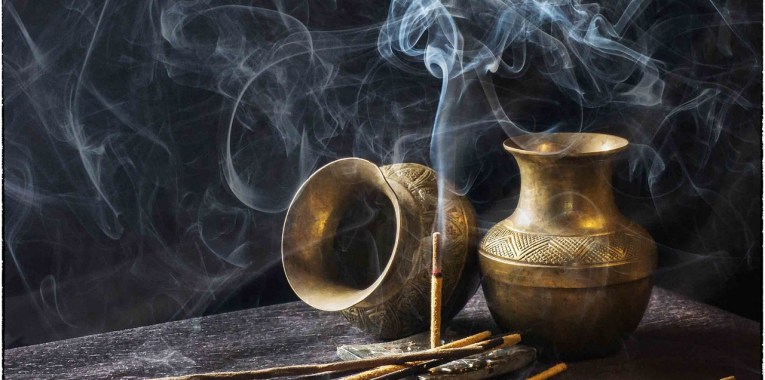
“The Lord spoke to Moses: . . . Prepare from these a holy anointing oil, a scented blend, the work of a perfumer; it will be holy anointing oil . . . Tell the Israelites: This will be my holy anointing oil throughout your generations. It must not be used for ordinary anointing on a person’s body, and you must not make anything like it using its formula. It is holy, and it must be holy to you. Anyone who blends something like it or puts some of it on an unauthorized person must be cut off from his people . . . As for the incense you are making, you must not make any for yourselves using its formula. It is to be regarded by you as holy – belonging to the Lord. Anyone who makes something like it to smell its fragrance must be cut off from his people.” (CSB – Read the chapter)
My family has a special Christmas plate and cup. They only come out once a year on Christmas Eve, and they only get used then to hold Santa’s cookies and milk. After that, they get washed and put away for the next year. To use them for any other purpose would seem wrong. Some things are just special like that. We understand either explicitly or perhaps merely intuitively that it wouldn’t be right to use them for anything else. As God was coming to the final parts of the tabernacle description, He gave the Israelites two things that were to be specially designated to only be used for worship purposes. Let’s talk about the sacred oil and incense.
Let me start with the obvious. I skipped a whole bunch of verses there. This passage really went all together as one big unit. The oil and incense were different from one another, but their purpose was similar enough that treating them separately didn’t make sense. I try to keep these to around 1500 words so that they don’t take too long for you to read. Transcribing sixteen verses would have eaten up a lot of that word count, and wouldn’t leave us much time to actually talk about them. So, I just included the highlights to give you a gist of what’s going on here. As always, I encourage you to click through the link and read the whole passage (and, really, the whole chapter for the sake of context) for yourself.
With that said, let’s get on to the passage. Anointing oil plays a significant role in the Biblical narrative, both Old and New Testament. It was a way to signify that something was special, different, set apart from the norm. Oil was also used more generally in a whole variety of other purposes in the culture of the day. It was used as fuel for lamps, as a kind of medicine for various skin conditions, it was perfumed in ways other than God directs here to mask foul odors (especially body odors), and so on and so forth.
What God was doing with this particular oil was following a pattern He repeated a surprising number of times across the Scriptures. He was taking something that was common, and giving it a holy makeover so that the people could have something they encountered regularly that would set their minds on Him. Every time they used oil in any other application, they would ideally give thought to the special oil used only for the tabernacle (and later temple). They would remember how good it smelled and recall the goodness of their God. They would consider how God declared it especially holy and reflect on God’s own holiness. God was finding ways to bring the sacred into the mundane.
This was all pointing forward to an idea the people of Israel never really understood even though it was all over their Scriptures until Jesus and the later apostles made it clearer for us. God isn’t interested only in the sacred. He wants to have authority over all of our lives. He wants to be our God in the big and the small moments of life. He wants our devotion when it counts most, but also when it seems to count least (because those are often the moments that count most even though we rarely realize it at the time).
This same idea applied to the special tabernacle incense. People then used incense all the time like they used oil. When bathing wasn’t a terribly common exercise, the stench of body odor was ubiquitous. Add to that the malodorous offerings of the animals they tended to live with in pretty close quarters and the smell of sewage from latrine systems that weren’t located far enough away from living spaces, and everything would have smelled bad all the time. Perhaps they got used to it and didn’t notice like we might if we paid them a visit, but burning incense helped to mask some of the worst of it. Like we talked about when exploring the altar of incense, the smell was a reminder to engage with God through prayer.
If these two special items carried such symbolism with them, though, wouldn’t it make sense that the people would want to create their own versions so they could be reminded of the goodness of God and to engage with Him through prayer even more often than just when they were at the tabernacle? That’s where our minds go fairly easily, but think about it just a second longer. Think about my family’s Christmas plate and cup. If we used those all the time, they would lose their specialness. They would become common, and all of the excitement and wonder the boys have (well…had for most of them) when we pull them out would be lost.
If the people made their own stock of the holy incense and holy anointing oil, they would gradually become familiar with them. Their aromas would eventually cease to stand out. They would become little more than another piece in the background of odors swirling about them all the time. Their very familiarity would give way to contempt. The things which were designed to bring the people into a greater and more worshipful awareness of God not only wouldn’t do that, it might actually point them away from Him. No one was going to benefit from that.
So, God gave them the instructions for making it, and then told them to keep it special. But look how He did this. Another religion might have given such knowledge only to the priests and kept it secret from the rest of the people. God didn’t operate in secret like that. He did what He did right out in the open. He invited them all to participate in a relationship with Him, but called them to do it in a way that kept themselves in that relationship rather than wandering away from it by inattention or treating Him like He was common.
Because we drift in the direction of making things common, though, He attached some consequences to choosing to ignore Him and doing what they wanted anyway. These consequences were intended to be severe enough to act as an effective deterrent. Smaller consequences would have left them willing to seriously consider ignoring Him in favor of what they wanted in spite of the consequences. We do that same kind of thing still today. If the consequences aren’t sufficiently severe, the allure of what we want is powerful enough to lead us to ignore the consequences. Set the consequences far enough (and enforce them justly, but strictly), and we’ll actually think twice.
We really don’t have a corollary to this, living as we do on this side of the cross and the resurrection. Jesus is our source of holiness. It is not found in anything we do or don’t do (save placing our faith in Him). That being said, we do see the apostle Paul warning believers to take the Lord’s Supper seriously in 1 Corinthians 10. And, the penalty he warns against is death. This is almost certainly not physical death, but rather death resulting from being separated from God because of sin. The real danger there is thinking you are good with God when you’re not.
This, as it turns out, isn’t so far from what God was trying to keep the Israelites from stumbling into here. He wants us to stay in a relationship with Him. But we have to do that on His terms and as He really is, not ours and as we want Him to be. Calling us to take Him seriously is a loving effort to keep us close and not let us drift away by inattention or willful sin. So, make sure you take Him seriously. He deserves it.
 The Nexus