Morning Musing: 1 Peter 2:2-3

“Like newborn infants, desire the pure milk of the word, so that by it you may grow up into your salvation, if you have tasted that the Lord is good.” (CSB – Read the chapter)

We had a hurricane come through our area yesterday. Thankfully, it wasn’t nearly as bad as it could have been. Perhaps the single biggest challenge was that the family was stuck at home all day and the Internet kept going in and out. For the kids at least, it was like living in the Dark Ages. Maybe the Stone Age. They had to break out an actual DVD in order to watch something on TV. It was rough. As I was out and about some during the day, though, a thought occurred to me that struck me as worth sharing. Maybe not, but I’ll let you decide.

Continue reading “Morning Musing: 1 Peter 2:2-3”

Morning Musing: Exodus 29:35-38, 44-46

“This is what you are to do for Aaron and his sons based on all I have commanded you. Take seven days to ordain them. Sacrifice a bull as a sin offering each day for atonement. Purify the altar when you make atonement for it, and anoint it in order to consecrate it. For seven days you must make atonement for the altar and consecrate it. The altar will be especially holy. Whatever touches the altar will be consecrated. This is what you are to offer regularly on the altar every day: two year-old lambs. . .I will consecrate the tent of meeting and the altar; I will also consecrate Aaron and his sons to serve me as priests. I will dwell among the Israelites and be their God. And they will know that I am the Lord their God, who brought them out of the land of Egypt, so that I might dwell among them. I am the Lord their God.” (CSB – Read the chapter)

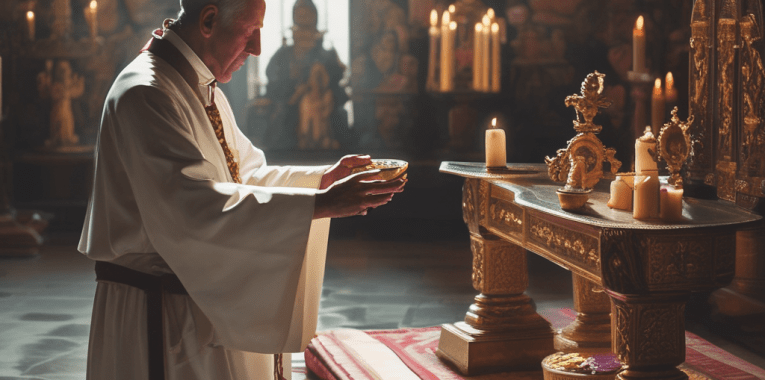
The old covenant was complicated. There were all kinds of rules and regulations to keep. If you touched the wrong thing at the wrong time or in the wrong way, you had to be made clean which required time and sacrifices to deal with. If you sinned, that required more sacrifices which meant more time and money lost. It was all just a lot. No one could have remembered it all. The average person was reliant on the priests to help them know what to do and when which gave the priests a ton of power. And everybody knows how well priests with lots of power tend to do. It worked for what it was, but it wasn’t ever intended to be God’s final plan. It did point to it, though. As we finish up our discussion of the ordination process, let’s talk about where it was pointing, and what we have today.

Read the rest…

Morning Musing: Exodus 29:29-34

“The holy garments that belong to Aaron are to belong to his sons after him, so that they can be anointed and ordained in them. Any priest who is one of his sons and who succeeds him and enters the tent of meeting to minister in the sanctuary must wear them for seven days. You are to take the ram of ordination and boil its flesh in a holy place. Aaron and his sons are to eat the meat of the ram and the bread that is in the basket at the entrance to the tent of meeting They must eat those things by which atonement was made at the time of their ordination and consecration. An unauthorized person must not eat them, for these things are holy. If any of the meat of ordination or any of the bread is left until morning, burn what is left over. It must not be eaten because it is holy.” (CSB – Read the chapter)

If you want people to think of something as different and special, you have to treat it as different and special. Our default is to engage with things around us like they are common. Different requires extra effort, and extra effort is not something life’s inertial pull allows for naturally. Even once we get used to something’s being special and treating it differently in light of that, still we can get so used to the special that it becomes common in our minds. This fact of life is what lies behind much of what we see going on in the ordination process for the priests of Israel. Let’s talk about what we see going on in this next part.

Read the rest…

Digging in Deeper: Exodus 29:22-28

“Take the fat from the ram, the fat tail, the fat covering the entrails, the fatty lobe of the liver, the two kidneys and the fat on them, and the right thigh (since this is a ram for ordination); take one loaf of bread, one cake of bread made with oil, and one wafer from the basket of unleavened bread that is before the Lord; and put all of them in the hands of Aaron and his sons and present them as a presentation offering before the Lord. Take them from their hands and burn them on the altar on top of the burnt offerings; as a pleasing aroma before the Lord; it is a food offering to the Lord. Take the breast from the ram of Aaron’s ordination and present it as a presentation offering before the Lord; it is to be your portion. Consecrate for Aaron and his sons the breast of the presentation offering that is presented and the thigh of the contribution that is lifted up from the ram of ordination. This will belong to Aaron and his sons as a regular portion from the Israelites, for it is a contribution. It will be the Israelites contribution from their fellowship sacrifices, their contribution to the Lord.” (CSB – Read the chapter)

One of the things that is so vital to understand about the Old Testament is that all of it points to Jesus. That’s its real value. That’s its real purpose. It doesn’t tell us how to live our lives. It doesn’t tell us what we should or shouldn’t be doing. It helps us see and understand the way God worked through history in order to bring about the means of our salvation in Christ. If we understand it through any other lens, it’s not going to make the kind of sense it should. WIth this lens in mind, let’s take a look at the next part of the priestly ordination ceremony, and talk about the kind of commitment God wants us to make with Him as well as what He offers us when we do.

Read the rest…

Getting Priorities in Order

This week we are taking another step forward in our journey through understanding more fully the kind of people we want to be if Jesus really is coming back one day. We’ve talked about being better for the world. This week we are turning things around a bit to talk about being better for God’s kingdom. If we really are citizens first of the kingdom of God as follower of Jesus, then the priorities of that kingdom need to define how we pursue life in our present kingdoms. Not only is this right on its face, it brings some added benefits that are pretty handy. Let’s talk about how all of this works and why in part four of Who Do You Want to Be.

Getting Priorities in Order

One of my favorite observations about how much time we have in our lives is also one of the most challenging and uncomfortable I’ve ever heard. Are you ready for this? Are you sure? You might want to tuck your toes in just in case. Here goes: You have time to do everything you most want to do. Whenever you hear someone complain about how little time they have to do this or that, if you really want to get under their skin, gently offer this observation back to them. Then take a step back because they might take a swing at you. Better yet, the next time you start to complain about how little time you have to do this or that, bring this observation to mind. Trust me: You won’t like it. But that doesn’t make it any less true. 

Read the rest…