
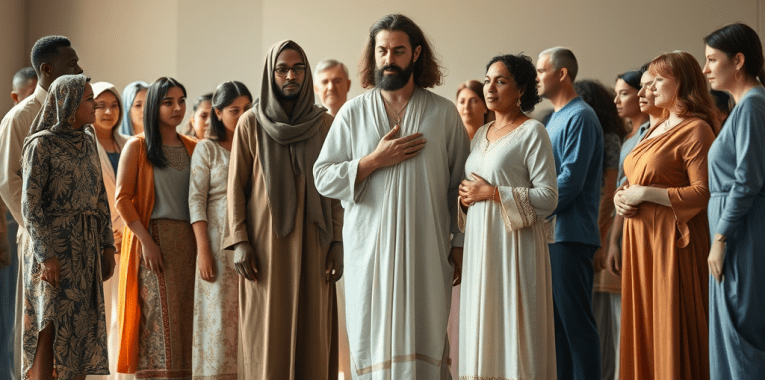
“Now as we have many parts in one body, and all the parts do not have the same function, in the same way we who are many are one body in Christ and individually members of one another.” (CSB – Read the chapter)
The best preachers have illustrations they go back to again and again. This isn’t because they’re boring and unoriginal (they’re the best preachers, not the worst). It’s because the illustrations are so good they’re worth being used over and over. What we encounter here is one of the illustrations to help understand the body of Christ that Paul comes back to more than once. Let’s talk about the body, the church, and what we mean to one another.
The human body is a wonder of design. Yes, there are plenty of arguments around today that it all just evolved by chance over time, but even the most detailed theories of human evolution are simplistic in their understanding of sheer weight of complexity of the human body. There are just too many interdependently integrated systems for the idea of chance to ultimately make sense. Given the volume of information involved in the system of coding that is our DNA (and other non-DNA coding systems as well), chance utterly fails as a coherent explanation of how it came to be what it is today. Yes, we have evolved in small ways over time. That’s fairly easily provable. But when you step back and look at things from the macro level, design is the only rational understanding.
None of the various systems in the body that make normal life possible operate independently of one another. Each depends on the others to work as they were designed. No two parts are the same much like no two people are the same, but all of them are necessary to make the integrated whole operate properly.
The church is just the same. “Now as we have many parts in one body, and all the parts do not have the same function, in the same way we who are many are one body in Christ and individually members of one another.” No two members of the church are the same. We all have different gifts and talents and passions and personalities and life-experiences. Even two people raised in the same home, experiencing the same set of life-shaping conditions turn out vastly different from one another. Yet each of us plays a role in the church in advancing the purposes of God in Christ.
Your gifts and talents and passions and personality and life-experiences are vital to the success of the church where God has placed you. As Paul notes when exploring the body-church illustration in a great deal more detail in 1 Corinthians 12, God placed each part in the body just as He wanted it to be. It may take some prayer and trial and error to find precisely the place God designed you to serve, but that’s work you need to be doing because that place is lacking, the body is currently weaker than it should be, until you find it.
One of the best ways to find your ministry sweet spot is simply to start serving. Serve in a variety of different areas. Try different things. Serve with different people. Get involved in places that seem like they might be out of your comfort zone. Have conversations with people around you who know you well and get their feedback on the ministry area for which you were designed. It’s also worth observing that our ministry sweet spots will change over time. God may use us in one area for a long time, but then when our season of life changes, move us to serve in another area. Occasionally He even moves people around to serve in different churches because of the needs of one versus another.
It is important here to pause and note the context of what Paul is saying here. These two verses follow on the heels of v. 3 where Paul calls believers to adopt an attitude of humility. Serving where God has planned for us to serve requires us to not think more highly of ourselves than we should. Our contribution is vital and necessary, but it is not sufficient on its own to make the church work. This warning applies to the often made opposite error of humility where we doubt the worth of our contribution. If God made you to serve in a particular area, even if that area doesn’t come with a lot of pomp and circumstance and public recognition, it still matters a lot. The example I have used many times before to challenge both errors here is this: Someone will attend a church without a preacher, but they won’t go long to a church with nasty bathrooms.
If the church is really like the human body, though, then we need to consider well what Paul says in the second part of v. 5. Paul says that we who are many are one in the body of Christ. In spite of our diversity, we are united in Christ as one body. No one part is more important – or less important – than any other in the proper and healthy functioning of the body. The moment we start to think otherwise, the body will cease to operate properly. It will start to fragment and dissolve. A fragmented body does exactly no one any good.
Paul also says, though, that we are individually members of one another. We are not independent of one another. Neither are we all completely dependent on each other. We are interdependent. We are each unique individuals, created by God for specific purposes in the advancement of His kingdom on earth. But we cannot achieve that purpose without being fully integrated into the larger body of Christ. We were made for this community, and it will be in this community that we will thrive.
This means that as a follower of Jesus, you have a duty to be an active part of a local body of Christ. I recently finished watching the second season of the Netflix series, Wednesday, about the Addams family (and as a preview, I’ll probably be writing more about my reflections on the series this Friday). A believer who is not part of a body of Christ is not like Thing, the lovable, disembodied hand. That’s movie make-believe. In real life, a hand detached from a body is just dead. It lies there and does nothing except to gradually rot away. That’s a better picture of the disembodied believer.
This means that if you are not in a church, you need to find one. Now. The idea that a believer can be connected well to Jesus and following Him faithfully apart from a church is a lie of the enemy that has seduced far too many believers into being utterly irrelevant for God’s kingdom. You need the church and the church needs you. But just being in a church isn’t enough.
At the end of the Wednesday season, Thing gets sewn onto a body that didn’t have a hand. There was no system integration; just a needle and thread. Being loosely attached to a body like that isn’t enough for a follower of Jesus. We need to be a fully integrated member of the body. This means you need to join a church as a complete and committed member. It’s no good having merely an association. You need the body and it needs you. Nothing less will do.
The church is the hope of the world. It is the institution through which God is advancing His kingdom on earth. It is the means by which people experience Jesus in His physical absence. Where the church is, God’s Spirit is present and active. But in order to accomplish all that God has for an individual, local church to accomplish, it needs all of its members fully integrated and fully committed. It needs you. So make sure you are on board. Be a part of the body.
 The Nexus