
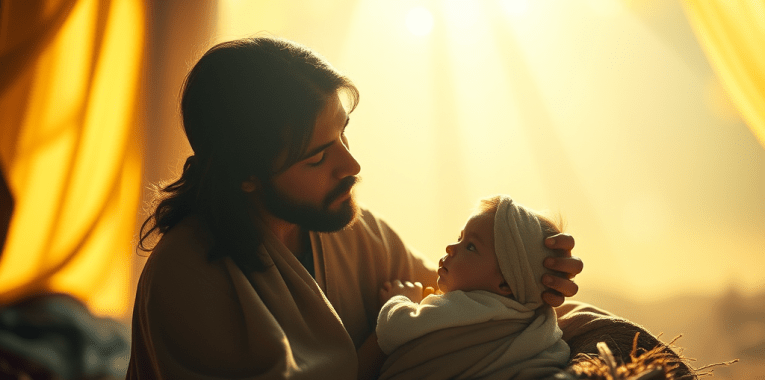
“For a child will be born for us, a son will be given to us, and the government will be on his shoulders. He will be named Wonderful Counselor, Mighty God, Eternal Father, Prince of Peace. The dominion will be vast, and its prosperity will never end. He will reign on the throne of David and over his kingdom, to establish and sustain it with justice and righteousness from now on and forever. The zeal of the Lord of Armies will accomplish this.” (CSB – Read the chapter)
Grace is hard to find in our world. The world outside God’s kingdom doesn’t do grace. It’s all judgment and vengeance. The irony of this is that the world accuses God of this very thing. Yet while God surely does bring judgment when it is due, His first instinct is grace. We see this grace put most gloriously on display in the coming of Christ as a baby to live and die for our salvation. The arrival, or advent, of Jesus was something God started preparing us for long before the time finally came. The prophet Isaiah foretold His arrival more than once. Let’s take a look at one such prophecy.
Much of the prophecy we find in the Old Testament is typological. This means that while it meant something to its original audience that was directly relevant to the circumstances they were facing, it can also be understood in a broader, historical context at the direction of the Holy Spirit to refer to things very distantly in the future from then. It has more than one type of fulfillment.
Isaiah’s two major prophecies about Jesus’ birth both fit into this category. We haven’t yet talked about the first one this year, but we have in years’ past. They both exist in the same contextual set of circumstances. Isaiah was offering a word of judgment to King Ahaz of Judah. The faithless and cowardly king was leading the people away from anything resembling faithfulness to the God who created them as a people, and who had long sustained them in the face of all sorts of challenges.
He saw the encroaching and terrifying advance of the Assyrians, and rather than turning to the God he couldn’t see, but who had a long record of helping His people survive the threat of major foreign powers, he turned to various regional neighbors with larger armies to help protect his kingdom from being conquered by this bloodthirsty empire from the East.
And yet, in spite of Ahaz’s faithlessness, God sent Isaiah to him with a message of strength and encouragement. He assured Ahaz that He would be with him and with the people to protect them from the Assyrian threat. Then, He told Ahaz to ask for a sign of His commitment. In a moment of feigned righteousness, though, Ahaz refused. Given the chance to allow God to prove Himself, Ahaz’s faith was so non-existent that he wouldn’t do even that.
God responded by telling Ahaz He would provide His own sign for the king and the people, but instead of a sign of assurance, it would be a sign of judgment. A young woman was going to conceive and bear a son, and this boy’s arrival meant that God was going to be with them. This was a typological prophecy. The first type that Ahaz and the people of Judah were to understand was that God was going to be with them to bring judgment for their disobedience and unfaithfulness. The second type is the one we more commonly understand today, a type that the Holy Spirit first directed Matthew to see and convey.
After writing more about the judgment God had planned for Judah for their unwillingness to trust in Him rather than merely in what they could see, Isaiah came back again to the idea of this son who was going to be born as a sign to the people. He had more to say about this child. And while there are definitely some good options for who this child was going to be in terms of Isaiah’s immediate context, the forward-looking understanding here seems powerfully obvious through the lens of the Gospel.
This coming child was going to be born to rule. The government would rest on His shoulders. His dominion would be vast, and the prosperity of His kingdom wouldn’t come in waves like so many nations experience today. It wouldn’t rise and fall. It would be without end. He would not only establish His kingdom, meaning He was going to clarify exactly what the boundaries of His authority were, He would sustain it forever. He would maintain those boundaries without end.
This all sounds very militaristic and even nationalistic to modern ears. That’s because we don’t think in terms of kings and kingdoms anymore. We think in terms of nations and cities. Establishing and securing borders has become something of a sharper focus these days, but not in the same sense Isaiah’s original audience would have thought about it. What all of this language meant for Israel was the promise of security. Their national leaders were proving incapable of establishing and sustaining their kingdom. The threats to their borders were not people trying to enter the country illegally, but foreign armies approaching to conquer.
Yet there have been leaders and rulers over the course of human history who have rested the government on their shoulders and established and sustained strong kingdoms. Could this not have been referring to any one of them? It could but for one thing: this kind of nation-establishing strength is not the only way Isaiah describes this child who would be born to rule. So many of the other leaders in this kind of dominant mold ruled with violence and fear. They have been totalitarian and authoritarian. They ruled with an iron fist, ruthlessly eliminating any and all opposition. They squelched freedom and kept their people cowed.
The child who would be born for us would be none of those things. He would establish and sustain His kingdom with justice and righteousness. God would be honored and glorified by His actions. They would be the actions of God Himself. He would pursue and do what is right with the very passion of God.
But there’s more. The character of this child who would rule would be good beyond our wildest hopes or dreams. He would be called Wonderful Counselor. His wisdom would be vast and righteous, and He would willingly and freely guide His people toward the best ends for them. He would be called Mighty God. His strength would be unmatched. No opposition would be able to stand against Him. He would be called Eternal Father. He would be a caring and compassionate ruler who always sought the best things for His people. He would be for them in a way that couldn’t be matched. And He would be called Prince of Peace. He would establish wholeness and completeness for His kingdom and His people.
This would be the ruler who would establish a kingdom where we can finally flourish and become fully what God created and called us to be. This is the ruler we have in Christ. He rules with love and justice, with righteousness and compassion, with holiness and gentleness. And all those who are willing to dwell with Him in His kingdom get to experience the blessings of His rule. What is perhaps most amazing of all, is that this is always what God had in mind for His people. He was talking about some 700 years before Jesus arrived. He pointed to it long before even that. And now we live with it. That’s some awfully good news. All because a child was born for us.
 The Nexus