
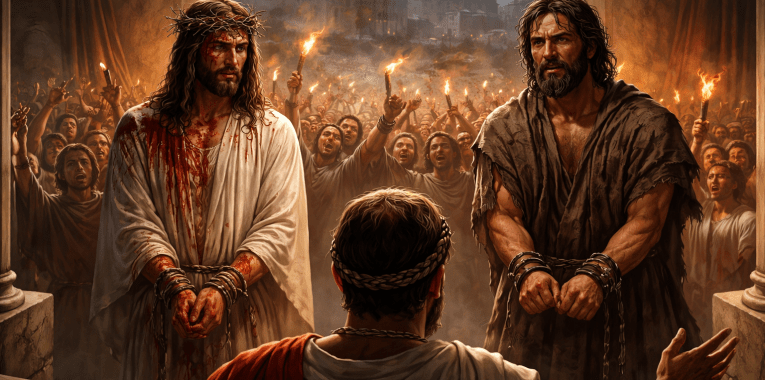
“At the festival Pilate used to release for the people a prisoner whom they requested. There was one named Barabbas, who was in prison with rebels who had committed murder during the rebellion. The crowd came up and began to ask Pilate to do for them as was his custom. Pilate answered them, ‘Do you want me to release the king of the Jews for you?’ For he knew it was because of envy that the chief priests had handed him over. But the chief priests stirred up the crowd so that he would release Barabbas to them instead. Pilate asked them again, ‘Then what do you want me to do with the one you call the king of the Jews?’ Again they shouted, ‘Crucify him!'” (CSB – Read the chapter)
Sometimes a single story in the Bible can have multiple different angles of interpretation, all of which are correct. Which one rises to the top in a particular season depends on the needs of the season. The author of Hebrews describes God’s word as living and active. The words themselves are not alive, but God’s Spirit is present in and around us, and He uses the words to reveal truth to us. Because they are His words first, He can use them to reveal different aspects of the truth to us at different times depending on our need and the particular growth He is working to draw out of us. One such story is the story of the release of Barabbas on the cusp of Jesus’ crucifixion. We’re here this morning because I had a conversation with one of my boys last night about what I was going to write about today, and this was his suggestion. It was a good one, so here we are.
All four Gospels mention the release of Barabbas. It seems like it shouldn’t have been a very significant event in the overall story of Jesus’ crucifixion, and yet here it is. If even one of the Gospels mention something we should pay attention because this is God’s word we are dealing with. When all four of them mention something, we had better sit up and take notice. And again, all four of them mention it.
Like with other stories mentioned across all four Gospel accounts there are some apparent discrepancies from one telling to another, but harmonizing them all doesn’t take much effort. What we get by the diversity is a pretty detailed picture of the event.
There was a man named Barabbas being held prisoner in Jerusalem because of his involvement in a recent attempted rebellion against the Roman authorities there. We do not know exactly which rebellion this was. Given the cultural climate of the day, there were many rebellions against Roman authority, so it could have been any number of them. Rome wouldn’t have recorded these. The Jews didn’t record all the losses because the rebellions were so common. Mark simply referred to it as “the rebellion,” suggesting his audience would know which one he was talking about—perhaps because of Barabbas’ association with it.
He didn’t simply participate in the rebellion, though, he murdered some Roman soldiers in the process. He took the lives of innocent men. Well, innocent may be too generous. They were active parts of a system that was actively abusing and oppressing the Jewish people. But we know from the Gospels and Acts that not all Roman soldiers were as evil as their empire. They were regular men who had families they were trying to provide for. Some were good and generous and kind. Eventually, some would believe in Jesus at risk to their own position and safety. We don’t know who these particular soldiers were, but that’s the point. Barabbas and his crew killed them without knowing either. They were just representatives of a system of oppression.
These kinds of rebellions against Rome never succeeded. And Rome did its best to discourage them. This “best” took the form of ruthlessly, violently putting down rebellions like this. All the participants were rounded up and crucified publicly to send the message that if you joined in one of these fools’ errands, you were going to wind up the same way. That was the case here. The rebellion failed and Barabbas was set for execution.
This would have been a normal rebel crucifixion, but for one very important detail: Barabbas wasn’t the only prisoner who was slated for crucifixion. What makes this interesting are two things. First, both of the men awaiting execution were named Jesus. That’s an intriguing little detail Matthew shares with us. The second thing that makes this so interesting is that this other prisoner wasn’t set for execution because He participated in a rebellion, but because the Jewish authorities were accusing Him of disturbing the peace. They actually accused Him of blasphemy, but that charge didn’t carry any weight with Rome, so they found one that did. This other Jesus, they said, claimed to be the king of the Jews.
So here you had two Jesuses. One was a known rebel and murderer. The other was in Pilate’s estimation innocent of any wrongdoing beyond irritating the chief priests. Both were slated for execution. But one could be released per Passover custom. Which Jesus would the people prefer?
The one Jesus sought to use political and cultural power as a means of advancement. He believed God was empowering him to advance His kingdom through physical means. Violence and murder weren’t ideal, but in pursuit of the higher goal of driving out the enemies of God’s people from the lofty position of power, they were necessary evils. This Jesus sought power. He sought to accumulate power. Sure, it was for his people, but he was accumulating power in one people at the expense of another. He was fighting to advance God’s kingdom at the expense of a kingdom of this world and the people who were operating within it. They were his enemies, and he was going to defeat them the only way those enemies understood how that kind of thing could be done.
The other Jesus was the opposite of this first Jesus in almost every way. He was pursuing the advance of the kingdom of God, but His means were radically different. He healed people. He served others. He submitted to authority. He loved everyone no matter what their background was. He proclaimed a kingdom that was not of this world. It would not advance by “normal” means. It was not going to be violent, and in fact it openly eschewed violence. Vigorous opposition to its advance would be met by love and compassion, mercy and graciousness. This was the kingdom where winning often looks like losing now because the goal is never temporary political and cultural power, but eternally transformed hearts and minds.
Which Jesus would the people choose?
We don’t have to wonder. They chose Barabbas. Now, they chose Barabbas at the prompting of the chief priests who wanted Jesus dead, but still, they chose Barabbas. I wonder how often we choose Barabbas today. How often do we choose the path of worldly power in our attempts to advance a heavenly kingdom? In the short term, this approach can look very effective. We can get our hands on the reins of power and quickly reshape our culture to our liking. We can outlaw behavior we don’t support. We can enshrine behavior we do. We can punish our enemies and strip power from those who oppose us. We can make the world a better place.
Yet while followers of Jesus should definitely not avoid politics—especially in a system such as we have here where all citizens have equal access to the same political process to shape and reshape the culture as they desire—we must never forget that the kingdom of God doesn’t advance primarily by means of worldly power. Political power doesn’t transform hearts and minds by itself. Politics tends to be downstream from culture. It is a reflection of where we are rather than a shaper of where we are going. If we rely on political means to achieve kingdom ends, then when the political winds blow in a different direction, we will cease to achieve those kingdom ends. When we use kingdom means to achieve kingdom ends, though, it won’t matter what the political scene is like, we will still be advancing the kingdom of God. Yes, certain political climates might make it more challenging to do that work, but loving our neighbors, showing compassion and mercy to the hurting, helping the weak and vulnerable, and so on and so forth are things we can do no matter who is in charge political or what their policies happen to be.
So, yes, we should vote and participate in the political process with wisdom and grace, but we should always choose the Jesus who advances on the power of God and not merely the powers of this world.
There is one other thing worth noting here. When the crowd chose Barabbas, he was the first person to receive grace because of Jesus’ sacrifice. He was granted a freedom he had not earned and certainly did not deserve. The Jesus of kingdom power extends that same grace to everyone. We haven’t earned it and don’t deserve it, and yet, like Barabbas, we too can go free because of His sacrifice. If we choose to use the means of this world to advance our ends—convincing ourselves that our ends are really God’s ends—and wind up making a big mess of things, there’s still grace for that if we will turn and receive it. He can redeem even our biggest messes by His grace and keep right on advancing His kingdom. His means win the day either way. Better to avoid the messes and just go with His way in the first place. Let’s choose the Jesus who always wins in the end.
 The Nexus