
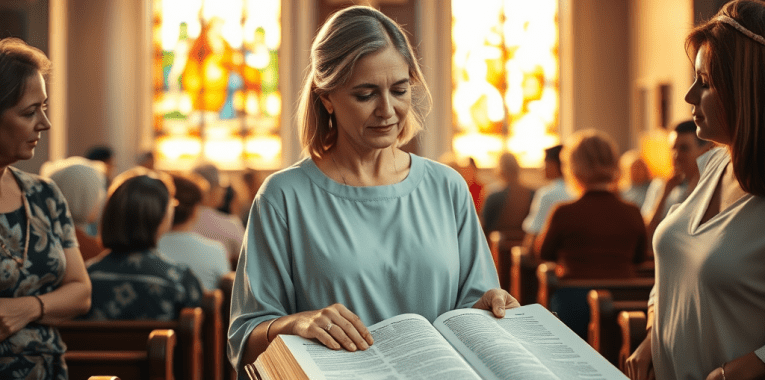
“I commend to you our sister Phoebe, who is a servant of the church in Cenchreae. So you should welcome her in the Lord in a manner worthy of the saints and assist her in whatever matter she may require your help. For indeed she has been a benefactor of many—and of me also.” (CSB – Read the chapter)
If you listen closely when you are on an airplane, at some point in the journey you’ll notice the engine sound—a steady drone throughout the flight up to then—change. It’s not a dramatic change, but there’s definitely a difference. This is the point the pilot has begun the final approach into the destination airport. Not long after this change in sound he’ll come on and make the relevant announcement. Today we begin our final approach toward landing our journey through Romans. What we’re going to encounter as we do are a whole lot of greetings. First, though, a commendation. If that sounds boring, however, think again. Just as there is often turbulence when going from one part of the sky to another, we’re yet going to encounter some highly debated verses. Hang on tight!
What role should a woman serve in the church? That is one of the more historically significant questions that have been asked by followers of Jesus over the last 2,000 years. How a particular believer or church or denomination answered it has caused no small amount of tension and division. Today we are not going to try to come up with a firm and clear answer to the question. But we are going to look at a verse that plays a role in the debate.
I have served two churches over the course of my ministry. One has women serving as deacons, one does not. In both cases the reason for their approach to the matter has more to do with tradition and denominational affiliation than careful study and reflection by all of the leaders of the church. I don’t say that by way of judgment in either case. I daresay that most churches have their approach to the question of the role women can play in the church set by denominational affiliation and tradition than careful study of all the relevant texts.
Perhaps they had a pastor in their past who took the church at the time through a journey of study and clarification, but I suspect most did not. What is more likely is that either the church simply goes along with whatever their denominational leadership has said on the matter, or they had a pastor in their history who was particularly well liked and supported whose position on the matter became the church’s position (a situation that was definitely the case in my former church).
So then, which church was doing deacon ministry the right way? Honestly, I think both are approaching it in a manner that is sincere and humble and genuinely seeks to honor Christ and advance the Gospel by their practice. Both churches have a host of deacons who are godly individuals committed to the growth and proclamation of the kingdom of God. As a pastor I was blessed in both situations by the way the deacons served and supported me.
Offering a definitive answer to the question of whether or not women should be serving as deacons isn’t my goal here today. But we are going to consider what Paul writes here as the first thing he says as part of his closing greetings to the church in Rome. The very first thing Paul says to them is to commend Phoebe, “who is a servant of the church in Cenchreae.” Cenchreae was one of the two port cities for the city of Corinth. Corinth was in the middle of the isthmus of land it occupies. Cenchreae is one of the two ports that allowed the larger city to claim to be a port city.
Apparently, Phoebe was a significant servant in that church who had come to Rome—possibly as a part of the group bearing the letter to them since Paul wrote this letter from Corinth—and whose ministry Paul was commending to the believers there. The church was to receive Phoebe graciously and to help her with whatever she might need. The reason Paul gives for their assistance is that she was a benefactor of many, including Paul.
That word “benefactor” means more than it seems at first glance by us. A benefactor in the ancient world was a wealthy individual who financially supported some number of clients. In a day when there was no kind of government social services to help citizens who were struggling financially, it was common for wealthy people to provide that help. This wasn’t merely out of the goodness of their heart. This was an intentional political arrangement where the clients were expected to be loud and public supporters of their benefactor in whatever cultural or political aims they might be pursuing.
For Phoebe to be a benefactor meant that she was likely very wealthy. The fact that she was traveling to Rome without mention of a husband was unusual in and of itself. That indicated that she was a business owner of some sort with enough wealth and cultural significance that she was able to travel between cities like this on her own, something that was not typical in that day. Phoebe, like Lydia in Macedonia, had become a believer, perhaps through the ministry of Paul, and was one of his financial supporters.
None of that seems like it should be at all controversial that v. 1 would cause any kind of a stir for biblical interpreters, but that’s because of the translation choice the CSB (which is the official translation of the Southern Baptist Convention) makes here. The word being translated “servant” is the Greek word from which we get our word “deacon.” In other words, a more literal translation here has Paul refer to Phoebe as a deacon of the church in Cenchreae.
Now, that word, deacon, in Greek literally means “servant.” So for the translations that opt for “servant” instead of “deacon,” they aren’t making any kind of an error in their rendering. But that same word is used by Paul in 1 Timothy 3 where he talks about the qualifications of a deacon in a way that is specifically referencing the leadership position in the church. All translations opt for “deacon” there instead of speaking of servants more generally like some choose to do here.
Complicating things even more here is the fact that Paul doesn’t just use the word “deacon” here. Greek is a gendered language. That means words can refer specifically to one gender or another. In this case, Paul adds an ending to the base word “deacon” that makes it specifically refer to a female deacon—a deaconess. The question that translators must answer here is simple: Was Paul referring to Phoebe generally as a servant of the church in Cenchreae, or was he referring to her official position as a deaconess in the church in Cenchreae?
Going just by what Paul writes here, it would seem that he was referring to her role position, not merely her generically as a servant. And, given that no translations have any trouble translating the relevant word as “deacon” in 1 Timothy 3, for the sake of consistency, it would seem that “deaconess” would be the naturally best choice for translation here. But, for translations that are coming from a group that is denominationally affiliated with a group that does not support women serving as deacons in the church, such a translation would seem to contradict their larger position on the matter such that “servant” is the chosen translation instead. In other words, the choice of translation here is influenced by a particular translator’s theology regarding the role women can play in the church more so than pure linguistic concerns.
So then, which translation is correct? That’s for you to do the study and research and decide for yourself. Personally, I am convinced that the only position that can potentially be restricted to only men in the church is the position of overseer, or what is often filled by the senior pastor. I won’t go into all the reasons for that now. What I will add, though, is that the person who occupies the position of overseer in a church depends somewhat on the church’s polity. In other words, the person serving as pastor in a given church may not actually be the overseer of the church depending on their denominational leadership structure. What all of this means in plain English is that I hold my position on where and how women should be serving in the local church with a fair bit of humility and openness. It is not an issue that determines anybody’s salvation which means I’m going to have plenty of charity toward those who disagree with my position in favor of a different one.
Rather than getting all focused on where women shouldn’t be serving in a church, we would do better to highlight and celebrate the important contributions they are making. Many churches wouldn’t make it without the faithful women they have serving in their ministries. Also, we are in an interesting place culturally in which young men are starting to come back to the church in large numbers, but in which young women are starting to leave the church in equally large numbers. I wonder what kind of a contribution to this exodus many loud and public debates within the church about the role of women in recent years that so often get fixated on all the places they can’t serve has made? Perhaps none, but perhaps a whole lot more than we imagine. I wonder what a shift toward highlight the incredibly equality between men and women the New Testament promotes, and a focus on the great and significant contributions that women have and are making to the church would serve to help balance things back out. A church that fully equips and empowers both men and women to serve fully to the capacity God has designed them each individually and uniquely for would be a powerful thing indeed.
 The Nexus