
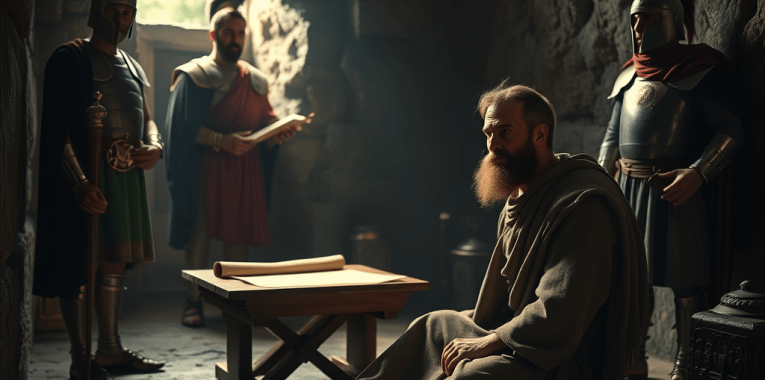
“Paul and Timothy, servants of Christ Jesus: To all the saints in Christ Jesus who are in Philippi, including the overseers and deacons. Grace to you and peace from God our Father and the Lord Jesus Christ. I give thanks to my God for every remembrance of you, always praying with joy for all of you in my every prayer, because of your partnership in the gospel from the first day until now.” (CSB – Read the chapter)
“‘The time has come,’ the Walrus said, ‘to talk of many things: Of shoes—and ships—and sealing-wax—of cabbages—and kings—and why the sea is boiling hot—and whether pigs have wings.’” Those words from the Lewis Carroll poem, The Walrus and the Carpenter, have since eighth grade meant it is time to make a change. It was just our class seating chart in Mr. Brock’s eighth grade algebra class. Today it means that our journey together through the Scriptures is heading off in a new direction. Romans is officially under our belt (along with Exodus, Amos, and Mark). Next up will be Paul’s letter to the Philippian believers. We’ll start right where Julie Andrews helpfully identified is a very good place to start: the very beginning. Let’s dive in.
Philippians is one of Paul’s prison epistles. He wrote it along with Ephesians, Colossians, and Philemon while he was imprisoned in Rome sometime in 60-62 AD. Of the four, Ephesians and Colossians are the least personal because Paul didn’t plant those churches. Philemon is personal, but that’s because it was to a single person. Of all the letters Paul wrote, this is the most loving and joyful.
Paul loved this church—something that becomes abundantly clear as you read the letter. They were dear to him in a way few other churches were. And there is all sorts of evidence the believers in Philippi returned the favor. As much as Paul cared for them, they cared for him actively and generously. In fact, Paul was writing in part to thank them for a care package they had sent him while he was in prison.
As far as the church itself goes, Philippi understood Paul’s tough situation pretty well. They were a small and struggling church not because of anything inherent to them. They existed in a context that was not merely Roman, but intensely Roman. It was a popular retirement city for former Roman army officers who tended to be very patriotic. These folks didn’t take kindly to this weird new cult and its insistence that someone other than Caesar was Lord.
These partners in suffering—the Philippians at the hands of their friends and neighbors; Paul at the hands of his Roman hosts—were united by it and loved each other through it. As we go through what Paul has to say over the next few weeks we are going to learn more about the grim nature of his circumstances and of the Philippians’ faithfulness in spite of their own challenges.
One of the themes we will see throughout the letter is the importance of doing ministry in community. Whether that community is one you are interacting with on a regular basis or only see more occasionally isn’t quite as important, but having that kind of community matters more than we could properly describe. In fact, we see that closeness and community here out of the gate.
The letter is addressed from Paul and Timothy, Paul’s mentee and ministry partner who was currently staying with him in Rome despite not being held under house arrest like Paul was, the servants of Christ Jesus. That’s the only thing that really mattered about them. They were servants of Jesus. They followed Him and did what He commanded. They said what He said and went where He went. If sometimes that led them into dangerous territory, that was okay because He was big enough to rescue them from it. And if He didn’t for some reason—something Paul will talk about later in this first chapter—that was okay too because then they would be able to be with Him in person. In following Jesus whether we are in a season of ease or intense persecution we still win because in Christ there is only victory.
They sent the letter “to all the saints in Christ Jesus [so those who were similarly followers of Jesus like they were] who are in Philippi, including the overseers and deacons.” The wording here is somewhat interesting. They didn’t mention the Philippi church here but merely “all the saints who are in Philippi.” The reference is to the church, but the church there likely existed as numerous house churches throughout the city. In spite of being many churches, though, like we talked about in Romans recently, they were all considered one church together.
One church can’t do a whole lot on its own. Now, yes, there are some very large churches who can, but most churches in the country today are groups of under 100 people working to advance the Gospel in their community. A hundred and twenty people with the power of the Holy Spirit changed the world, but more is better. When multiple local churches all work together toward a single goal, combining their resources and human potential, a great deal more can get accomplished. When whole associations of churches think of themselves as one great church, the sky’s the limit in terms of how much they can accomplish for God’s kingdom.
The letter was written not just to the members of these churches but also to the overseers and deacons, the leaders of those churches. Now, the fact that overseers is plural could be a reference to the fact that the one Philippi church was lead by a council of elders as is the popular thing for Baptist churches to be working toward establishing today thanks to the ongoing work of Mark Dever over the span of multiple decades, but it could also be a reference to the fact that each of these house churches had its own overseer—what we would call a senior pastor today. The overseers worked together as a single unit giving great encouragement to things like the Baptist Association that I am a part of, but they perhaps weren’t a council of elders so much as a group of pastors of individual churches who did their work and led their churches like they were all truly part of one body.
After blessing them with the grace and peace of “God our Father and the Lord Jesus Christ,” Paul opens with a glorious declaration: “I give thanks to my God for every remembrance of you, always praying with joy for all of you in my every prayer, because of your partnership in the gospel from the first day until now.”
Now, I’ll admit, I am often tempted to tune out statements like this when I’m reading through one of Paul’s letters so that I can skip to the good stuff that comes next. But let’s pause for just a moment to consider the weight of his words here. I wonder, do you have anyone whose very memory leads you to turn to God in prayerful gratitude? This person has played such a profound and positive role in your life that you can’t help but to thank God for them. And, yes, Paul’s expression here is surely somewhat hyperbolic to make the point of his gratitude and love for the Philippi believers, but what is clear is just how dear to him they were. He loved these people, and from the things he says in this letter, they loved him too; a love they expressed in tangible terms.
If you don’t have someone like this in your life, you might consider fixing that. One of the best ways to get this kind of person in your life is to be actively involved in a church body. There, surrounded by other believers with whom you worship and serve and work to advance God’s kingdom you are likely to be in close proximity to someone who will begin to have this kind of impact on you over time.
On the other side of being impacted by this, do you have anyone you are seeking to impact? Are you the person someone else turns to grateful prayer to God for every time they think of you? If you have been so impacted by someone else you should be actively looking to pay that favor forward. Whether this means taking on someone younger than you in a mentoring relationship or looking to be a blessing for a fellow believer in the church with whose soul you particularly resonate or just developing a best friend, the effort is worthwhile. God will use your impact—and, yes, you can make an impact like this if you try with the help of God’s Spirit—to accomplish much kingdom good. You’ve simply got to step up and make it.
Paul also talks here about praying joyfully. Are you joyful in your praying? That’s not the same thing as asking if you are happy all the time in your praying. Prayer is simply the means by which we invest and develop in our relationship with God in Christ through the Holy Spirit. Joy is a deep-seated contentedness that comes from knowing who God is and how our story in Him is going to go in the end. It is the result of an abiding awareness of the victory we already have in Christ such that even when we face terribly hard or dangerous or tragic circumstances on our journey to that end, we nonetheless know where the journey is going to take us. When you are talking to God, it should always be with that awareness fully present in your mind such that even when you are having hard conversations with Him you are nonetheless joyful as you do it.
One last thing here. Paul was so connected with the Philippian believers because they had served the Lord together. They were partners with him in the gospel and had been since his first association with them. Are you serving the Lord with someone like that? Are you working with someone or a group of someones to advance God’s kingdom in intentional ways? Are you experiencing life with them in both its ups and its downs as you struggle forward toward that kingdom goal? That may not seem to make much of a difference right now, but building relationships through ministry is a work that pays off in spades over time. Somewhere down the road you are going to be incredibly grateful that you put in the effort. But you won’t be grateful if you don’t start putting in the effort. This is yet another big reason why the church matters so much: you have a group of people who love you and who are committed to you and you to them. Ministry and following Jesus were not intended to be done alone.
Philippians may be a little letter, but it has some big substance to it. We’ve just dipped our toes in the water today. I can’t wait to explore with you all that God has yet in store for us as we keep pressing forward. I hope you’re ready!
 The Nexus