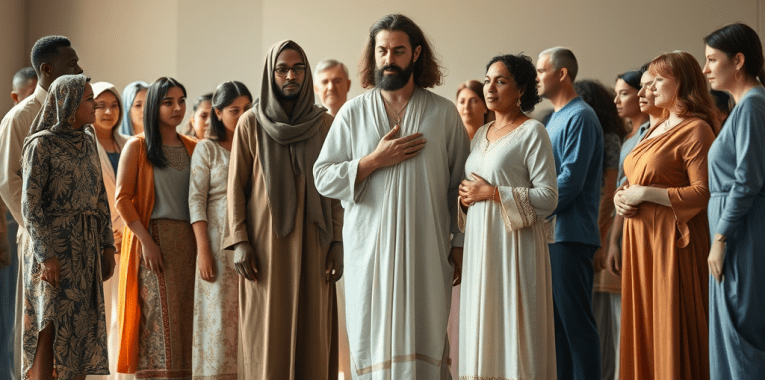
“Indeed, the body is not one part but many. If the foot should say, ‘Because I’m not a hand, I don’t belong to the body,’ it is not for that reason any less a part of the body. And if the ear should say, ‘Because I’m not an eye, I don’t belong to the body,’ it is not for that reason any less a part of the body. If the whole body were an eye, where would the hearing be? If the whole body were an ear, where would the sense of smell be? But as it is, God has arranged each one of the parts in the body just as he wanted.” (CSB – Read the chapter)
Earlier this week we spent a bit of time with Paul’s characterization of the church as the body of Christ in Romans 12. I noted then that in 1 Corinthians 12, he explores this theme in a great deal more depth and detail. I also noted then that we were going to come back to the idea today through the lens of the latest season of Wednesday on Netflix. Well, here we are. I reviewed the first season here. We’re not going to do a full review of the second season today, but there was one scene and a minor theme that jumped out at me as filled to the brim with Gospel implications. Let’s talk about cousin Thing and disembodied parts.
“Now as we have many parts in one body, and all the parts do not have the same function, in the same way we who are many are one body in Christ and individually members of one another.” (CSB – Read the chapter)
The best preachers have illustrations they go back to again and again. This isn’t because they’re boring and unoriginal (they’re the best preachers, not the worst). It’s because the illustrations are so good they’re worth being used over and over. What we encounter here is one of the illustrations to help understand the body of Christ that Paul comes back to more than once. Let’s talk about the body, the church, and what we mean to one another.
“‘But you,’ he asked them, ‘who do you say that I am?’ Simon Peter answered, ‘You are the Messiah, the Son of the living God.’ Jesus responded, ‘Blessed are you, Simon son of Jonah, because flesh and blood did not reveal this to you, but my Father in heaven. And I also say to you that you are Peter, and on this rock I will build my church, and the gates of Hades will not overpower it.'” (CSB – Read the chapter)
I want to come back yet again this week to a passage we have looked at a couple of times recently, including just last week. If the church is the body of Christ, and if, as we talked about last time, the church is to be proclaiming the identity of Jesus to the world in everything we do, then what does it mean to be the church, and what should be the relationship of an individual follower of Jesus to the church? Let’s dig back in today to some more of the implications of what Jesus revealed about the church to His disciples.
“Circumcision benefits you if you observe the law, but if you are a lawbreaker, your circumcision has become uncircumcision. So if an uncircumcised man keeps the law’s requirements, will not his uncircumcision be counted as circumcision? A man who is physically uncircumcised, but who keeps the law, will judge you who are a lawbreaker in spite of having the letter of the law and circumcision. For a person is not a Jew who is one outwardly, and true circumcision is not something visible in the flesh. On the contrary, a person is a Jew who is one inwardly, and circumcision is of the heart — by the Spirit, not the letter. That person’s praise is not from people but from God.” (CSB – Read the chapter)
What is it that makes you who you are? Most people have some sort of identity that they count as defining of them. This identity is often at least somewhat connected to the tribe they consider themselves to be a part of. Actually, our tribal association very often plays a huge role in defining who we are. Although some people break from the tribe they were born into in order to intentionally join another one, most people stay at least mentally connected with the tribe they were born into throughout their life. We literally cannot understand ourselves apart from the framework our tribe provides…even if we don’t properly understand what that framework (i.e., worldview) is. If someone were to come along and tell you that everything you thought you knew about your tribe was wrong, to say this revelation would be disorienting (assuming you even gave them the time of day) is likely a rather dramatic understatement. Well, that’s what Paul does here. Let’s talk about it and what it means for us.
After taking a week off last week to enjoy some time away with the family, we are back on it this week, continuing in our teaching series, Nuts and Bolts. For these few weeks, we are talking about the church, what it is, and how to get it right. After spending the first two parts of the series looking at the big picture of what the church is, starting today we are beginning to unpack how the church was designed to work. And, like the basic unit of operation when it comes to the human body is the cell (yes, there’s a good argument to be made that proteins fit that bill a bit better, cells work as an okay metaphor here), the basic unit of operation when it comes to the body of Christ is the church member. So, this week, we are talking about church membership. While much of this is going to wind up being focused on my own congregation, the ideas here are broadly applicable. Consider how they might apply to you and your situation. Enjoy.
Membership Matters
So, the other night we were all sitting around the table eating dinner together, and the subject came up of what the boys are currently learning in school. One of them said that he had been learning about the cell. I still remember sitting in science classes in 8th and 9th grade and learning about all the various parts of the cell. I remember rather distinctly the fact that there are a lot of parts. To be such tiny things, cells are really pretty complicated. They are a work of engineering magic that is absolutely unrivaled by anything we’ve ever created.
We didn’t use to understand this. Used to be, biologists thought cells were just little blobs of goo that really didn’t do very much except to provide the basic structure and framework for an organism. Then we built better microscopes, and discovered there’s a whole world of complexity and function down there that we are only just beginning to grasp. For tiny things, cells are a big deal. Your body is composed of roughly 37 trillion cells of about 200 different types. Any single one of them by itself doesn’t do much and doesn’t seem to matter. After all, what’s one cell out of 37 trillion? But without all of them collectively doing what they do, there would be no you. One part may not seem to make much of a difference by itself, but when you combine that one part with a whole bunch of other parts, some pretty incredible things start to become possible.