“Therefore, there is now no condemnation for those in Christ Jesus, because the law of the Spirit of life in Christ Jesus has set you free from the law of sin and death.” (CSB – Read the chapter)
I finally broke down and did it. I waited as long as I could. I really could have done it at any time, but I just didn’t want to at first. But then everybody was doing it. Just about literally everybody. And everybody was talking about it. And it was a cultural phenomenon. And I finally just had to see for myself. So I did it. It wasn’t very long. And it was better than I expected. It really was as good as most everybody had said. And there were just so many Gospel touchpoints. It wasn’t perfect by any stretch on that mark, but it touched on some truths that are really important to understand. If only it offered real solutions. Wondering what I’m talking about? I finally watched the international smash hit, KPop Demon Hunters. Let’s talk about it.
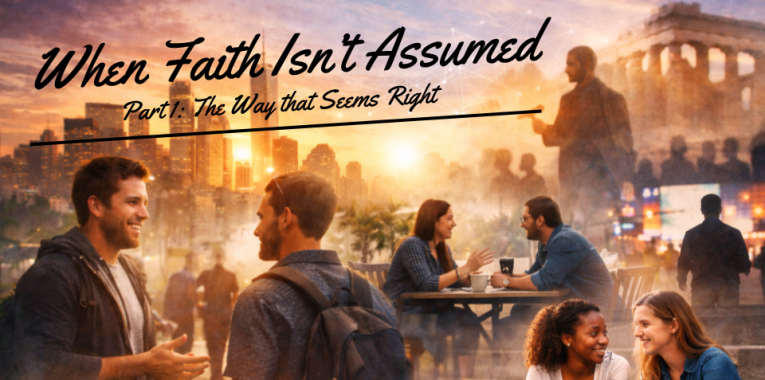
This Sunday we kicked off a brand-new teaching series. Before Jesus departed the scene physically, He left His disciples some final marching orders. They were to make disciples everywhere they went. They were to be His witnesses locally, regionally, and internationally. They were to proclaim and advance the Gospel. The Christian faith has always been a missionary faith. In recent years in this country, though, being on mission for God has become an increasingly difficult task as our culture continues down the road of becoming post-Christian. How are we supposed to share the Gospel in a post-Christian culture where faith is no longer assumed? For the next few weeks, we’ll be talking about that very thing. This week we are starting with a topic that has to be addressed first in this effort: truth. How do we stand on the reality of truth in a culture that rejects such notions? Let’s talk about it.
The Way that Seems Right
Have you ever found yourself wishing we could go back to a simpler time in the past? You know, one where neighbors talked and actually knew each other better. Where kids could be sent out to play all day without worrying about where they were or what they were doing. Where so many marriages didn’t end in divorce. Where men were expected and allowed to be men, and women were expected and allowed to be women. One where the country wasn’t so polarized by politics; where the political left and the political right at least both loved America, and the ideas the nation stands for. Where most people went to church and you could pray and talk about the Bible in schools and in public, and the people who didn’t already believe it responded with repentance rather than persecution.
“When the time came to completion, God sent his Son, born of a woman, born under the law, to redeem those under the law, so that we might receive adoption as sons.” (CSB – Read the chapter)
The family is the basic building block of any stable, healthy society. Thriving societies have a culture of strong, committed families. If you want to explain the breakdown of a society – take a society like ours for instance – you don’t really need to look much further than the breakdown of the families that constitute it. Nearly every social pathology can be traced back to a family problem of some kind. Communities with large numbers of stable, intact families are objectively better than those without. The trouble is, too many culture-shaping aspects of our society don’t seem to understand that. It is notable then, when a major Hollywood release not only highlights, but celebrates the goodness and worthwhileness of family. The latest major Marvel film, which I have finally been able to watch, does just that. Let’s talk about why Fantastic Four lives up to its moniker.
Marriage is something that affects all of our lives in one way or another. Most people are going to be married at some point in their lives. And, the various authors of the Scriptures have some things to say about marriage. This all means that as a church, it’s something we need to talk about from time to time. For the next four weeks, that’s exactly what we are going to do in a brand-new series called Back to the Basics. We are going to talk about four adjustments we can make in our marriages at a very fundamental level that will help put us on a track toward the relationships we want most. Let’s get start with today with a conversation about getting our priorities right.
Love God First
We do a lot of building in my house. The exact thing being built varies, but the building itself is consistent. Perhaps the most common building that happens is with Legos. Now, of course, you can build anything you want with Legos if you have the right bricks. The sky really is the limit in terms of the creative potential of that particular medium. Most of the Lego building that goes on in my house, though, is with pre-designed sets. These sets come with all the pieces you need to build whatever it is, packaged neatly in numbered bags, and with a set of instructions that walks you step-by-step through the process of building. Pro-tip, though: Don’t open all the bags at once. That makes the building a lot more tedious. Depending on the complexity of the build, the instructions range from fairly short to book length. But however long they happen to be, the most important thing is that you follow them carefully. If you use the wrong piece or put the right piece in the wrong place, that’s going to cause trouble later on in your building process. I can remember some sets I got mostly built only to discover that I had placed a piece incorrectly dozens of pages before. I had to go back and systematically take things apart in order to get it straightened out the right way. It was not very much fun.
“Without revelation people run wild, but one who follows divine instruction will be happy.” (CSB – Read the chapter)
It’s been a little while since I’ve gotten to do something like this. Part of the blame for that lies with my own schedule of late. The other part of the blame doesn’t fall on me, though. There just hasn’t been a whole lot from the other side that has furnished me the opportunity. The opportunity for what? Another media review! It’s fun Friday, and Marvel has finally released more content onto Disney+ for us to talk about. This time, appropriately enough given the season, it was all about witches. There were broomsticks and cauldrons and cats and spooky locations and more than a little of the occult. Let’s talk about Agatha All Along, Marvel’s first attempt to take a page out of Sony’s playbook and make a series in which the hero is a villain. And, fair warning, if you haven’t seen the series yet and plan to, don’t read on. I’m going to spoil all the big reveals as we go.





 The Nexus