The Message that Saves

If we are going to share the Gospel in a post-Christian culture, we have to be clear on what exactly the Gospel is ourselves. We’ve spent the previous two installments of our teaching series, When Faith Isn’t Assumed, talking about the reality of truth and the person of Jesus. Today we are rounding out this sequence by coming back to Jesus again. This time, instead of focusing so much on who He is, we are giving our attention entirely to what He does: Jesus saves. Let’s talk about it.

The Message that Saves

If you were to walk up to a random stranger on the street and tell them you think they are a sinner in need of salvation, you may get one of a variety of reactions, but none of those will likely be very positive. They may just roll their eyes and walk away from you. They may tell you where to take your opinion of them. They might even punch you in the nose for saying something so offensive to them. Simply put: They won’t like it. But just because they won’t like hearing it does not for that reason make it any less true. 

Read the rest…

The Way that Seems Right

This Sunday we kicked off a brand-new teaching series. Before Jesus departed the scene physically, He left His disciples some final marching orders. They were to make disciples everywhere they went. They were to be His witnesses locally, regionally, and internationally. They were to proclaim and advance the Gospel. The Christian faith has always been a missionary faith. In recent years in this country, though, being on mission for God has become an increasingly difficult task as our culture continues down the road of becoming post-Christian. How are we supposed to share the Gospel in a post-Christian culture where faith is no longer assumed? For the next few weeks, we’ll be talking about that very thing. This week we are starting with a topic that has to be addressed first in this effort: truth. How do we stand on the reality of truth in a culture that rejects such notions? Let’s talk about it.

The Way that Seems Right

Have you ever found yourself wishing we could go back to a simpler time in the past? You know, one where neighbors talked and actually knew each other better. Where kids could be sent out to play all day without worrying about where they were or what they were doing. Where so many marriages didn’t end in divorce. Where men were expected and allowed to be men, and women were expected and allowed to be women. One where the country wasn’t so polarized by politics; where the political left and the political right at least both loved America, and the ideas the nation stands for. Where most people went to church and you could pray and talk about the Bible in schools and in public, and the people who didn’t already believe it responded with repentance rather than persecution. 

Read the rest…

Digging in Deeper: Romans 10:18-21

“But I ask, ‘Did they not hear?’ Yes, they did: ‘Their voice has gone out to the whole earth, and their words to the ends of the world.’ But I ask, ‘Did Israel not understand?’ First, Moses said, ‘I will make you jealous of those who are not a nation; I will make you angry by a nation that lacks understanding.’ And Isaiah says boldly, ‘I was found by those who were not looking for me; I revealed myself to those who were not asking for me.’ But to Israel he says, ‘All day long I have held out my hands to a disobedient and defiant people.’” (CSB – Read the chapter)

For the last two chapters now, Paul has been talking about Israel and their rejection of the Gospel. He has struggled with it emotionally even as he understands it experientially. But even though he understood the fact of it, he nonetheless marvels at it with his audience. Here, at the end of chapter 10, Paul begins asking some more hard questions about Israel’s rejection, God’s plans in light of it, and what this all means for non-Jewish followers of Jesus. Let’s start digging into this with him.

Read the rest…

Digging in Deeper: Romans 6:3-5

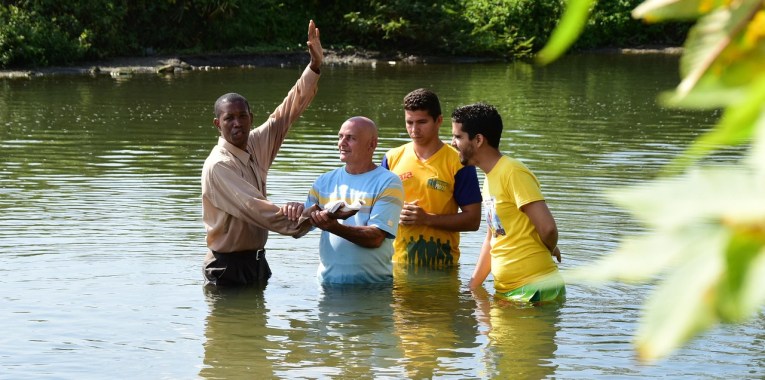
“Or are you unaware that all of us who were baptized into Christ Jesus were baptized into his death? Therefore we were buried with him by baptism into death, in order that, just as Christ was raised from the dead by the glory of the Father, so we too may walk in newness of life. For if we have been united with him in the likeness of his death, we will certainly also be in the likeness of his resurrection.” (CSB – Read the chapter)

I am a Baptist preacher. We Baptists love baptism. It’s kind of in the name. And when we say the word, we mean it with its original Greek meaning. The word batidzo, from which our English word is merely a transliteration rather than a translation, means to immerse something in water, not to merely sprinkle some water over it. One of the two things that makes a Baptist church a Baptist church is a requirement that a person has been baptized before they can be a member. Yet as important as the practice is to us, we didn’t invent it. In fact, Christians generally didn’t invent it. Lots of religions used some form of baptism as an initiatory and cleansing rite. We simply took something that was already in existence and added our own unique symbolism to it. Here we find Paul talking about some of that symbolism. Let’s walk through this with him.

Read the rest…

Digging in Deeper: Ephesians 6:4

“Fathers, don’t stir up anger in your children, but bring them up in the training and instruction of the Lord.” (CSB – Read the chapter)

I’ve long been a numbers guy. Numbers just stick in my head. Random numbers. And they don’t go away. Sometimes it’s pretty handy like at my former church, before I was really using a cell phone all that much, when I had almost half the phone numbers of the members memorized. Because I’m a numbers guy, I love looking at data. It doesn’t matter too much what the data is, but sociological research data is some of my favorite to digest, especially when it’s on a topic I care about and from a research outfit whose methodology I trust. I’ve had the chance recently to review some research from the Barna organization into the world of people who are spiritually curious. Let me highlight a couple of things I’ve noticed along the way.

Read the rest…