The Way that Seems Right

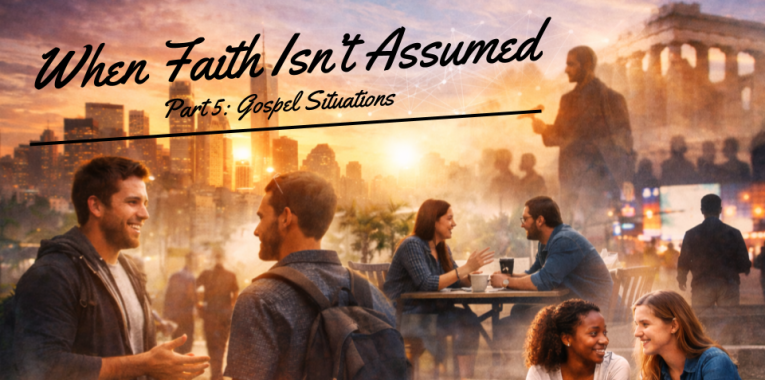
This Sunday we kicked off a brand-new teaching series. Before Jesus departed the scene physically, He left His disciples some final marching orders. They were to make disciples everywhere they went. They were to be His witnesses locally, regionally, and internationally. They were to proclaim and advance the Gospel. The Christian faith has always been a missionary faith. In recent years in this country, though, being on mission for God has become an increasingly difficult task as our culture continues down the road of becoming post-Christian. How are we supposed to share the Gospel in a post-Christian culture where faith is no longer assumed? For the next few weeks, we’ll be talking about that very thing. This week we are starting with a topic that has to be addressed first in this effort: truth. How do we stand on the reality of truth in a culture that rejects such notions? Let’s talk about it.

The Way that Seems Right

Have you ever found yourself wishing we could go back to a simpler time in the past? You know, one where neighbors talked and actually knew each other better. Where kids could be sent out to play all day without worrying about where they were or what they were doing. Where so many marriages didn’t end in divorce. Where men were expected and allowed to be men, and women were expected and allowed to be women. One where the country wasn’t so polarized by politics; where the political left and the political right at least both loved America, and the ideas the nation stands for. Where most people went to church and you could pray and talk about the Bible in schools and in public, and the people who didn’t already believe it responded with repentance rather than persecution. 

Read the rest…

Morning Musing: Romans 15:20-21

“My aim is to preach the gospel where Christ has not been named, so that I will not build on someone else’s foundation, but, as it is written, ‘Those who were not told about him will see, and those who have not heard will understand.’” (CSB – Read the chapter)

The last thing Jesus said before returning to the Father’s right hand was to commission His followers to proclaim the Gospel. This call wasn’t something that was only for those special few who were called to be missionaries, though, it was for all of His followers. All of us are to be involved in proclaiming the good news and making disciples. That this is happening should be a given. How it happens, however, is a much more open question. Paul here talks about how He was called to that. Let’s talk about how we might be.

Read the rest…

Morning Musing: Romans 15:17-19

“Therefore I have reason to boast in Christ Jesus regarding what pertains to God. For I would not dare say anything except what Christ has accomplished through me by word and deed for the obedience of the Gentiles, by the power of miraculous signs and wonders, and by the power of God’s Spirit. As a result, I have fully proclaimed the gospel of Christ from Jerusalem all the way around to Illyricum.” (CSB – Read the chapter)

What is it that causes the Gospel to grow and spread? If you look much into it, you’ll find all sorts of evangelism methods and programs. The most popular of them are marketed well and cost a pretty penny to get your hands on. But while these aren’t entirely without merit—and indeed, some of them are pretty helpful if implemented well—these aren’t the things that cause the Gospel to grow. Paul speaks to some of what does here. Let’s take a look.

Read the rest…

Morning Musing: Romans 15:14-16

“My brothers and sisters, I myself am convinced about you that you also are full of goodness, filled with all knowledge, and able to instruct one another. Nevertheless, I have written to remind you more boldly on some points because of the grace given me by God to be a minister of Christ Jesus to the Gentiles, serving as a priest of the gospel of God. God’s purpose is that the Gentiles may be an acceptable offering, sanctified by the Holy Spirit.” (CSB – Read the chapter)

Humility is one of the fundamental virtues necessary for growth and development in the Christian life. Embracing the Gospel begins from a place of humility—we must humbly accept that God is God and we are not. Along the way, though, ever more humility is required both to learn and to teach others. We see both sides of this humility in what Paul says next as he begins to turn much more personal as he is winding down this great letter.

Read the rest…

Morning Musing: Romans 12:17

“Do not repay anyone evil for evil. Give careful thought to do what is honorable in everyone’s eyes.” (CSB – Read the chapter)

One of the principles kids tend to operate by is that turnabout is fair play. If someone has wronged you in some way, it’s only right, it’s only fair, it’s only just that you get to do it back to them in return. This principle lies at the heart of one of the foundational ideas in the history of jurisprudence: an eye for an eye. The idea that we should respond to others in kind has been baked into the cake of humanity from nearly the start. And then came the Christian worldview to turn that idea on its head. Let’s talk about what Paul, borrowing from Jesus, had to say about it to the church in Rome.

Read the rest…