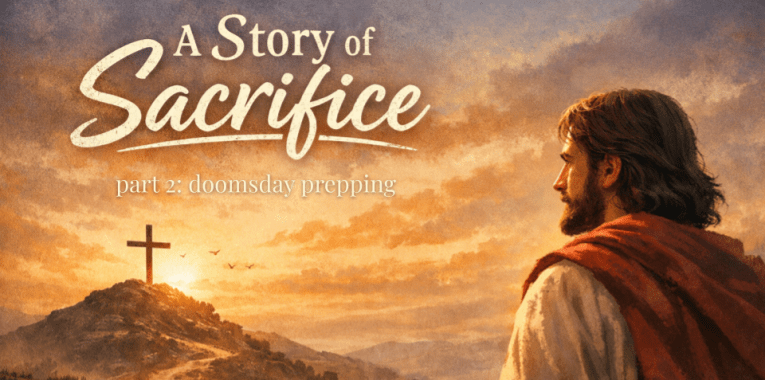
Doomsday Prepping

Jesus had a lot to say about the end of the world. He spoke of judgment as often as the prophets of old. That makes sense given that He was a prophet. He was far more than that, of course, but He wasn’t less than that. As we move forward with Luke in his story of sacrifice, we find Jesus having a conversation with the disciples about the future and judgment that was coming to Jerusalem itself and the world as a whole. It’s a wild picture. Let’s take a look at what He has to say and what it might mean for us with Easter in view.

Doomsday Prepping

Everybody knows the world is going to end at some point in the future. It’s not a matter of if; only of when. And I don’t say that simply as a Bible-believing follower of Jesus. Secular scientists tell us that at some point in the hopefully distant future the sun is going to go supernova, explode, and that’ll be the end of our solar system. Fun fact: that was not always the “common knowledge” that it is today. Used to be, all of the smartest people in the world “knew” the universe was eternal. It has always been here and would always be here. Christians with their beliefs about the end of the world with the return of Christ were so quaint and primitive. Albert Einstein famously introduced a made up fudge factor into some complicated equations he discovered that let physicists describe the universe in very mathematical terms that resulted in their showing the universe was eternal because if you solved them without that, they pointed to a finite beginning point of the universe, and he “knew” that wasn’t correct. Then science caught up with theology at about the same time that we invented weapons capable of utterly destroying the world several times over, and since then, everybody has known the world is going to end at some point in the future. 

Read the rest…


Morning Musing: Philippians 2:14-18

“Do everything without grumbling and arguing, so that you may be blameless and pure, children of God who are faultless in a crooked and perverted generation, among whom you shine like stars in the world, by holding firm to the word of life. Then I can boast in the day of Christ that I didn’t run or labor for nothing. But even if I am poured out as a drink offering on the sacrificial service of your faith, I am glad and rejoice with all of you. In the same way you should also be glad and rejoice with me.” (CSB – Read the chapter)

One of the things you learn a as a parent as that there are two ways to do something. You can do it happily or you can grumble your way through it. Well, you don’t actually learn this so much as experience it. Often. This is the kind of thing you expect from children, but adults are hardly immune from it. It is far more common than it seems like it should be for us to forget that grumbling our way along is bad for everyone. When this leaks into the church, it can make a real mess. Paul offers some counsel here to lead us in a different direction. Let’s take a look.

Read the rest…

But Is It Real?

This week we are kicking off a brand-new teaching series that is going to take us through the celebration of Jesus’ resurrection from the dead on Easter. For the next few weeks, we are going to be walking through Luke’s Passion Narrative beginning with Jesus’ triumphant ride into Jerusalem. These stories are perhaps families, but there is great worth in giving a fresh set of eyes to an old story. You just might be surprised what we’ll find along the way. Let’s get started with a look at Jesus’ message of judgment and how we need to adjust our lives in light of it.

But Is It Real?

Did your folks ever leave you home alone when you were a kid? Once I was old enough, mine did on occasion. And maybe your experience was like mine. Did they ever leave and by the absence of any departing instructions give you total free reign over the house and what you would do in it while they were gone? Yeah, mine didn’t do that very often either. There’s just too much trouble a kid can get into when left entirely to his own devices. What’s the solution to this problem? Why, it’s to keep them engaged with chores and projects, of course! As a result, when your parents left, you got a list. If you completed the list before they got home, that was good. If you didn’t…not so good. 

Read the rest…

The Way that Seems Right

This Sunday we kicked off a brand-new teaching series. Before Jesus departed the scene physically, He left His disciples some final marching orders. They were to make disciples everywhere they went. They were to be His witnesses locally, regionally, and internationally. They were to proclaim and advance the Gospel. The Christian faith has always been a missionary faith. In recent years in this country, though, being on mission for God has become an increasingly difficult task as our culture continues down the road of becoming post-Christian. How are we supposed to share the Gospel in a post-Christian culture where faith is no longer assumed? For the next few weeks, we’ll be talking about that very thing. This week we are starting with a topic that has to be addressed first in this effort: truth. How do we stand on the reality of truth in a culture that rejects such notions? Let’s talk about it.

The Way that Seems Right

Have you ever found yourself wishing we could go back to a simpler time in the past? You know, one where neighbors talked and actually knew each other better. Where kids could be sent out to play all day without worrying about where they were or what they were doing. Where so many marriages didn’t end in divorce. Where men were expected and allowed to be men, and women were expected and allowed to be women. One where the country wasn’t so polarized by politics; where the political left and the political right at least both loved America, and the ideas the nation stands for. Where most people went to church and you could pray and talk about the Bible in schools and in public, and the people who didn’t already believe it responded with repentance rather than persecution. 

Read the rest…

Morning Musing: Romans 15:14-16

“My brothers and sisters, I myself am convinced about you that you also are full of goodness, filled with all knowledge, and able to instruct one another. Nevertheless, I have written to remind you more boldly on some points because of the grace given me by God to be a minister of Christ Jesus to the Gentiles, serving as a priest of the gospel of God. God’s purpose is that the Gentiles may be an acceptable offering, sanctified by the Holy Spirit.” (CSB – Read the chapter)

Humility is one of the fundamental virtues necessary for growth and development in the Christian life. Embracing the Gospel begins from a place of humility—we must humbly accept that God is God and we are not. Along the way, though, ever more humility is required both to learn and to teach others. We see both sides of this humility in what Paul says next as he begins to turn much more personal as he is winding down this great letter.

Read the rest…