For Our Good

After a few days off, it’s good to be back. The Advent season is a time for preparing for the arrival of Jesus into our world and into our lives. For the next few weeks, as we take part in the preparation, we are going to spend some time looking at the stories of Jesus’ arrival. When Jesus arrived, heaven met earth in a way that left earth forever changed for the good. These classic stories give us some insight on how that happened. They may be familiar, but there is nonetheless great wisdom here if we will have it. Let’s get started with Matthew’s story of Jesus’ birth and see what the Spirit has to say through it.

For Our Good

Many of you know that I enjoy building metal models. They are all over my office. I think what I enjoy most is following instructions carefully and winding up with a neat-looking finished product in the end. There are enough things in this world that don’t have nice, neat endings where you can see and physically hold in your hand the results of your work. These metal models give you just that. And these days, the more complex they are, the more fun they are. I think my last model had somewhere near 200 pieces and 8 double-sided pages of instructions. That felt good to finish. 

Read the rest…

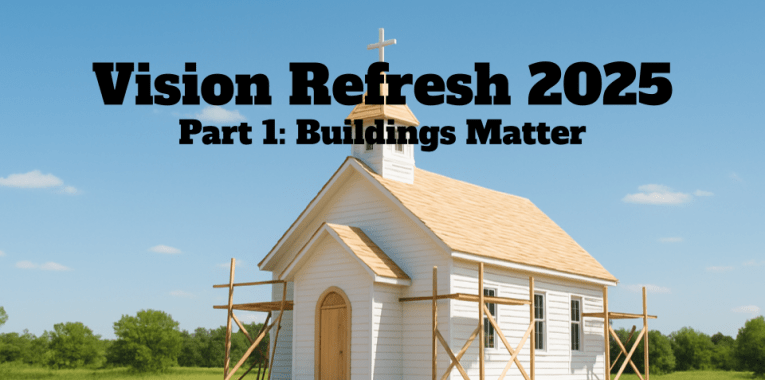
Buildings Matter

A year ago, we started out on a journey to expand and renovate our facilities here at First Baptist Oakboro. Over this week and next, we are checking back in on where we are, what God is doing, and why the work we are pursuing is still worth the effort. We’ll start today with the prophet Haggai and his call for the people of Israel to rebuild the temple. When we put God’s things first, He blesses the effort. Let’s dive in.

Buildings Matter

Have you ever hit one of those seasons when everything just feels like a rat race? You wake up, get dressed, go to work, come home, go to bed, and start it all over the next day. It feels like nothing ever really changes. You aren’t really going anywhere. You’re just doing the things that need to be done because they need to be done. You never feel like you get to the things you do just because you want to do them. No sooner do you get to what seems like it will be the end of one season than you find yourself back at the start having to run the whole thing over. It can all start to feel pointless. It can be depressing. How do we find purpose again when we get stuck like this? The answer is found in putting first things first. 

Read the rest…

Morning Musing: Romans 11:13-16

“Now I am speaking to you Gentiles. Insofar as I am an apostle to the Gentiles, I magnify my ministry, if I might somehow make my own people jealous and save some of them. For if their rejection brings reconciliation to the world, what will their acceptance mean but life from the dead? Now if the firstfruits are holy, so is the whole batch. And if the root is holy, so are the branches.” (CSB – Read the chapter)

Have you ever benefited from an opportunity that someone else missed? I was waiting for a table at a busy restaurant with limited seating the other day. While I was sitting there the hostess called for two different groups who weren’t there anymore. She scratched both names off the list and ours moved up. We wound up not having to wait nearly as long as we thought. Just before we were seated, though, one of them came back to see if they could still get a table. They could, but it was going to mean starting over at the bottom of the long list. Paul says Israel’s missing out on God’s kingdom because of their rejection of Jesus gave this kind of an opportunity to the rest of the world. Let’s take a look at what he’s saying here.

Read the rest…

Digging in Deeper: Romans 11:1-5

“I ask, then, has God rejected his people? Absolutely not! For I too am an Israelite, a descendant of Abraham, from the tribe of Benjamin. God has not rejected his people whom he foreknew. Or don’t you know what the Scripture says in the passage about Elijah—how he pleads with God against Israel? ‘Lord, they have killed your prophets and torn down your altars. I am the only one left, and they are trying to take my life!’ But what was God’s answer to him? ‘I have left seven thousand for myself who have not bowed down to Baal.’ In the same way, then, there is also at the present time a remnant chosen by grace.” (CSB – Read the chapter)

Mike Tyson is famous for saying “everyone has a plan until they get punched in the mouth.” Having things all worked out in theory and being able to adapt quickly to obstacles that come along with the goal of completely disrupting if not outright derailing our plans are two very different things. God had a plan for what He wanted to accomplish in and through Israel. Yet even for us to hear that sentence calls to mind things that God may not have meant. This is important for us to understand because trying to make sense out of what we understand God’s plans to have been and how things actually went can be tricky. Let’s join Paul in thinking through some of that here.

Read the rest…

Digging in Deeper: Romans 9:22-29

“And what if God, wanting to display his wrath and to make his power known, endured with much patience objects of wrath prepared for destruction? And what if he did this to make known the riches of his glory on objects of mercy that he prepared beforehand for glory—on us, the ones he also called, not only from the Jews but also from the Gentiles? As it also says in Hosea, ‘I will call Not My People, My People, and she who is Unloved, Beloved. And it will be in the place where they were told, you are not my people, there they will be called sons of the living God.’ But Isaiah cries out concerning Israel, ‘Though the number of Israelites is like the sand of the sea, only the remnant will be saved; since the Lord will execute his sentence completely and decisively on the earth.’ And just as Isaiah predicted: ‘If the Lord of Armies had not left us offspring, we would have become like Sodom, and we would have been made like Gomorrah.’” (CSB – Read the chapter)

So, yesterday we started a really uncomfortable conversation about God’s sovereignty and our subjection to that sovereignty. We like to think of ourselves as truly and completely free individuals. We are autonomous beings. And then Paul asks something like, “On the contrary, who are you, a human being, to talk back to God? Will what is formed say to the one who formed it, ‘Why did you make me like this?'” That hits hard. And the more you think about it, the harder it hits. In fact, it hits hard enough that whereas I was originally going to treat these verses in the same post as yesterday’s passage, there was enough here when I started writing that I had to break it up into two posts. Without further ado, then, let’s keep working through Paul’s exaltation of God’s sovereignty and what that means for us.

Read the rest…