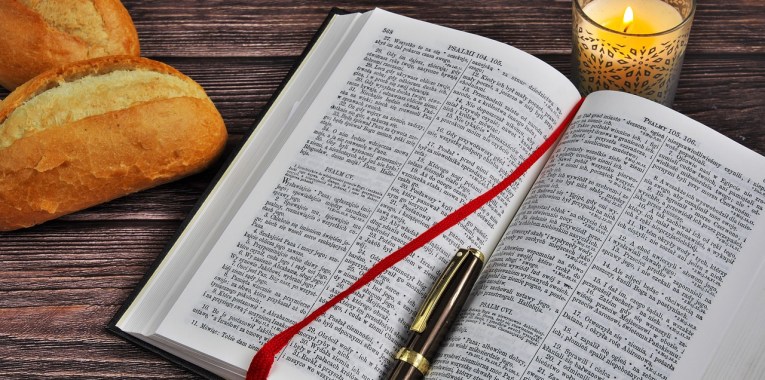
Digging in Deeper: Mark 6:17-20

“For Herod himself had given orders to arrest John and to chain him in prison on account of Herodias, his brother Philip’s wife, because he had married her. John had been telling Herod, ‘It is not lawful for you to have your brother’s wife.’ So Herodias held a grudge against him and wanted to kill him. But she could not, because Herod feared John and protected him, knowing he was a righteous and holy man. When Herod heard him he would be very perplexed, and yet he liked to listen to him.” (CSB – Read the chapter)

Have you ever been in a situation that blew up to such an extent that you figured God had completely forgotten about you, or perhaps was punishing you for something you didn’t even realize you had done? That can be a scary and disorienting place to be. You thought you were right on track with Him, but suddenly things go sideways, and it seems like the devil had won that particular battle. There was no way God could do something to redeem this. It was simply a lost cause. And then some well-meaning jerk came along to remind you of Romans 8:28 where Paul said that all things work together for good for those who love God and are called according to His purposes. And while perhaps he didn’t mean it this way, the implication is that either you didn’t love God enough, weren’t being called according to His purposes, or both. You didn’t punch him, but you did wonder a bit if maybe he wasn’t on to something. What are we supposed to do when our situations blow up and it feels like God is nowhere to be found?

Read the rest…

Morning Musing: Exodus 11:9-10

“The Lord said to Moses, ‘Pharaoh will not listen to you, so that my wonders may be multiplied in the land of Egypt.’ Moses and Aaron did all these wonders before Pharaoh, but the Lord hardened Pharaoh’s heart, and he would not let the Israelites go out of his land.” (CSB – Read the chapter)

Let me give you a bit of a peek behind the curtain this morning. I often write the introductions for these posts several weeks before I write the rest of them. These introductions serve as placeholders so that when I come back to actually write the full post I have a bit of a reminder of what I was thinking when I was first studying through a particular passage. As a result, I’m often studying one part of the text while writing about another a few chapters back. On occasion this lets me see connections between two different parts that I might otherwise miss. Way back at the beginning of chapter 7, just before God set Moses loose on Pharaoh, He told him (again) what was going to happen. The words He used then were remarkably similar to these words right here. Let’s come back to them again and touch yet again on this theme of Pharaoh’s hard heart. From that, we’ll spend a moment reflecting on why all of the repetition we find in this story is so important.

Read the rest…

Morning Musing: Hebrews 7:1-10

“For this Melchizedek, king of Salem, priest of God Most High, met Abraham and blessed him as he returned from defeating the kings, and Abraham gave him a tenth of everything. First, his name means king of righteousness, then also, king of Salem, meaning king of peace. Without father, mother, or genealogy, having neither beginning of days nor end of life, but resembling the Son of God, he remains a priest forever. Now consider how great this man was: even Abraham the patriarch gave a tenth of the plunder to him. The sons of Levi who receive the priestly office have a command according to the law to collect a tenth from the people  — that is, from their brothers and sisters — though they have also descended from Abraham. But one without this lineage collected a tenth from Abraham and blessed the one who had the promises. Without a doubt, the inferior is blessed by the superior. In the one case, men who will die receive a tenth, but in the other case, Scripture testifies that he lives. And in a sense Levi himself, who receives a tenth, has paid a tenth through Abraham, for he was still within his ancestor when Melchizedek met him.” (CSB – Read the chapter)

We’ve seen his name over and over in this letter. I even stopped and gave some background on who he was. Here at last, though, we arrive at the part where the author of Hebrews finally explains who Melchizedek is and why he has been using him as an illustration of the kind of priest Jesus is vis-a-vis the Levitical priesthood. I included the whole block of text about it here so you didn’t have to click through to read it all. Like the big block from chapter 5 we looked at a few weeks ago, I couldn’t break this up. We’ll take the rest of chapter seven in slightly smaller bits as he draws more contrasts between Melchizedek and Jesus and the Levitical priesthood. For now, though, let’s talk through what’s going on here.

Read the rest…

Morning Musing: Matthew 26:39

“Going a little farther, he fell facedown and prayed, ‘My Father, if it is possible, let this cup pass from me. Yet not as I will, but as you will.'” (CSB – Read the chapter)

There are some parts of the Christian life that are pretty easy to sell. The love and forgiveness and eternal life practically offer themselves to newcomers. Having God on your side and with you all the time doesn’t hurt either. There are some parts, though, that are a little less customer-friendly sounding. One of those is put on display here in Jesus’ conversation with His Father shortly before going to the cross. Let’s talk this morning about what happens when our will and God’s will aren’t the same.

Read the rest…

Morning Musing: Mark 15:15

“Wanting to satisfy the crowd, Pilate released Barabbas to them; and after having Jesus flogged, he handed him over to be crucified.” (CSB – Read the chapter)

There are some characters without whom a particular story would simply not be the same. Now, of course the main characters are vital to the narrative, but I’m talking about the secondary characters. These are the men and women (or some other mythological or animal or alien creature) in supporting roles, but who play their role or are written into the role so well they make the story work. I’m thinking about characters like Samwise Gamgee from the Lord of the Rings trilogy. Frodo is obviously the protagonist, but without Sam, he never would have completed his quest. The story simply wouldn’t have been the same. There’s a reason one of the main Oscar categories is best supporting actor and actress. Well, in the story of Jesus’ crucifixion, Pilate plays this kind of a role. Let’s spend just a few minutes together this morning talking about him.

Read the rest…