Digging in Deeper: Philippians 3:10-11

“My goal is to know him and the power of his resurrection and the fellowship of his sufferings, being conformed to his death, assuming that I will somehow reach the resurrection from among the dead.” (CSB – Read the chapter)

What is it that matters most in the end? We can offer up all sorts of different answers to that question. Various folks have pointed to money or possessions in one way or another. Most people, though, generally have a sense that isn’t the right answer. We could also point to things like relationships, good works, or renown. Here, as Paul is talking about what matters most to him, he points to something we don’t think about—even as followers of Jesus—but which should fall a whole lot more centrally on our radar. Let’s take a look at what he has to say.

Read the rest…

Doomsday Prepping

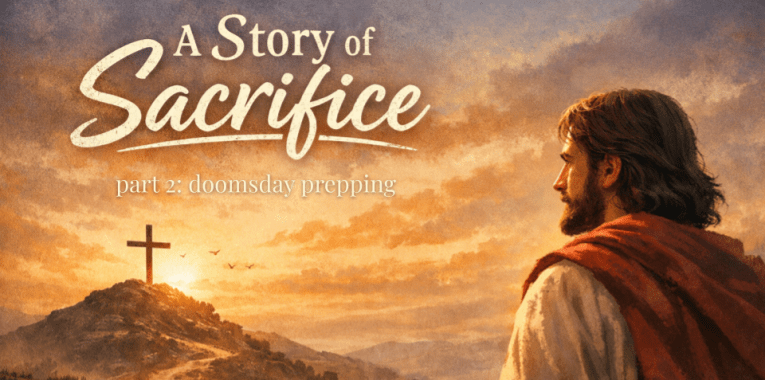
Jesus had a lot to say about the end of the world. He spoke of judgment as often as the prophets of old. That makes sense given that He was a prophet. He was far more than that, of course, but He wasn’t less than that. As we move forward with Luke in his story of sacrifice, we find Jesus having a conversation with the disciples about the future and judgment that was coming to Jerusalem itself and the world as a whole. It’s a wild picture. Let’s take a look at what He has to say and what it might mean for us with Easter in view.

Doomsday Prepping

Everybody knows the world is going to end at some point in the future. It’s not a matter of if; only of when. And I don’t say that simply as a Bible-believing follower of Jesus. Secular scientists tell us that at some point in the hopefully distant future the sun is going to go supernova, explode, and that’ll be the end of our solar system. Fun fact: that was not always the “common knowledge” that it is today. Used to be, all of the smartest people in the world “knew” the universe was eternal. It has always been here and would always be here. Christians with their beliefs about the end of the world with the return of Christ were so quaint and primitive. Albert Einstein famously introduced a made up fudge factor into some complicated equations he discovered that let physicists describe the universe in very mathematical terms that resulted in their showing the universe was eternal because if you solved them without that, they pointed to a finite beginning point of the universe, and he “knew” that wasn’t correct. Then science caught up with theology at about the same time that we invented weapons capable of utterly destroying the world several times over, and since then, everybody has known the world is going to end at some point in the future. 

Read the rest…

Digging in Deeper: 1 John 1:5-10

“This is the message we have heard from him and declare to you: God is light, and there is absolutely no darkness in him. If we say, ‘We have fellowship with him,’ and yet we walk in darkness, we are lying and are not practicing the truth. If we walk in the light as he himself is in the light, we have fellowship with one another, and the blood of Jesus the Son cleanses us from all sin. If we say, ‘We have no sin,’ we are deceiving ourselves, and the truth is not in us. If we confess our sins, he is faithful and righteous to forgive us our sins and to cleanse us from all unrighteousness. If we say, ‘We have not sinned,’ we make him a liar, and his word is not in us.” (CSB – Read the chapter)

The world is broken. People are broken. They do what’s wrong at least as often as they do what is right…sometimes more often. They are selfish. They do what they want and don’t think too much about how getting what they want will affect the people around them. And nobody seems to be able to do much about it. What if there was a way, though, to fix it? What if there was a way to make everybody do the right thing, to make them be decent people? What it be worth it? The second season of Amazon Prime’s, Fallout, ponders that very question. Let’s talk about it.

Read the rest…

Morning Musing: Philippians 1:12-14

“Now I want you to know, brothers and sisters, that what has happened to me has actually advanced the gospel, so that it has become known throughout the whole imperial guard, and to everyone else, that my imprisonment is because I am in Christ. Most of the brothers have gained confidence in the Lord from my imprisonment and dare even more to speak the word fearlessly.” (CSB – Read the chapter)

In his letter to the Thessalonian believers, Paul said that we should give thanks in everything. That sounds nice in theory, but tends to fall apart in practice. This is because there are things that happen to us on occasion that we are not thankful for. Sometimes we are rather unthankful for them. How do you respond when something that seems irredeemably bad happens? Frustration? Anger? Righteous indignation? As if offering a case study for the Thessalonians, Paul here follows his own command, giving us a pretty interesting perspective. Let’s check it out.

Read the rest…

Morning Musing: Philippians 1:6

“I am sure of this, that he who started a good work in you will carry it on to completion until the day of Christ Jesus.” (CSB – Read the chapter)

I was watching a movie the other night and in one scene a dad had taken his kids backpacking in the mountains. As they were hiking to their intended campsite, he kept telling them, “There’s just one more hill.” But then they’d crest that hill only to find another one waiting for them. Sometimes life feels that way. We make some forward progress only to discover just how much further we still have to go. This is especially true when we’re talking about following Jesus and becoming more like Him. Paul here offers us some encouragement in the journey. Let’s take a look.

Read the rest…