“When a man gives his neighbor valuables or goods to keep, but they are stolen from that person’s house, the thief, if caught, must repay double. If the thief is not caught, the owner of the house must present himself to the judges to determine whether or not he has taken his neighbor’s property. In any case of wrongdoing involving an ox, a donkey, a sheep, a garment, or anything else lost, and someone claims, ‘That’s mine,’ the case between the two parties is to come before the judges. The one the judges condemn must repay double to his neighbor. When a man gives his neighbor a donkey, an ox, a sheep, or any other animal to care for, but it does, is injured, or is stolen, while no one is watching, there must be an oath before the Lord between the two of them to determine whether or not he has taken his neighbor’s property. Its owner must accept the oath, and the other man does not have to make restitution. But if, in fact, the animal was stolen from his custody, he must make restitution to its owner. If it was actually torn apart by a wild animal, he is to bring it as evidence; he does not have to make restitution for the torn carcass. When a man borrows an animal from his neighbor, and it is injured or died while its owner is not there with it, the man must make full restitution. If its owner is there with it, the man does not have to make restitution. If it was rented, the loss is covered by its rental price.” (CSB – Read the chapter)
What does it take to have a full-functioning society? A whole range of things, of course. Societies are complex affairs with more moving parts than anyone realizes. (This is why, by the way, that centrally planned economies never work as well as free market economies – no one has the full range of information, knowledge, or wisdom they need in order to fairly and justly manage all of a society from a single, centralized location.) In order for them to be working in such a way that allows for life and flourishing for the largest number of people, some behavior regulation is generally in order thanks to sin. Specifically, there needs to be rules in place for how people will handle disputes among themselves. What we see here is an example of one such set of rules God gave to Israel. Let’s talk about what’s going on here and what larger wisdom this points to that might benefit us.
John Adams once wrote that “our Constitution was made only for a moral and religious people.” He went on to observe that “it is wholly inadequate to the government of any other kind” of people. His point in this was that the kinds of freedoms our Constitution was designed to safeguard with as minimally invasive a government as was possible could only be sustained by a people who were themselves virtuous. Of course, he understood, that kind of virtue only existed among a people who were moral and religious. Absent religion, virtue does not flourish and cannot be sustained. And when virtue vanishes from a culture – that is, when people stop regulating their behavior on their own – other external means of behavioral regulation must be enacted to prevent a general anarchy from overtaking a society.
We will always do what we believe to be in our own self-interest. And, we will pursue that self-interest at the expense of the people around us if necessary. That’s natural behavior in a world broken by sin. We might still do some good for the people around us, but only where we understand that good to be an advancement of our self-interest. When we are operating strictly on natural terms, genuine kindness and selflessness are pretty rare things. That’s why stories about such things are so impressive to us. But you don’t have to just take my word for any of this. Just look at our culture. As we continue to secularize, separating ourselves more and more thoroughly from any kind of a religious commitment, rates of volunteerism are plummeting, charitable giving is dropping, loneliness and isolation are increasing, crime rates are rising, broken families and the host of social maladies those cause are flourishing, and so on and so forth. But we want what we perceive what is good for us, so we keep running down this path.
In this kind of society, what invariably winds up happening is that Darwin gets proved right. The law of survival of the fittest takes over. The strongest people are able to exert their will over the weak and the whole society eventually falls apart into rampant injustice. And the strong here can take all kinds of different forms from the wealthy to the politically connected to highly educated to simply those with the physical strength and will to make those around them do what they want.
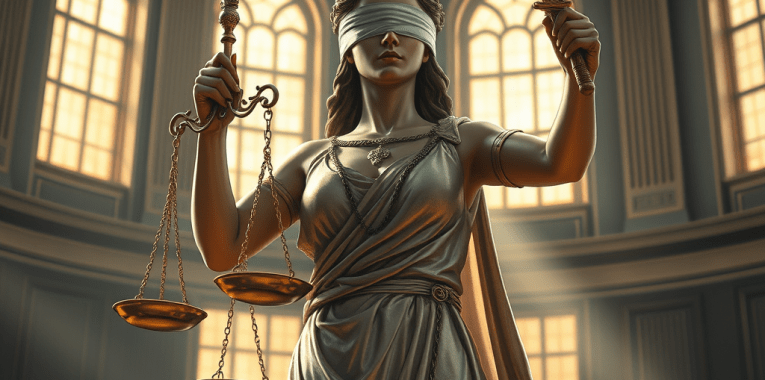
All of this is the direction every society eventually moves. It takes active effort to stop this and move in the other direction toward a more equitable form of justice. This more equitable justice comes to play in ways both large and small. On both scales, though, it very often takes the form of a neutral, third-party adjudicator who can step in and resolve competing claims between two people that cannot be resolved amicably. Of course, these third-parties must be not only guided, but empowered by a set of laws that set the boundaries, expectations, and requirements by which such disputes will be resolved. A just judicial system like this is a non-negotiable for any kind of a healthy and prosperous society to function.
When people lose trust in this because of a growing cynicism or else a too-frequent encounter with broken points in the system, injustice will flourish. They will begin taking matters into their own hands. Societal breakdown will eventually follow. Tribalism will take over. That never ends well.
Historically speaking, the church functioning well has proven to be the only antidote to this societal poison. This doesn’t mean the church has always gotten it right, and in fact when the church works itself into a place of social or political power it unfailingly starts to look more like the world than the vision for the church laid out in the New Testament, but that doesn’t change the fact that the church and a healthy religiosity has proven the only means of avoiding this end.
God is just, and He wanted the society He was building to reflect that. Laws like these were aimed at setting some boundaries to keep the people pursuing a path of justice rather than the law of the jungle that tended to dominate in other societies. Healthy societies today also reflect God’s character in this regard.
So, does this mean the church should work to be in a place of political or regulatory power in a given culture? While there are some who would argue for this end, I am not one of those. That’s not the place for the church. What the church should do, though, is inform the worldview of the people who are operating in those positions so that laws and regulations reflect the justice of God rather than falling to injustice in one form or fashion. When we capture the hearts and minds of the people with the Gospel, we don’t need to operate from a place of political or cultural power. When virtue flourishes, regulations designed to manage behavior in a certain direction can be minimized. In this kind of an environment, freedom flourishes. Freedom flourish because virtue flourishes because faith flourishes. There’s a direction connection from one to the next.
What, then, does any of this mean for us? It means we should seek to pursue the path of Christ in all our dealings. We should operate with kindness and compassion for the people around us rather than mere self-interest. We should practice loving one another with courage and boldness. And we should teach those around us to do the same. We teach by instruction and by example. We may not be able to transform the whole culture, but we can transform our own spheres of influence. And if enough followers of Jesus transform their own spheres of influence wherever those happen to be, all of a sudden, real cultural change becomes a possibility. That’s an end worth striving for.





 The Nexus