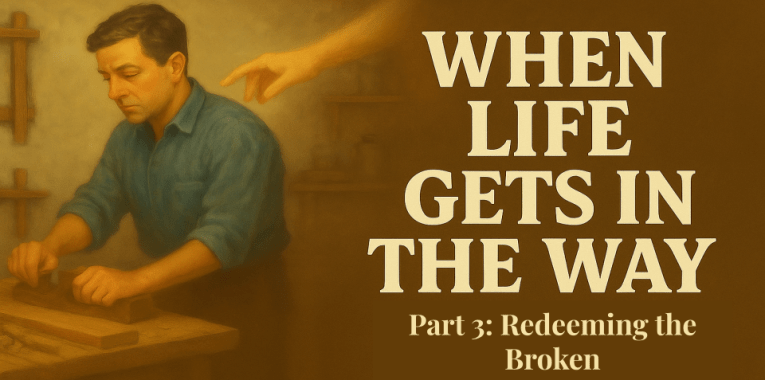
Redeeming the Broken

Interruptions are part of life. For the last couple of weeks in our teaching series, When Life Gets in the Way, we have been talking about the kinds of interruptions God’s plans can bring to our lives and what to do in those times. But what about when our interruptions are the cause of our own, sinful choices. What then? Today we are going to explore the story of a Bible “hero” whose choice to sin seems like it should have derailed all of God’s plans for his life. But it didn’t. Let’s talk about why and what that might mean for us.

Redeeming the Broken

People are different. Now, you can take that statement in several different ways, but what I mean is that we’re not like the rest of creation. When Moses was poetically describing the creation process, when he got to the part where God made people, he presented it differently than all the other aspects of creation. He changed the poetic pattern, which would have been a major tipoff that something was different. He said this: “So God created man in his own image; he created him in the image of God; he created them male and female.” In bearing God’s image—His personal characteristics, not His divine ones—God made us distinct from the rest of creation. 

Read the rest…

Morning Musing: Exodus 39:32-43

“So all the work for the tabernacle, the tent of meeting, was finished. The Israelites did everything just as the Lord had commanded Moses. . . .The Israelites had done all the work according to everything the Lord had commanded Moses. Moses inspected all the work they had accomplished. They had done just as the Lord commanded. Then Moses blessed them.” (CSB – Read the chapter)

There’s an old saying that goes like this: Practice makes perfect. It sounds good, but it’s not really true in that form. A more accurate rendering would be this: Practice makes permanent. If you do something enough times, you will always do it that way. But if you don’t do it quite correctly all of those times, you will always do it wrongly. In order for practice to make perfect, it has to be evaluated. Once the tabernacle construction was complete, it came time to evaluate what they had done. Let’s take a look at how this process unfolded.

Read the rest…

Digging in Deeper: Exodus 36:2-7

“So Moses summoned Bezalel, Oholiab, and every skilled person in whose heart the Lord had placed wisdom, all those hearts moved them, to come to the work and do it. They took from Moses’s presence all the contributions that the Israelites had brought for the task of making the sanctuary. Meanwhile, the people continued to bring freewill offerings morning after morning. Then all the artisans who were doing all the work for the sanctuary came one by one from the work they were doing and said to Moses, ‘The people are bringing more than is needed for the construction of the work the Lord commanded to be done.’ After Moses gave an order, they sent a proclamation throughout the camp: ‘Let no man or woman make anything else as an offering for the sanctuary.’ So the people stopped. The materials were sufficient for them to do all the work. There was more than enough.” (CSB – Read the chapter)

One of the things you have to learn as a parent is that you can’t do everything for your kids. Some parents learn that lesson better than others. You can typically tell which parents are which by looking at their kids. If you do everything for your kids, they won’t learn to do anything for themselves. They won’t learn to take ownership of things and make their own responsible, informed decisions. They won’t gain the satisfaction of contributing meaningfully to a project, of working hard and seeing the fruits of their labors. When God commanded the building of the tabernacle, He could have just plunked it down in the middle of camp fully completed. But He didn’t. He brought the people in on the project. And, to their credit, they responded. Let’s talk about what we see here and how God still works today.

Read the rest…

Morning Musing: Exodus 7:8-13

“The Lord said to Moses and Aaron, “When Pharaoh tells you, ‘Perform a miracle,’ tell Aaron, ‘Take your staff and throw it down before Pharaoh. It will become a serpent.’” So Moses and Aaron went in to Pharaoh and did just as the Lord had commanded. Aaron threw down his staff before Pharaoh and his officials, and it became a serpent. But then Pharaoh called the wise men and sorcerers — the magicians of Egypt, and they also did the same thing by their occult practices. Each one threw down his staff, and it became a serpent. But Aaron’s staff swallowed their staffs. However, Pharaoh’s heart was hard, and he did not listen to them, as the Lord had said.” (CSB – Read the chapter)

How do you convince someone that God is real? How do you convince them that He is worth their lives and obedience? That’s a tough question to answer and one that depends on both the person and the circumstances. Sometimes, though, the only way to get through to someone is by putting on a bit of a show. How big a show again depends, but sometimes God puts on a pretty big one. When God sent Moses to confront Pharaoh, He knew it was going to take a really big show in order to convince him. Let’s look here at how that show begins and why God was always the ringmaster.

Continue reading “Morning Musing: Exodus 7:8-13”

Morning Musing: Exodus 6:28-30

“On the day the Lord spoke to Moses in the land of Egypt, he said to him, ‘I am the Lord; tell Pharaoh king of Egypt everything I am telling you.’ But Moses replied in the Lord’s presence, ‘Since I am such a poor speaker, how will Pharaoh listen to me?'” (CSB – Read the chapter)

We tend to revere certain people who have achieved what we determine to be great things. Part of this is totally understandable. When someone has done something we can’t do, we are impressed by that. Part of this is a leftover from the Fall and our sinful nature. It’s easier to look to people we can see than to a God we can’t. Most religions do this regularly and lean into it. Christianity has certainly been guilty of this over its history. Yet it is the one religion that doesn’t find any support for this in its founding documents. The Scriptures are clear over and over again that people are not great; God is. Let’s talk about why this matters so much.

Read the rest…