Morning Musing: Romans 7:22-25

“For in my inner self I delight in God’s law, but I see a different law in the parts of my body, waging war against the law of my mind and taking me prisoner to the law of sin in the parts of my body. What a wretched man I am! Who will rescue me from this body of death?  Thanks be to God through Jesus Christ our Lord! So then, with my mind I myself am serving the law of God, but with my flesh, the law of sin.” (CSB – Read the chapter)

You’ve been there before. You knew the right thing to do in a situation. You further knew what the consequences of doing the wrong thing would be. But you did the wrong thing anyway. And now you’re facing the consequences. There aren’t many feelings worse than that. The right word for that feeling is wretched. Let’s join Paul as he concludes his reflections on the nature of our struggle against sin and the sense of wretchedness that brings.

Read the rest…

Morning Musing: Romans 6:12-14

“Therefore do not let sin reign in your mortal body, so that you obey its desires. And do not offer any parts of it to sin as weapons for unrighteousness. But as those who are alive from the dead, offer yourselves to God, and all the parts of yourselves to God as weapons for righteousness. For sin will not rule over you, because you are not under the law but under grace.” (CSB – Read the chapter)

One of the more important parenting lessons I’ve heard and tried to live out is to not speak negative characteristics into the life of your child. What I mean is, when you are angry or frustrated with your child, don’t say, “You are such a __________,” or, “you are so _________,” where the blank is filled in with some negative characteristic. Jerk, slob, cheater, lazy, stupid, embarrassing, and so on. The reason is simple: when you say that kind of thing to your kids, what they hear is, “I’m lazy,” or, “I’m stupid,” or, “I’m a cheater,” or, “I’m a jerk.” With that idea drumming through their mind, there is a higher than zero likelihood that they’ll live down to it. Instead, call them forward to virtuous characteristics by the way you speak to them. “I see how hardworking you are, but this didn’t reflect that. How can I help you live out more consistently who I know you are?” Paul here is doing some good parenting with believers by calling us to live up to our identity in Christ. Let’s take a look at how he’s doing this.

Read the rest…

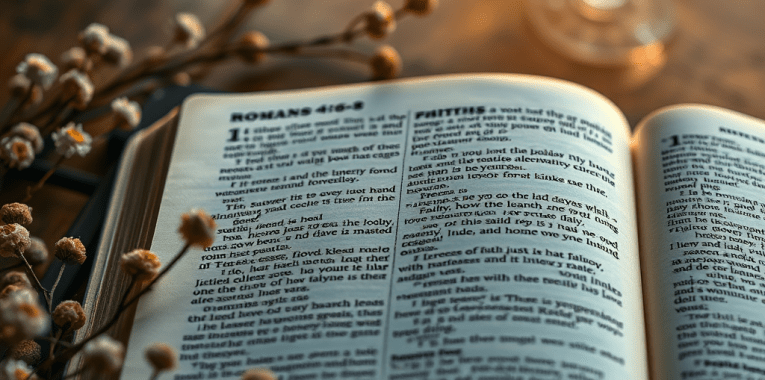
Morning Musing: Romans 4:6-8

“Likewise, David also speaks of the blessing of the person to whom God credits righteousness apart from works: Blessed are those whose lawless acts are forgiven and whose sins are covered. Blessed is the person the Lord will never charge with sin.” (CSB – Read the chapter)

History builds on itself. You can’t make proper sense out of the present without understanding the past. History is linear like that. It is always going somewhere. Sometimes it winds this way and that and even doubles back a bit, but forward is always, ultimately where it is going. This is because it is being guided along by a God who has a plan. It is a plan He has been slowly revealing for a very long time. And He also leaves clues ahead of time for those with eyes to see. A bit of an excursus today as we pause to ponder an accessory point in Paul’s argument. Let’s talk about God’s plans and how we know them.

Read the rest…

Morning Musing: Romans 3:25-26

“God presented him as the mercy seat by his blood, through faith, to demonstrate his righteousness, because in his restraint God passed over the sins previously committed. God presented him to demonstrate his righteousness at the present time, so that he would be just and justify the one who has faith in Jesus.” (CSB – Read the chapter)

When an offense occurs, someone is responsible and someone is offended. There may be more than one responsible party, and there may be more than one offended party, but there is at least one of each. Indeed, if there is no offended party, then it wasn’t an offense. That is, it wasn’t wrong. And when this offense has occurred, it has to be made right or justice is never achieved. Today, let’s explore why God is always the ultimate offended party, and what He has done about making sure justice—His justice—is ultimately satisfied.

Read the rest…

Morning Musing: Romans 3:5-6

“But if our unrighteousness highlights God’s righteousness, what are we to say? I am using a human argument: Is God unrighteous to inflict wrath? Absolutely not! Otherwise, how will God judge the world?” (CSB – Read the chapter)

The picture of God as judge is not a popular one nowadays. This wasn’t always the case. The pre-modern world didn’t have much of a problem with it at all. Our being repulsed by the idea is a consequence of modern and postmodern philosophical movements over the last roughly 200 years changing the way we think about ourselves and right and wrong and God more generally. As we work through Paul’s concluding argument in his grand presentation of the hard news of the Gospel in order to set up the good news (which we’ll finally get to next week), he starts things off by highlighting some potential reactions to the argument he has been making. We dealt with the first of these last week. Let’s take on the second today: Is God right to issue judgment against sin?

Read the rest…