Morning Musing: Romans 6:6-11

“For we know that our old self was crucified with him so that the body ruled by sin might be rendered powerless so that we may no longer be enslaved to sin, since a person who has died is freed from sin. Now if we died with Christ, we believe that we will also live with him, because we know that Christ, having been raised from the dead, will not die again. Death no longer rules over him. For the death he died, he died to sin once for all time; but the life he lives, he lives to God. So, you too consider yourselves dead to sin and alive to God in Christ Jesus.” (CSB – Read the chapter)

As you read through Romans 6, Paul repeats himself. He makes one basic point and then drives it into our heads almost relentlessly. The reason for this is simple: This stuff is crucial to understand if we are going to properly understand the Gospel. And the point he makes is one we have talked about before. Apart from Christ, we are slaves to sin. In Christ, we are free. Let’s explore this with Paul here a little further.

Read the rest…

Digging in Deeper: Romans 6:3-5

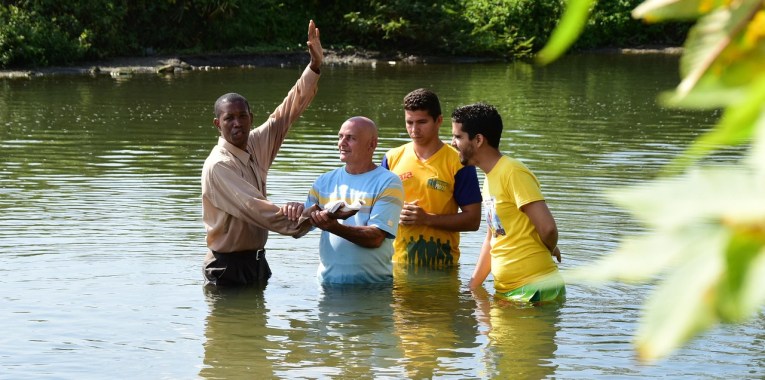
“Or are you unaware that all of us who were baptized into Christ Jesus were baptized into his death? Therefore we were buried with him by baptism into death, in order that, just as Christ was raised from the dead by the glory of the Father, so we too may walk in newness of life. For if we have been united with him in the likeness of his death, we will certainly also be in the likeness of his resurrection.” (CSB – Read the chapter)

I am a Baptist preacher. We Baptists love baptism. It’s kind of in the name. And when we say the word, we mean it with its original Greek meaning. The word batidzo, from which our English word is merely a transliteration rather than a translation, means to immerse something in water, not to merely sprinkle some water over it. One of the two things that makes a Baptist church a Baptist church is a requirement that a person has been baptized before they can be a member. Yet as important as the practice is to us, we didn’t invent it. In fact, Christians generally didn’t invent it. Lots of religions used some form of baptism as an initiatory and cleansing rite. We simply took something that was already in existence and added our own unique symbolism to it. Here we find Paul talking about some of that symbolism. Let’s walk through this with him.

Read the rest…

Morning Musing: Romans 6:1-2

“What should we say then? Should we continue in sin so that grace may multiply? Absolutely not! How can we who died to sin still live in it? (CSB – Read the chapter)

When you write a lot of things, you occasionally find when you go to write something new that you’ve written it before. That happened a couple of weeks ago as I was starting to studying Romans 6 in preparation for writing about it as we continue our journey. More specifically, I discovered that I had written about these two verses before. I also found myself agreeing with what I said then. So, with some updates after six years, and for the first time ever in nearly eight years of writing this blog, here’s a repeat of an old post.

What should be the relationship of a follower of Jesus to sin? Obviously we shouldn’t do it, but let’s be honest: a simple “ought not” isn’t usually sufficient to keep us from it. We need to understand the why behind the ought before we’re going to wrap our hearts and minds around it to a sufficient degree that it begins to have the kind of power in our lives it needs to have. Here in beginning of Romans 6, after Paul has just been telling us about the power of grace in light of the power of sin, the apostle explores this very idea. His treatment may not be exhaustive, but it is powerful. Let’s start unpacking this today, and continue with Paul on the idea over the next several days.

Read the rest…

Morning Musing: Romans 5:20-21

“The law came along to multiply the trespass. But where sin multiplied, grace multiplied even more so that, just as sin reigned in death, so also grace will reign through righteousness, resulting in eternal life through Jesus Christ our Lord.” (CSB – Read the chapter)

Every relationship has boundaries. Those boundaries exist whether we are aware of them or not. If we violate those boundaries ignorantly, we may not necessarily be intentionally at fault of anything, but we still have departed from the relationship. Knowing exactly where the boundaries are is helpful, but it also makes our transgressing them all the more problematic because now we know what we are doing. When God gave the Law He made the problem of sin even worse than it already was. But He also set the stage for even more powerfully making things right. Let’s explore this together as we finish off chapter five today.

Read the rest…

Morning Musing: Romans 5:18-19

“So then, as through one trespass there is condemnation for everyone, so also through one righteous act there is justification leading to life for everyone. For just as through one man’s disobedience the many were made sinners, so also through the one man’s obedience the many will be made righteous.” (CSB – Read the chapter)

Every major event of world history hinges on a single decision. We may not be able to pin down exactly when that decision was made, much less who made it, but there is always a point at which history gets set on a particular path. Paul here is talking about the two most important hinge points in human history. One resulted in everything’s being broken, the other opened the doors to their being set right again. Let’s talk about it.

Read the rest…