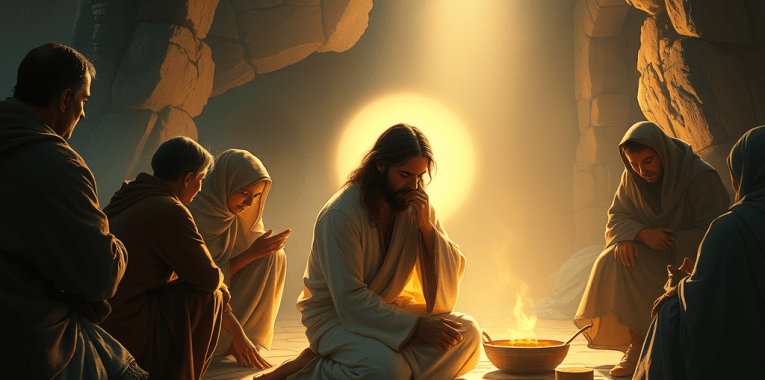
Digging in Deeper: Romans 14:22-23

“Whatever you believe about these things, keep between yourself and God. Blessed is the one who does not condemn himself by what he approves. But whoever doubts stands condemned if he eats, because his eating is not from faith, and everything that is not from faith is sin.” (CSB – Read the chapter)

One of the lessons many state curricula seek to teach students early on in their education process is how to differentiate between facts and opinions. Of course, such an effort is deeply worldview dependent, and so parents should be actively engaged with those lessons at home to make sure they are properly supporting or else tuning interference if their states curriculum has been primarily shaped by a worldview position they don’t support. That all being said, the effort is worthwhile in the abstract. One reason for this comes out in what Paul writes here at the end of Romans 14. Let’s talk about facts and opinions on sin.

Read the rest…

Morning Musing: Romans 14:19-21

“So then, let us pursue what promotes peace and what builds up one another. Do not tear down God’s work because of food. Everything is clean, but it is wrong to make someone fall by what he eats. It is a good thing not to eat meat, or drink wine, or do anything that makes your brother or sister stumble.” (CSB – Read the chapter)

We live in a culture that has a well ingrained “me first“ mentality. We think about ourselves and what we need before we give much thought to anyone else. Now, not everyone falls prey to this. Some people naturally have a servant-minded personality. Others are raised to think about others first. But even this can become tainted by our me first mentality. They put others first because they’ve been trained to think their worth is found in what they can do for others, and so they serve others as a means of assuring their own value (at least in their own mind). Most of the time we are sufficiently isolated from each other that this isn’t such a huge deal. But in the church, this mindset can be debilitating. Let’s take a look at some counsel from Paul on dealing with this tendency.

Read the rest…

Morning Musing: Romans 14:16-18

“Therefore, do not let your good be slandered, for the kingdom of God is not eating and drinking, but righteousness, peace, and joy in the Holy Spirit. Whoever serves Christ in this way is acceptable to God and receives human approval.” (CSB – Read the chapter)

I had a conversation the other day with a young man who is going through a tough season. He loves the Lord and earnestly desires for his life to reflect that, but his road has been rocky all the same. One of the questions he kept coming back to as we talked is what God’s will is for this or that. I finally told Him that while God cares about the details of our lives, He’s more concerned with the forest than the trees. If we are committed to honoring and glorifying Him in the large things, the small things will fall into place. That’s something like Paul is getting at here in instructing the church in Rome on how to get along together. Let’s take a look.

REad the rest…

Digging in Deeper: Romans 14:13-15

“Therefore, let us no longer judge one another. Instead decide never to put a stumbling block or pitfall in the way of your brother or sister. I know and am persuaded in the Lord Jesus that nothing is unclean in itself. Still, to someone who considers a thing to be unclean, to that one it is unclean. For if your brother or sister is hurt by what you eat, you are no longer walking according to love. Do not destroy, by what you eat, someone for whom Christ died.” (CSB – Read the chapter)

In the early 20th century, some philosophers and literary critics, tired of what they saw as the restrictiveness of modernity, began to explore beyond its limits. Starting from the jumping off point that the meaning of a particular text isn’t fixed, they gradually began to apply this relativistic thinking to all of life. Thus cultural relativism was born. While possessing perhaps a grain of truth, relativism’s impact on culture broadly has mostly been poisonous that at least many Christian philosophers have been working to counter ever since. So then, why does Paul seem to propose a kind of relativism here? Let’s explore what he is saying and how we can create peaceful, welcoming churches.

Read the rest…

Digging in Deeper: Acts 5:34-39

“But a Pharisee named Gamaliel, a teacher of the law who was respected by all the people, stood up in the Sanhedrin and ordered the men to be taken outside for a little while. He said to them, ‘Men of Israel, be careful about what you’re about to do to these men. Some time ago Theudas rose up, claiming to be somebody, and a group of about four hundred men rallied to him. He was killed, and all his followers were dispersed and came to nothing. After this man, Judas the Galilean rose up in the days of the census and attracted a following. He also perished, and all his followers were scattered. So in the present case, I tell you, stay away from these men and leave them alone. For if this plan or this work is of human origin, it will fail; but if it is of God, you will not be able to overthrow them. You may even be found fighting against God.’ They were persuaded by him.” (CSB – Read the chapter)

Baptists love to have meetings. Better yet, we love to have business meetings. If you hang around a Baptist church long enough, you will eventually have the chance to attend a business meeting. I daresay you would be hard pressed to find a Baptist church that doesn’t have regular business meetings in some form or fashion. Our next one is coming up here in a few weeks. I had the chance to attend the annual meeting of the Baptist State Convention this week. As far as meetings go, it was about as vanilla and uncontroversial as you could have hoped for. But on the last afternoon, something grabbed hold of my attention in a big way. I will almost certainly develop it into a whole sermon at some point. It really was that powerful. Let me tell you about it.

Read the rest…