
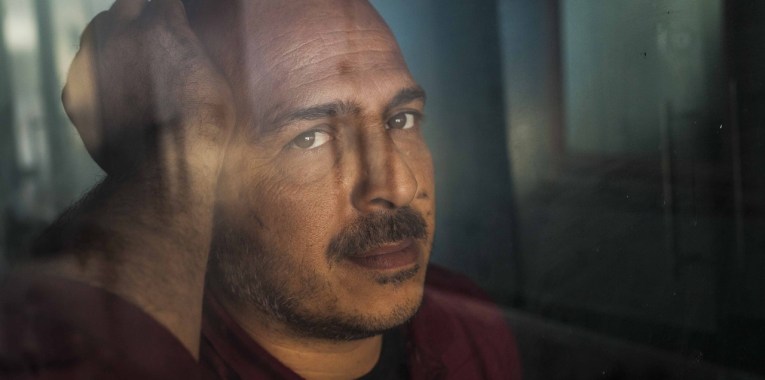
Why Do We Suffer?

This week we are in the third part of our teaching series, Confident in the Face of Hard Questions. This will be the most emotionally challenging stop on our journey. This week we are going to tackle the question of why there is suffering in the world created by a supposedly good God. This is a deeply emotional question with intensely personal elements to it. You have perhaps asked this question yourself. You certainly know people who have even if you didn’t know that about them. The answers to this question won’t be easy, but they are good. Let’s dive in together to see what the Scriptures have to say about it.

Why Do We Suffer?

There is a humanitarian crisis unfolding right now in Gaza. There’s an ongoing one in Ukraine. China is still keeping millions of Uyghur Muslims in concentration camps in the Xinjiang Province even though that has dropped out of the news. That is in addition to that nation’s ongoing and vigorous persecution of Christians…who make up a larger percentage of the population than Chinese Communist Party members. Azerbaijan has launched a genocidal effort to exterminate or otherwise forcibly relocate all of the Armenian Christians in a disputed border region between the nations, leading to massive suffering on the part of tens of thousands. Muslims in Pakistan are becoming more and more aggressive in their persecution of Christians in the nation. So are Hindus in India. The two nations don’t like each other, but they both agree that they hate Christians more. A category five Hurricane hit the Pacific coast of Mexico last week from which the recovery efforts have only just begun. A shooter in Maine just last week murdered 18 and injured another 13, some critically. Several people in our own community have had their lives disrupted just recently by unexpected, unwelcome, and scary news that bodes for a very difficult road stretching out in their near future. 

Read the rest…

Digging in Deeper: 1 Peter 1:3

“Blessed be the God and Father of our Lord Jesus Christ. Because of his great mercy he has given us new birth into a living hope through the resurrection of Jesus Christ from the dead.” (CSB – Read the chapter)

As far as the world is concerned, the way of Jesus is a way of weakness and failure. Well, weakness in a world dominated by what is perceived as strength invites aggressive people to challenge and persecute those who are given the unfortunate label. Those people and institutions and even nations that are thought to be weak are made into targets. They can become scapegoats for all kinds of problems. Eventually they are seen as less than fully human, and once that particular line is crossed in the minds of their adversaries, a whole range of awful things suddenly fall within the realm of reasonable, acceptable, and even good to do to them. The apostle Peter, who had once fully bought into the world’s narrative of strength, opens his first letter by offering praise to God because of the living hope He has given us through the resurrection of Jesus from the dead. The trouble with a resurrection hope is that it starts with a death. In this case it was a voluntary death that was not resisted. The world sees that as weakness and responds accordingly. How do we live with a living hope in a world that doesn’t understand such a thing?

Read the rest…

Where It All Begins

Yesterday was Easter, the day for celebrating the resurrection of the Son of God. History turns on this event. The world looks the way it does today because of this event more than just about any other. It’s a remarkable story. Today, let’s spend some time reflecting on just what it means for us that Jesus rose from the dead.

Where It All Begins

Jesus was dead…and then He wasn’t. 

If you were to take that statement, get rid of Christianity entirely, and drop it into any other context, it wouldn’t make any sense. At all. None. Zero. Zilch. Nada. Across the centuries of human history, various different religious movements offered up theories and ideas about what might lie on the other side of the grave. But none of them had anything like the resurrection of Jesus as a part of their frame of reference. Now, some of them developed something like it after Jesus’ resurrection, but not before. This is because we didn’t have a category for something like that. Instead, when Jesus was buried late in the afternoon on the Friday when He died, everyone expected Him to stay put. 

Read the rest…

Digging in Deeper: Luke 24:18-24

“The one named Cleopas answered him, ‘Are you the only visitor in Jerusalem who doesn’t know the things that happened there in these days?’ ‘What things?’ he asked them. So they said to him, ‘The things concerning Jesus of Nazareth, who was a prophet powerful in action and speech before God and all the people, and how our chief priests and leaders handed him over to be sentenced to death, and they crucified him. But we were hoping that he was the one who was about to redeem Israel. Besides all this, it’s the third day since these things happened. Moreover, some women from our group astounded us. They arrived early at the tomb, and when they didn’t find his body, they came and reported that they had seen a vision of angels who said he was alive. Some of those who were with us went to the tomb and found it just as the women had said, but they didn’t see him.'” (CSB – Read the chapter)

On the third day, Jesus rose. In three days, should our Lord tarry, we will celebrate that great truth with joy and gladness. Should He not tarry, we’ll celebrate His great return which will be even better. Yet the day it happened, nobody expected it. Nobody. Not a single person. Even the people who were witnesses to the risen Lord at first couldn’t recognize Him because they didn’t even have a category for His being alive. As we prepare to celebrate the best news of all, let’s reflect on one of the more humorous scenes after the resurrection.

Read the rest…

Digging in Deeper: Hebrews 2:8b-9

“For in subjecting everything to him, he left nothing that is not subject to him. As it is, we do not yet see everything subjected to him. But we do see Jesus – made lower than the angels for a short time so that by God’s grace he might taste death for everyone – crowned with glory and honor because he suffered death.” (CSB – Read the chapter)

What is it that makes Jesus so great? That, perhaps more than just about anything else, is the question the author of Hebrews is seeking to answer over the course of his letter. While there are several good answers to the question generally and three in particular to which he gives the lion’s share of his attention, we see his arguing for one here that may not be something we think about all that often. Let’s dig in to what he’s talking about this morning.

Read the rest…