
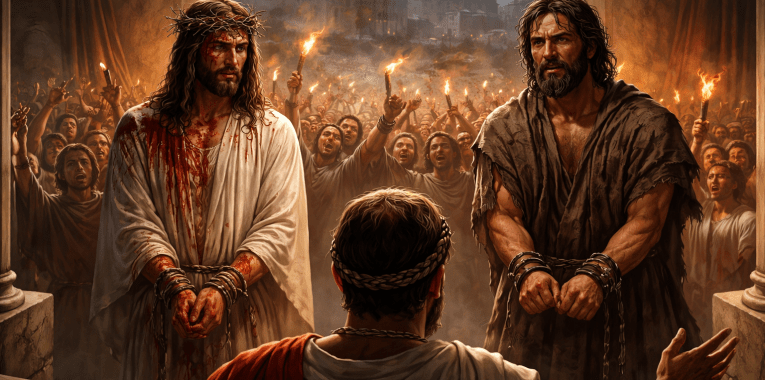
“At the festival Pilate used to release for the people a prisoner whom they requested. There was one named Barabbas, who was in prison with rebels who had committed murder during the rebellion. The crowd came up and began to ask Pilate to do for them as was his custom. Pilate answered them, ‘Do you want me to release the king of the Jews for you?’ For he knew it was because of envy that the chief priests had handed him over. But the chief priests stirred up the crowd so that he would release Barabbas to them instead. Pilate asked them again, ‘Then what do you want me to do with the one you call the king of the Jews?’ Again they shouted, ‘Crucify him!'” (CSB – Read the chapter)
Sometimes a single story in the Bible can have multiple different angles of interpretation, all of which are correct. Which one rises to the top in a particular season depends on the needs of the season. The author of Hebrews describes God’s word as living and active. The words themselves are not alive, but God’s Spirit is present in and around us, and He uses the words to reveal truth to us. Because they are His words first, He can use them to reveal different aspects of the truth to us at different times depending on our need and the particular growth He is working to draw out of us. One such story is the story of the release of Barabbas on the cusp of Jesus’ crucifixion. We’re here this morning because I had a conversation with one of my boys last night about what I was going to write about today, and this was his suggestion. It was a good one, so here we are.
Read the rest…
 The Nexus