“The Lord spoke to Moses: . . . Prepare from these a holy anointing oil, a scented blend, the work of a perfumer; it will be holy anointing oil . . . Tell the Israelites: This will be my holy anointing oil throughout your generations. It must not be used for ordinary anointing on a person’s body, and you must not make anything like it using its formula. It is holy, and it must be holy to you. Anyone who blends something like it or puts some of it on an unauthorized person must be cut off from his people . . . As for the incense you are making, you must not make any for yourselves using its formula. It is to be regarded by you as holy – belonging to the Lord. Anyone who makes something like it to smell its fragrance must be cut off from his people.” (CSB – Read the chapter)
My family has a special Christmas plate and cup. They only come out once a year on Christmas Eve, and they only get used then to hold Santa’s cookies and milk. After that, they get washed and put away for the next year. To use them for any other purpose would seem wrong. Some things are just special like that. We understand either explicitly or perhaps merely intuitively that it wouldn’t be right to use them for anything else. As God was coming to the final parts of the tabernacle description, He gave the Israelites two things that were to be specially designated to only be used for worship purposes. Let’s talk about the sacred oil and incense.
“The Lord spoke to Moses: ‘Make a bronze basin for washing and a bronze stand for it. Set it between the tent of meeting and the altar, and put water in it. Aaron and his sons must wash their hands and feet from the basin. Whenever they enter the tent of meeting or approach the later to minister by burning a food offering to the Lord, they must wash with water so that they will not die. They must wash their hands and feet so that they will not die; this is to be a permanent statute for them, for Aaron and his descendants throughout their generations.” (CSB – Read the chapter)
Confession time: I didn’t usually wash my hands after using a public restroom (or any restroom really) for most of my life. I stopped to do it occasionally, but just occasionally. Then Covid happened. Now I almost always do. What changed? A relentless public relations campaign that drilled the importance of handwashing into the minds of our culture as a way to “stop the spread.” For most of human history handwashing was practiced about as frequently as I did it before Covid, if that much. But Israel’s priests at least were supposed to wash before entering the tabernacle. Let’s talk about why.
“The Lord spoke to Moses: ‘When you take a census of the Israelites to register them, each of the men must may a ransom for his life to the Lord as they are registered. Then no plague will come on them as they are registered. Everyone who is registered must pay half a shekel according to the sanctuary shekel (twenty gerahs to the shekel). This half shekel is a contribution to the Lord. Each man who is registered, twenty years old or more, must give this contribution to the Lord. The wealthy may not give more and the poor may not give less than half a shekel when giving the contribution to the Lord to atone for your lives. Take the atonement price from the Israelites and use it for the service of the tent of meeting. It will serve as a reminder for the Israelites before the Lord to atone for your lives.'” (CSB – Read the chapter)
One of the most awkward things for many preachers to talk about is money. The reason for this is not simply because of a fear of stepping on their people’s toes. The reason is that it is hard to address the subject without its feeling or seeming very self-serving. After all, the preacher’s salary comes from the church. His telling the people to give can come across like little more than his reminding them to pay him. No one wants that. The next part of the tabernacle cycle here is the description of an annual financial offering the people were to give. Let’s talk through what we see here and how we should see it through a new covenant lens.
“You are to make an altar for the burning of incense; make it of acacia wood. . .You are to place the altar in front of the curtain by the ark of the testimony – in front of the mercy seat that is over the testimony – where I will meet with you. Aaron must burn fragrant incense on it; he must burn it every morning when he tends the lamps. When Aaron sets up the lamps at twilight, he must burn incense. There is to be an incense offering before the Lord throughout your generations. . .Once a year Aaron is to perform the atonement ceremony for the altar. Throughout your generations he is to perform the atonement ceremony for it once aa year, with the blood of the sin offering for atonement on the horns. The altar is especially holy to the Lord.” (CSB – Read the chapter)
If you were to ask a spiritually sensitive person about their prayer life, the odds are reasonably good that she will tell you she doesn’t pray enough. Of course, if you were to follow up with a question about how much constitutes “enough,” you would likely not get a terribly specific answer, but she will at least be confident she doesn’t hit that mark whatever it happens to be. I’m thinking about prayer today because even though it doesn’t look like it, this next description of the tabernacle complex is all about prayer. Let’s talk about the altar of incense and why Jesus is again better than the old covenant.
Scholars don’t really have any idea why this description is saved for here instead of being grouped with the descriptions of all the rest of the tabernacle furniture. This and the bronze basin get saved for the end along with the recipes for the incense mentioned here as well as the anointing oil mentioned several times in the last chapter. There’s also a bit about the atonement money the people were to pay as a tax, but we’ll talk more about that tomorrow. Still, here is where it sits, so, we’ll talk about it now.
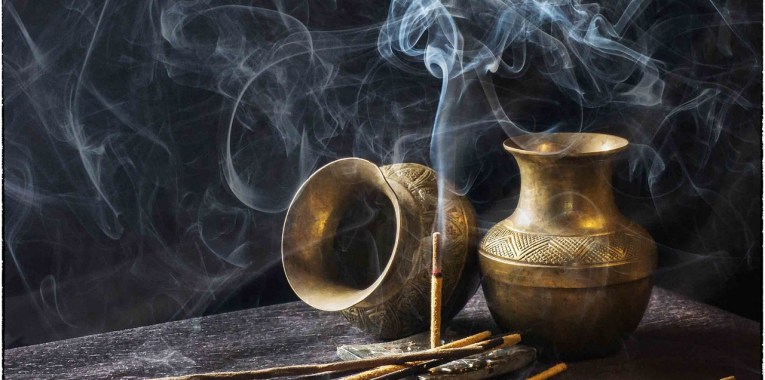
The altar of incense was there for the burning of incense. It’s kind of in the name. The smell of the incense was to create a unique aroma to the space that gave the priests a constant reminder that they were in the presence of God. They were to be in a constant state of prayer when they were in the tabernacle. Of course, understanding what this would have been like and what it was for requires us to properly understand the purpose of prayer.
The priests were not to be in a state of constantly asking God for things. That’s not the point of prayer. Prayer is about building a relationship with God. It is the primary vehicle for that to happen just like open, back-and-forth communication is the primary vehicle for developing a relationship with anyone else. The smell of the incense reminded the priests that they needed to be constantly pursuing a deeper and more robust relationship with God. They needed to be doing this so they could effectively serve as intercessors for the people before God. It was an invitation to them – and through them to the rest of the people – to be engaged with the spiritual disciplines.
A spiritual discipline is an activity designed to deepen our love for, trust in, and understanding of God the Father through Jesus at the direction of the Holy Spirit. There are all kinds of spiritual disciplines. They are all worthy of our time and attention at different points in our lives. Depending on the particular season we are in, one discipline or another may be more helpful in terms of successfully directing our attention more fully toward God than it otherwise is without that help. Yet while some disciplines can be pursued more occasionally and in certain seasons, others should unquestionably be pursued daily. Into this last category we can place things like prayer, engaging with the Scriptures (both casually and in more serious study), and engaging with the church body.
The challenge with these more regular disciplines, though, is how much we should do them. Like I said before, it is easy to get into the mindset of thinking that however much we are pursuing them, the right amount is more than we are currently doing. The danger to this thinking is that we can shift in our motivations from pursuing a deeper relationship with God to striving for a religious activity because of some misplaced guilt over a perceived lack. If we are pursuing the spiritual disciplines as little more than guilt-driven religious activities, we are wasting our time. They won’t do us any good. They won’t draw us closer to God in Christ and will in fact be more likely to push us away from Him as we gradually grow to resent Him thanks to the guilt we feel hanging over our heads every time we do something in pursuit of Him. What’s more, they won’t do us any good because if we are driven by guilt, then we’re not really pursuing them to build a relationship with Him in the first place. We’re pursuing them so we don’t feel so badly about ourselves.
So then, what is the right amount in terms of pursuing the various spiritual disciplines? The answer is that it depends. Because of what prayer fundamentally is, we can be in posture of prayer all the time. We can treat God like He is with us at every moment because through the Holy Spirit He is with us at every moment. This means we can always be engaging with Him that way. Engaging with the Scriptures is something that should probably done at least daily. Some days will allow for more time for that than others, but making this particularly important vehicle for understanding God’s character and plans more fully a priority is worth the effort it takes to do that. As for engaging with the church, that should be done at least weekly at the worship gathering, but if there are opportunities beyond that for fellowship and community Bible study and prayer, those will be exceedingly worthwhile time in terms of developing your spiritual life in healthy ways. As I regularly tell my people around here: If you want to grow in your faith, you need to do those three things. If you don’t do all of them, you won’t grow. You’ll at most plateau. If you do them consistently and intentionally, you just about won’t be able to help growing.
In the end, what the altar of incense was about – encouraging regular, prayerful intercession on the part of the priests, is yet another function that Jesus fulfills better than they could. We can turn to Him in prayer and through the other spiritual disciplines because He is always on the job. He doesn’t have to worry about purifying Himself so that He can get face to face with the Father. He’s permanently there, raised to glory after His sin-defeating death on the cross. Because He dwells in us through the Holy Spirit, He knows our needs far better than the priests ever knew the needs of the people. And He doesn’t get tired or grow old. He’s constant. He’s eternal. And He’s for us. Thanks be to God for this indescribable gift.
And, because we are back to another physical part of the tabernacle, here’s a quick artist’s rendering of what it might have looked like.
“This is what you are to do for Aaron and his sons based on all I have commanded you. Take seven days to ordain them. Sacrifice a bull as a sin offering each day for atonement. Purify the altar when you make atonement for it, and anoint it in order to consecrate it. For seven days you must make atonement for the altar and consecrate it. The altar will be especially holy. Whatever touches the altar will be consecrated. This is what you are to offer regularly on the altar every day: two year-old lambs. . .I will consecrate the tent of meeting and the altar; I will also consecrate Aaron and his sons to serve me as priests. I will dwell among the Israelites and be their God. And they will know that I am the Lord their God, who brought them out of the land of Egypt, so that I might dwell among them. I am the Lord their God.” (CSB – Read the chapter)
The old covenant was complicated. There were all kinds of rules and regulations to keep. If you touched the wrong thing at the wrong time or in the wrong way, you had to be made clean which required time and sacrifices to deal with. If you sinned, that required more sacrifices which meant more time and money lost. It was all just a lot. No one could have remembered it all. The average person was reliant on the priests to help them know what to do and when which gave the priests a ton of power. And everybody knows how well priests with lots of power tend to do. It worked for what it was, but it wasn’t ever intended to be God’s final plan. It did point to it, though. As we finish up our discussion of the ordination process, let’s talk about where it was pointing, and what we have today.




 The Nexus