
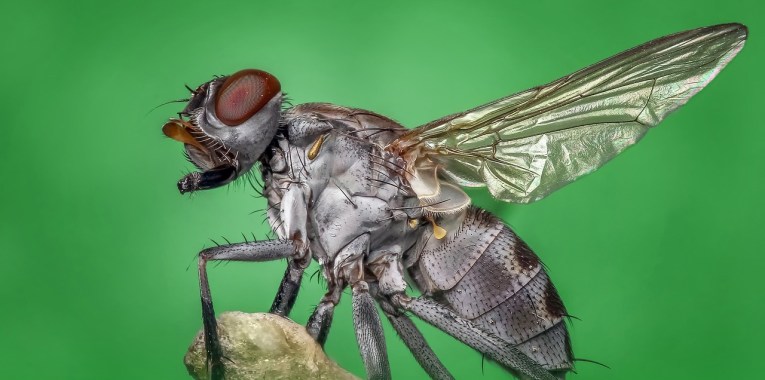
“The Lord said to Moses, ‘Get up early in the morning and present yourself to Pharaoh when you see him going out to the water. Tell him: This is what the Lord says: Let my people go, so that they may worship me. But if you will not let my people go, then I will send swarms of flies against you, your officials, your people, and your houses. The Egyptians’ houses will swarm with flies, and so will the land where they live. But on that day I will give special treatment to the land of Goshen, where my people are living; no flies will be there. This way you will know that I, the Lord, am in the land, I will make a distinction between my people and your people. This sign will take place tomorrow.'” (CSB – Read the chapter)
I hate flies. Are you with me in that? A few months ago, the doors of the building where my office is located were left open for an extended period of time and flies got in. Lots of flies. And they all seemed to wind up in my office. I systematically hunted them down and killed them one by one. I had to. I wasn’t going to be able to get any work done until I did. The next plague God sent against the Egyptians was the plague of flies. With this fourth plague, what has become the standard script changes just a bit. Let’s talk about what’s different here and how God demonstration of HIs power to Pharaoh is developing.
I always wonder a bit just how much time there was between the various plagues God brought on Egypt during this sequence. After the Nile and the waters around it turned back from blood to water, how long was it before frogs started hopping out of them? Once they finished burning all the smelly piles of dead frogs, how long was it before gnats started rising out of the dust? And then, how long of a reprieve did they have before the flies buzzed into town? I guess it really doesn’t matter how long there was between individual plagues. However long it was, it wasn’t long enough. It would not have been very much fun to be an average Egyptian in those days.
And these flies weren’t like our normal, if irritating, house flies. These were probably biting flies that were more along the lines of our horse flies. This plague would not have been fun. I mean, none of them would have been particularly enjoyable – they were all plagues, after all, which tend to be bad by definition – but this one would have definitely been worse than the last three. They were all super inconvenient and irritating, but not physically painful. Now things were getting ratcheted up a notch. They were getting more personal and, yes, more painful.
This fourth plague begins a new sequence of three. As such, it introduces some new things into the mix while also remaining connected to what has already been. Here, we find ourselves going back to God’s giving instructions for Moses to go to Pharaoh to actively announce what is coming. Like with the very first plague, this one also has Moses going to meet Pharaoh when he is going out to the water early in the morning.
There is a sense in which things are restarting, giving Pharaoh and all of Egypt the chance to respond positively to God’s commands instead of stubbornly refusing to play ball. The past is done. Now is their chance to write a new future that doesn’t include any further suffering or pain. This cycle of three series of judgments with opportunities for repentance built into them is a pattern we will eventually find repeated in Revelation. God’s story is indeed a symphony with themes getting developed and repeated throughout the work.
This plague, however, introduces something new as well. This time, instead of the misery being shared equally by everyone in the nation, apparently including the Israelites, God announces through Moses that He is going to make a distinction between the Egyptians and His people. The flies will torment the Egyptians, but in the land of Goshen where the Israelites lived, there wouldn’t be any. These plagues were designed to bring misery to Pharaoh and his people and now they would start to do so with greater specificity than they had before.
God is working to make it increasingly undeniable that what is happening isn’t some mere quirk of nature, an unfortunate twist of fate, or the work of some minor god (if there was such a thing). This is all the work of the God of Israel, the one true God, the God who created the world and everything in it and has total sovereignty over every single part of it. Pharaoh is not doing battle against some false deity whose followers he can intimidate into submission by sheer force of will. He is attempting to go toe to toe with the God who created him and granted him whatever meager authority he happens to exercise over a tiny slice of humanity for a limited set of years. This is not a battle he can win. Yet God’s approach is not to show up with overwhelming power and force his hand from the start. He is showing remarkable restraint in gently turning up the pressure in hopes that Pharaoh will respond with repentance of his own volition. Of course, God knows he won’t because He knows the real start of Pharaoh’s heart, but He’s giving him the opportunity all the same because that’s the kind of God He is.
God also wants Pharaoh to understand something: the things that are happening to Egypt are directly linked to his refusal to let God’s people go. The coming and increasingly severe punishments for his disobedience are going to fall on Egypt and Egypt alone. God’s people will be spared from them. As we will see in coming days, Lord willing, when things start getting really bad, He will offer a way out of the worst of it to all those in Egypt who are willing to trust in Him and obey His word.
Our God is not one who punishes indiscriminately. He does not delight in judgment. He is capable of bringing judgment with a hammer, yes, but He is also capable of bringing judgment with a scalpel. He is just. When His judgment comes, He will bring it on those who deserve it. Those who don’t will be spared. Of course, no one is undeserving of judgment on their own. Our only hope is in Christ. He alone is worthy of reward. We receive grace when we are willing to trust in Him and what He accomplished. Then, when the final judgments are issued, we will join Him in the eternal land of Goshen where there will be no flies.
 The Nexus