
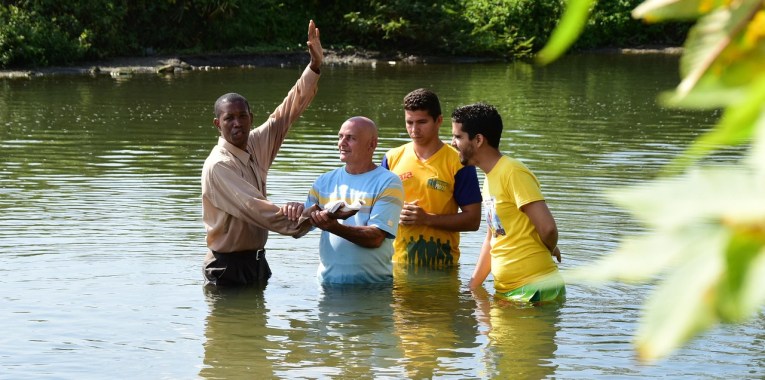
“Or are you unaware that all of us who were baptized into Christ Jesus were baptized into his death? Therefore we were buried with him by baptism into death, in order that, just as Christ was raised from the dead by the glory of the Father, so we too may walk in newness of life. For if we have been united with him in the likeness of his death, we will certainly also be in the likeness of his resurrection.” (CSB – Read the chapter)
I am a Baptist preacher. We Baptists love baptism. It’s kind of in the name. And when we say the word, we mean it with its original Greek meaning. The word batidzo, from which our English word is merely a transliteration rather than a translation, means to immerse something in water, not to merely sprinkle some water over it. One of the two things that makes a Baptist church a Baptist church is a requirement that a person has been baptized before they can be a member. Yet as important as the practice is to us, we didn’t invent it. In fact, Christians generally didn’t invent it. Lots of religions used some form of baptism as an initiatory and cleansing rite. We simply took something that was already in existence and added our own unique symbolism to it. Here we find Paul talking about some of that symbolism. Let’s walk through this with him.
One of the things we see God doing throughout the Scriptures is meeting people where they are, entering into the things they already knew, redeeming those, and using what they already know to point them toward Him. The reason He can and does do this is that in spite of the fact that much of the world doesn’t know Him or have much interest in Him, He nonetheless created it. All people are still made in His image whether they understand and embrace that image or not. Because we are created in His image, even when we are not in a right relationship with Him, we still reflect His basic character. That reflection may be broken and incomplete because of sin, but even a dirty mirror will reflect the sun when it happens to be positioned just right.
We see this in the ordinance of baptism. When Jesus was on His way out the door, so to speak, one of the last things He said to the disciples was recorded for us in Matthew 28:19-20. “Go therefore and make disciples of all nations, baptizing them in the name of the Father and of the Son and of the Holy Spirit, teaching them to observe everything I have commanded you. And remember, I am with you always, to the end of the age.”
All of this is to be done while we are going – that is, while we are out pursuing the path down which He is calling us. And what is to be done? We are to make disciples. That’s the basic command here. In translations like this one it looks like the command to go is primary, but a translation that better captures the sense of the Greek would be something like, “As you are going…” The going is assumed. Make disciples is the command.
Jesus then goes on to tell us two things we are to be doing with these disciples that we make. The second one is that we are to teach them to observe (obey) everything Jesus commanded. Well, Jesus gave one primary command: love one another as I have loved you. All the rest is just commentary on that. The first thing Jesus tells us to do with the disciples we make is to baptize them. In other words, we are to initiate them into the club, and then we are to teach them to be good members.
This command is why baptism has always been such a big deal to the church. There have been plenty of debates over how it should be practiced, and those will in all likelihood continue. And, personally, theologically, I think there is a position in that debate that is most correct. I am convinced and committed to the idea that baptism should be by full immersion in almost every instance except where that is medically or physically impossible for some reason. That is, baptism involves dunking a person totally underwater.
What is probably the single most important factor in determining where a person falls on this particular debate is not a mechanical question, but a theological one. What does baptism actually do. That it should be done is clear. Jesus commanded it here and that settles that part of the question. But what does it actually do?
Some folks hold that baptism plays some kind of a role in extending God’s grace to us in a way that is not otherwise accessible. If this is the case, then the earlier someone can be baptized, the better. In fact, if this is the case, then this grace should be granted to a person before she is even able to make a conscious decision to follow Jesus.
This thinking lies behind the practice of baptizing babies. You cannot, however, fully immerse a baby in water even though that’s what the original Greek word actually meant. You have to settle for sprinkling them with a little bit of water. This is why so many church traditions practice infant baptism.
I don’t think that’s correct. I have yet to come across or read anything in the New Testament that would give credence to that approach to baptism. At the same time, though – and this is important – I also don’t see anything that gives credence to the idea that baptism is somehow a necessary precursor to following Jesus. Jesus commanded it as an initiation rite, but He did not say that someone couldn’t follow Him without having experienced it.
Because of this, just because someone reads the same Scriptures I do and concludes that baptism confers grace in such a way that it should be given to babies doesn’t mean they aren’t seeking to follow Jesus and advance the Gospel as much as I am. They are still my brothers and sisters in Christ. We may worship in denominations that reflect our theological conclusions on the question of baptism, but we are still part of the same universal church even if we are in different expressions of it. We are not divided on the questions that matter most.
What I see in the New Testament in passages like this one from Paul is teaching pointing toward the conclusion that baptism is a symbol. It is an important and powerful symbol. It is powerful enough that churches like mine insist on a person’s having had the opportunity to experience it before membership will be extended, but it is still only a symbol.
Indeed, I have recently baptized a number of folks who were sprinkled as babies in another tradition. This doesn’t mean I think their experience didn’t matter or wasn’t spiritually significant for them. It means that I don’t think they experienced baptism as Jesus and the other New Testament authors commended and the early church practiced. If they are going to be fully aligned with my church as a member, then given my church’s position on baptism, they need to be baptized in accordance with how we believe it should be practiced. A member of a Baptist church who hasn’t been baptized would be a little like someone’s being a member of a swimming club but not knowing how to swim. It wouldn’t make sense.
But again, what does this symbol mean? Paul tells us here. When we are baptized, we are proclaiming our spiritual participation in the death of Christ. “Or are you unaware that all of us who were baptized into Christ Jesus were baptized into his death?” Jesus died so we don’t have to. When we align our lives with Him by placing our faith in Him as our Savior and Lord, we are aligning ourselves with every part of who He is and what He did including His death to pay the price of sin. When we go under the water, it is a proclamation that we have spiritually died and been buried with Him. What He did, He did for us, and we receive it in its entirety.
If we are participants in His sin-defeating death, though, we also get to be participants in His life-giving resurrection. “Therefore we were buried with him by baptism into death, in order that, just as Christ was raised from the dead by the glory of the Father, so we took many walk in newness of life.” Jesus died. Jesus rose. When He came walking back out of that grave on the third day, He did so with a new body that was fit for eternity. Death no longer has any dominion over Him or those who are in Him. In Christ, Paul says, we are new creations. The old is gone and the new has come. Our sins are forgiven and we can walk in the freedom of life. “For if we have been united with him in the likeness of his death, we will certainly also be in the likeness of his resurrection.”
This is what our baptism proclaims. The baptism doesn’t make any of it happen. Rather, it is a public proclamation that it has happened within us. Every baptism is an opportunity to proclaim the Gospel so that others may see and hear and be drawn to it themselves. Accordingly, every time I baptize someone, I tell the congregation what is happening. There’s nothing magic about those waters. Nothing is happening spiritually in that moment that is making the person different than she already is in Christ. But she is living in obedience to His command in such a way that makes her identification with Him public. That brings a level of accountability all disciples need. And, she is naturally inviting others to be disciples with her. That puts her further in line with Christ’s authority and command.
If you are a follower of Jesus and haven’t experienced the power of this symbol, I would encourage you to find a church that practices it and join them so that you can. It won’t save you, but it will put you in line with the path of Christ in a spiritually significant way. I hope you will.
 The Nexus
This you may find interesting.
It is a post detailing the correct chronology of the NT and the implications.
LikeLike
Actually Paul’s faith was created by a loss of vision….his own on the road to Damascus.
LikeLike
Actually Paul’s faith was created by a loss of vision….his own on the road to Damascus.
LikeLike
That may not have created his faith, but it certainly got his attention. Good observation on that. I hadn’t thought about that.
LikeLike