
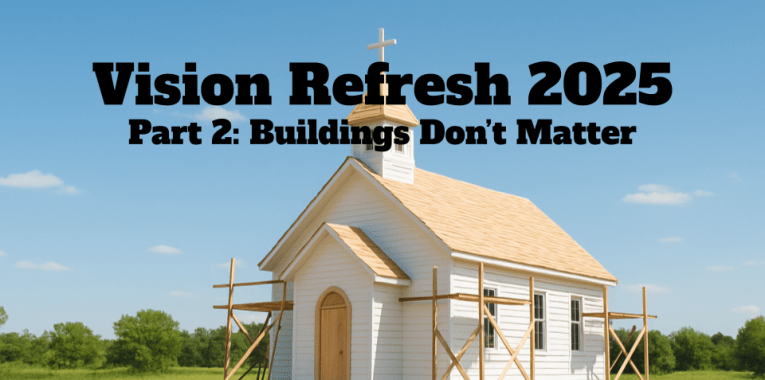
Last time we talked about the fact that buildings can play a significant role in our efforts to advance God’s kingdom. Not every church has a facility from which to launch their kingdom-advancing efforts, and God doesn’t need buildings to do that, but the ones that do and use them well have a powerful ministry tool at their disposal. It is a good thing that we are preparing to build a building at my church. But in the grand scheme of things, buildings don’t advance God’s kingdom. The church does. Let’s talk about it.
Buildings Don’t Matter
I am not a church planter. Unless God does something dramatic—which I am not anticipating in the least—that’s not going to change. I’m pretty comfortable in the knowledge that He has called me to pastor churches that already exist—like this one…where I plan to be for a very long time. Now, I support church planters. I think they do good and important work. But If I’m being totally honest, I struggle some with the knowledge of just how many churches are out there that already exist and which need good pastors to lead them back to health and relevancy in their communities.
One of the major struggles of church plants is often finding a facility where they can meet. The church Nate and Marisa are involved with up in Fredericksburg is currently without a building. They have broken themselves down into small groups that are meeting in homes all over the city where they are continuing to do good work. Existing churches, though, don’t typically have that particular challenge. They already have buildings. Sometimes those buildings are older and in need of some work, but they’re paid for. Oftentimes, they’re even just sitting there mostly empty, waiting to be used.
Now, church planting is still necessary because having a church in a place where there aren’t very many people generally, and lost people in particular, doesn’t help get new people into God’s kingdom very well, which is one of our primary goals. But what are we supposed to think about all those mostly empty churches waiting to be filled with people? Well, it wouldn’t be a bad idea to ask how they got empty in the first place. I know that’s not a terribly comfortable question—especially for the people in those churches—but uncomfortable doesn’t mean unnecessary.
The reasons churches decline and dwindle are many. It would be simplistic to try to ascribe that state of affairs to a single cause. But at the risk of being simplistic, can I suggest a cause that lies at the heart of many fading and dying churches? At some point along the way, they stopped being the church. Oh, they still hit the mark every now and then, but on the whole, they’ve departed from their core mission of making disciples who make disciples, and have gotten focused instead on a variety of other things that, while perhaps good, aren’t core to their mission as a church.
And for these churches that have dwindled down to almost nothing because of their losing sight of who God designed them to be, having buildings that church plants don’t isn’t helping them. A building can certainly make life easier and more convenient for many churches; it can certainly enable them to do much good, Gospel ministry that would otherwise be much more difficult to accomplish, but a building doesn’t make a church. A church makes a church. And this morning, I want to talk with you about the importance of being the church.
This morning we are in the second of our two-part conversation taking a fresh look at where God is leading us as a church especially with our plans to expand and renovate our facilities in mind. It has been just almost a year now since we together pledged to give sacrificially above and beyond our normal giving to see God’s plans for a new worship space and renovated Bible study space come to fruition. We aren’t moving dirt and stacking sticks and bricks just yet, but we’re close. And as we prepare to celebrate Homecoming and God’s goodness to us throughout the years next week, it seemed worthwhile to remind ourselves of just what God has called us to do and why that still matters so very much.
Last time, with the writings of the Hebrew prophet, Haggai, as our guide, we talked about the fact that buildings matter in our pursuit of God’s kingdom. Having a space where we can concentrate our efforts to make disciples who make disciples, and from which we can launch our efforts to bless our community and beyond is a good thing. Being able to serve our community with our facilities is a good thing. Having a centralized location where young people can come to experience the church at its best, and where they can learn to love the church because of that experience—an experience you are helping them to have week after week—is a good thing. God is doing a work in this community, and He is using the facilities He has given us to advance it. As He leads us forward to add to our campus, then, He is going to use those additions to see this work continue and expand.
If you’ll remember, though, I told you last time that over the course of these two weeks we were going to look at two ideas which when set side-by-side seem completely contradictory of one another. If the first from last week was that buildings matter in our pursuit of God’s kingdom, this week we are indeed going to flip that on its head. Buildings don’t matter in our pursuit of God’s kingdom. Yet we’re not going to flip that around the opposite way just for fun or to be cute. We are going to do that for a very specific reason. As much as buildings really do matter in our efforts as a church to grow the kingdom of God, I want us to be very clear about the fact that buildings aren’t ultimately what advances God’s kingdom; the church is.
In a day when many churches have increasingly fancy and sophisticated buildings—and in a season when we are aiming to build a building to help us advance God’s kingdom more effectively than we already are—this is sometimes an easy fact to forget. Things are made even muddier here by the fact that we so often conflate churches with buildings, using the same word to describe two things that while connected are nonetheless distinct. I don’t say any of that as a means of scolding us, though, but rather merely observation. We can find some comfort perhaps in the fact that we are not the first people to suffer from this confusion when and where we do. We can actually find evidence of the idea that buildings play a role in the advance of God’s kingdom all by themselves all the way back in the New Testament. I’d like to take a look at one particular example of this with you this morning.
If you have a copy of the Scriptures handy, find your way with me to Acts 6. Acts is Dr. Luke’s record of the growth and spread of the early church. The first half or so of the record focuses on the growth of the church in Jerusalem and the regions surrounding it. The second part gives most of its attention to Paul’s efforts to take the Gospel to the rest of the known world. The whole story is structured around Jesus’ directive to the disciples shortly before His ascension back to the Father to be His witnesses in Jerusalem, all Judea and Samaria, and to the ends of the earth.
In Acts 6, we find the church dealing with a ministry issue that resulted in the creation of the first deacons. One of this original group of seven was a man named Stephen. Stephen may have started his ministry focused on the ministry issue that resulted in his elevation to a position of leadership in the church, but his incredible giftedness as an evangelist quickly saw him go beyond that to active community engagement. The trouble was that the community wasn’t thrilled with his engagement. More specifically, the church’s Jewish opponents found in Stephen a man who could be the object of their ire. Because of the miracles the apostles had done, and the stories about Peter’s word of judgment resulting in the deaths of Ananias and Sapphira, nobody wanted to mess with them. Stephen didn’t have that kind of a reputation, though, so he became the next most convenient target.
The trouble for Stephen’s opponents, though, was that he was smarter than they were. And he had the Holy Spirit. From Acts 6:9: “Opposition arose, however, from some members of the Freedmen’s Synagogue, composed of both Cyrenians and Alexandrians, and some from Cilicia and Asia, and they began to argue with Stephen. But they were unable to stand up against his wisdom and the Spirit by whom he was speaking.”
Undeterred, they switched from legitimate means of attack to illegitimate ones. Verse 11 now: “Then they secretly persuaded some men to say, ‘We heard him speaking blasphemous words against Moses and God.’ They stirred up the people, the elders, and the scribes; so they came, seized him, and took him to the Sanhedrin. They also presented false witnesses who said, ‘This man never stops speaking against this holy place and the law. For we heard him say that this Jesus of Nazareth will destroy this place [that is, the temple] and change the customs that Moses handed down to us.’”
So, because they couldn’t out-argue Stephen, they attacked his message with lies wrapped in a veneer of truth. What these critics were referencing here is almost certainly one of the lines of attack used against Jesus Himself in His sham trial before the Sanhedrin where Stephen now was, before He was sent to the cross. From Mark 14:55: “The chief priests and the whole Sanhedrin were looking for testimony against Jesus to put him to death, but they could not find any. For many were giving false testimony against him, and the testimonies did not agree. Some stood up and gave false testimony against him, stating, ‘We heard him say, “I will destroy this temple made with human hands, and in three days I will build another not made by hands.”’ Yet their testimony did not agree even on this.”
Earlier in Jesus’ ministry, the first time He made a big scene in the temple of driving out the moneychangers and vendors, Jesus was challenged to provide proof of His authority to speak such a word of condemnation against the temple system. From John 2:18: “So the Jews replied to him, ‘What sign will you show us for doing these things?’ Jesus answered, ‘Destroy this temple, and I will raise it up in three days.’ Therefore the Jews said, ‘This temple took forty-six years to build, and will you raise it up in three days?’” John goes on to explain that Jesus was using a metaphor for His coming death and resurrection, but no one understood it at the time. Not even the disciples got it until after the resurrection.
Stephen had likely at some point referenced this exchange, and so his opponents, like Jesus’ opponents before him, were using it as a line of attack that seemed legitimate, but which was really a distortion and misunderstanding of the truth. And the reference to Jesus’ wanting to overturn the customs of Moses goes no doubt goes straight back to the Sermon on the Mount where Jesus declared over and over again, “You have heard it was said…but I say to you,” and then went on to offer a fresh take on something in the Law of Moses. So, Stephen’s opponents weren’t lying outright, but they were being pretty intentionally deceptive all the same.
In response, then, Stephen offers this lengthy self-defense, recorded for us in Acts 7. He launches into this long review of Israel’s history during the Exodus through the wilderness in order to dispute the accusation that he was saying something against Moses. He points out that Moses himself was rejected by the people in his calls for the people to be faithful to God and God alone. When Moses lingered too long on the mountain, receiving the Law from God that Stephen’s opponents held so dear, the Israelites then goaded Aaron to make a calf idol for them to worship. They rejected God in other ways at other times as well during the Exodus journey. These rejections persisted to the point that God finally rejected them and sent them into captivity in Babylon.
This part of his defense climaxes in v. 37: “This is the Moses who said to the Israelites: ‘God will raise up for you a prophet like me from among your brothers and sisters.’” In other words, Moses, who was rejected by the people over and over in favor of their own worship preferences, prophesied that God was going to send another prophet just like him. This other prophet would be just like him not only in his message and ministry, Stephen is implying, but in his being rejected by the people. That is: Jesus is this prophet Moses foretold. Stephen wasn’t saying anything against Moses. He was pointing to Jesus who was the fulfillment of Moses.
As for his speaking against the temple, Stephen addresses that in the next section, which is what I really want us to not miss this morning. Listen to this now from v. 44: “Our ancestors had the tabernacle of the testimony in the wilderness, just as he who spoke to Moses commanded him to make it according to the pattern he had seen. Our ancestors in turn received it and with Joshua brought it in when they dispossessed the nations that God drove out before them, until the days of David. He found favor in God’s sight and asked that he might provide a dwelling place for the God of Jacob. It was Solomon, rather, who built him a house…”
In other words, and like we talked about last week, the people had the tabernacle from God. That was His plan. But David wanted to build a temple. Solomon actually built the temple. They built it to be a dwelling place for God. Just like all the other peoples had temples where their gods lived, David wanted to build God a house where He could live. This wasn’t pagan thinking on David’s part, but a genuine desire to honor the God who had done so much for him, but it nonetheless resulted from an idea about God that wasn’t true.
Look at v. 46 now: “…but the Most High does not dwell in sanctuaries made with hands.” And to prove his point so his opponents couldn’t accuse him of just making things up, Stephen goes on to quote from the prophet Isaiah: “…as the prophet says: ‘“Heaven is my throne, and the earth is my footstool. What sort of house will you build for me?” says the Lord, “or what will be my resting place? Did not my hand make all these things?”’”
So, what’s Stephen’s point here? His point is that God didn’t—and doesn’t—dwell in a building. He’s far too big for that. The Jews in the first century imagined that the presence of God was somehow contained to the temple. Yes, they called Him the Lord of Heaven and Earth, but the temple was His house. That’s where He lived in their minds. Stephen’s argument is that accusing him of speaking against the temple as if that was offensive to God doesn’t make any sense. The temple isn’t where the presence of God is contained. He may have met the people there to receive their worship, but how could the one who made the world and everything in it be imagined to dwell in a house made by the things He Himself made? The simple answer is that He couldn’t.
We’ve talked before about the fact that we get our word “church” from an old German word that meant, “the house of the Lord.” The first century thinking that Stephen was trying to counter here leaked into the church anyway. Yes, the church—what Jesus originally called His ekklesia—is the physical representation of Christ on earth. We are the ones in whom God’s Spirit dwells. And though His Spirit dwells in each of us individually as His followers, the power of His Spirit in us is unleashed properly when we are operating together as a body. God doesn’t bless Lone Rangers to go off and be fruitful apart from the church body. And, yes, it’s often true that a particular local expression of the body of Christ has met together in a finite, physical location—that is, a building—in order to have a kind of home base from which to pursue the advancement of His kingdom into their community and beyond.
But when we start making too great a connection between the people who make up the church and the place where they most frequently gather to do a great deal of their kingdom work, we introduce the potential for ideas that can lead us away from that work’s happening like it should. If we do that we’ll either start to guard our facilities so jealously that we cease to use them as a ministry tool to bless our community, or we’ll look to a building as a solution to things it was never intended by God to be a solution for.
Building a building may get some curiosity seekers to come to church—and I suspect we’ll see at least some of that happen—but it won’t by itself connect anyone to the Gospel. If a church is dying and happens to have dumpy facilities, a new or renovated building won’t by itself help them get turned around in a growing direction again. Buildings don’t advance God’s kingdom; the church does.
Can a church use a building to advance God’s kingdom? Of course it can! I made that point rather emphatically to you last week. We wouldn’t be doing what we are doing if that weren’t the case. But while this building and the renovations we are going to pursue with it have all the potential in the world of helping us to be more fully the church God has called and equipped us to be, neither of those things by themselves will accomplish anything. Buildings don’t advance God’s kingdom; the church does. There are too many empty buildings that used to hold churches for us to think otherwise. Buildings don’t advance God’s kingdom; the church does.
What this means is that we’ve got to be the church. The things we have been doing without a new sanctuary space or renovated educational space are the same things we need to still be doing when we do have those. If we aren’t pursuing with intentionality and passion the kingdom-advancing things God has set before us now, having a new space isn’t going to make us any more likely to do them. Oh, there may be a veneer of it for a little while if for no other reason than the excitement of the project, but unless the core of our efforts is sound, the veneer will wear off quickly, leaving us with nothing but a big, empty building. Buildings don’t advance God’s kingdom; the church does.
Okay, so then how do we do this? Well, who do I tell you every single week that God made us to be? We are a people with whom anyone can connect to grow in Christ and reach out for His kingdom. We can start by making sure we are pursuing that at every point in our organization. We keep being the incredibly welcoming and friendly church that we are, receiving everyone who comes in our doors with graciousness and hospitality, making sure they know we are glad they are here because we love people. We keep pouring into the Gospel community that is happening on Wednesday nights, keeping open wide a boulevard of grace for folks who want to be a part of what God is doing here, but can’t get here on Sunday mornings for one reason or another. Making sure that every single person who walks in our doors knows they are beloved of God and welcomed to be here is worth all the effort we can give it.
We must also strive to be growing in Christ together. This means that we make it our goal to see every single person connected with this community here not only on Sunday mornings, but is connected in a Sunday school group and engaged with Bible study on Wednesday nights so that we are all engaged together with God’s word to the end of growing in our knowledge and understanding of the faith. If you are already connected in one of these groups, and you see someone who isn’t yet connected, invite them to join your group. If you are at a point in your journey with Jesus where you’ve been following Him for several years, you need to be actively considering who you can take under your wing in order to mentor them along in the faith. If you aren’t engaged with helping lead our kids and youth to experience the wonder of the Gospel through the church in some way, you probably need to consider that. If you are someone who connects through worship, Wes is always looking for more folks to be involved in our worship ministries. All of this and more lies at the heart of making disciples who make disciples, which is one of our core callings as a church.
In addition to connecting and growing, we need to be reaching out for His kingdom together. Doing ministry here is necessary and important, and every single person who is a member here should be involved in serving in some capacity. That’s why God put you here. But ministry here can’t be the sum total of our activity as a church. Needs abound in the community around us. We are surrounded as well by great ministries who are doing a ton of great legwork to uncover what those needs are so churches like ours can come along and meet them. From West Stanly Christian Ministries to Faith Alive Ministries to the Coalition for Christ, there is no shortage of ways to connect with missions opportunities in our backyard.
There are opportunities beyond our own community too. The Baptist State Convention has multiple mission camps across the state where we can send teams to serve on short-term projects in areas of high need. Our local group of Baptist churches, the Uwharrie Baptist Association, is intentionally developing a partnership with a ministry in New England in hopes of creating a partnership pipeline for being a part of advancing the Gospel in one of the most spiritually dark places in the entire world. (New England is less Christian than China!) Beyond even this, the Baptist State Convention has several international partnerships that offer opportunities to be a part of taking the Gospel to the ends of the earth.
We could keep going beyond this, but we’ll be here all day. The point here, though, is simple: We’ve got to be the church if we want to see God’s kingdom advance. We’ve got to be the church God made us to be. We’ve got to be a people with whom anyone can connect to grow in Christ and reach out for His kingdom. If we don’t hit that mark, all the buildings in the world won’t make the slightest bit of difference. Buildings don’t matter if we aren’t the church. Buildings don’t advance God’s kingdom; the church does.
But when we are committed to being the church God made us to be, those same buildings that don’t make any difference when we’re not suddenly become flush with significance. They can be the difference between doing a little bit of ministry; of doing a little bit of disciplemaking; of doing a little bit of missions, and absolutely blowing the doors off because of how much kingdom-advancing is going on here. This is because when we commit ourselves to being the church—fully the church our God in Christ and by the power of the Holy Spirit has made us to be—we have the power of the God who said, “Heaven is my throne, and the earth my footstool,” flowing through us. When He asked “what sort of house will you build for me?” we can give Him our answer: We are the house. Buildings don’t advance God’s kingdom; the church does. And when we are the church, God’s kingdom will indeed advance.
So, let’s be the church. Let’s build a building. And let’s see just how far God plans to advance His kingdom through us. I can’t wait, and I hope you can’t either.
 The Nexus