
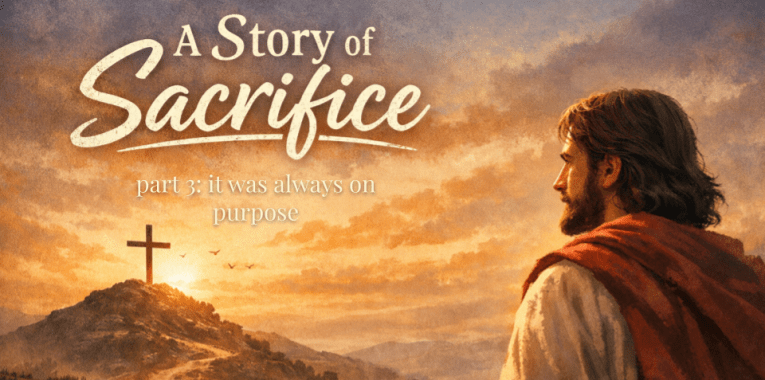
The idea of something being the beginning of the end seems odd. Endings should just be endings, not beginnings. And yet, the sequence of things that lead to that end have to begin somewhere. The final beginning of Jesus’ end in this life started with dinner. It unfolded from there into a series of events that looked from the outside-in like they were all spiraling out of control, making Jesus a helpless victim of His circumstances. Yet nothing could be further from the truth. Nothing Jesus did ever happened by accident. The things that happened to Him weren’t an accident either. As we continue our journey through Luke’s Story of Sacrifice this week, we are talking about just how in command Jesus really was. Let’s dive right in.
It Was Always on Purpose
In the late 1500s, an English Protestant preacher and scholar named John Foxe wrote a book that quickly became an enduring spiritual and devotional classic. Foxe’s Book of Martyrs sought to tell the stories of believers who had been persecuted for their faith, many of whom paid the ultimate price in that persecution. His goal was to encourage other believers with these powerful stories to perform great acts of faith and faithfulness in their own lives. These kinds of stories are indeed powerful. They are inspiring. Hearing gripping stories about incredible acts of devotion has a way of motivating copycats in the best possible sense. It can encourage those who are facing similar troubles in their own lives. It can grow the church in remarkable ways. As the early church father, Tertullian, once wrote, “The blood of the martyrs is the seed of the church.”
One of the more awe-inspiring such stories from the last generation happened just over a decade ago. A group of 20 Coptic Christians from Egypt along with one man from Ghana who happened to be in the wrong place at the wrong time were kidnapped by Islamic State terrorists from a city in Libya where they were all working. They were taken to a beach on the Mediterranean coast where one by one each man was given a chance to recant his faith on camera. When he refused, he was summarily executed by one of the terrorists. The Ghanaian man wasn’t a believer before that moment, but when his turn came he confessed that “their God is my God,” and joined his new brothers in the arms of Christ.
It’s a powerful story of faith and faithfulness in the face of the utmost of adversity. I tell you all of that to make this observation. While those men refused to be victimized, they were nonetheless victims of their circumstances. They didn’t wake up that morning planning to die. And while they surely knew what their fate would be when the Islamic State terrorists kidnapped them (the barbarity of ISIS was well-known at that time, especially in that part of the world), they weren’t going to do anything to hasten or help the process. They didn’t have any power save the power of their testimony. What their captors wanted was what was ultimately going to happen.
Jesus was a martyr because of His faithfulness to God just like these men were. But unlike these men, Jesus was never merely a victim of His circumstances. And as we get into this next part of our journey to the cross with Luke’s Story of Sacrifice, that’s exactly what I want you to see. This morning we are in the third part of our journey, and the drama is starting to really pick up. This morning, our story starts in a special place that I want to give some intentional attention to before we move on to the rest of the story in just a little bit.
If you have a copy of the Scriptures handy, join me in Luke 22. We’ll start right at the beginning of the chapter. We’ve gotten now to the end of the week. For a solid week Jesus has been antagonizing the religious leaders of the Jews by proclaiming the kingdom of God in public, and by refusing to fall into their traps for Him. The people were thrilled, but these powerbrokers of Jewish society were most decidedly not. Something was going to have to be done, but it was going to have to be done in such a way as to not inflame the crowds lest they cause themselves even more of a public relations headache. Well, much to their delight, an opportunity soon presented itself that was going to give them everything they wanted.
“The Festival of Unleavened Bread, which is called Passover, was approaching. The chief priests and the scribes were looking for a way to put him to death, because they were afraid of the people. Then Satan entered Judas, called Iscariot, who was numbered among the Twelve. He went away and discussed with the chief priests and the temple police how he could hand him over to them. They were glad and agreed to give him silver. So he accepted the offer and started looking for a good opportunity to betray him to them when the crowd was not present.”
So, Jesus was set to be victimized in a way that was entirely beyond His control. If this were a movie, the score would have turned very sinister here before taking a slightly more hopeful turn as the action shifts back to Jesus who seems to be entirely unaware of the machinations of this growing conspiracy. All He seemed to know was that it was time to celebrate the Passover with His disciples. “Then the Day of Unleavened Bread came when the Passover lamb had to be sacrificed. Jesus sent Peter and John, saying, ‘Go and make preparations for us to eat the Passover.’ ‘Where do you want us to prepare it?’ they asked him. ‘Listen,’ he said to them, ‘when you’ve entered the city, a man carrying a water jug will meet you. Follow him into the house he enters. Tell the owner of the house, “The Teacher asks you, ‘Where is the guest room where I can eat the Passover with my disciples?’” Then he will show you a large, furnished room upstairs. Make the preparations there.’ So they went and found it just as he had told them, and they prepared the Passover.”
Now, there’s a lot we could say about the Passover meal and its connections with the story of salvation that is unfolding before our eyes. It was a meal rich with spiritual significance and symbolism. The disciples knew all of this very well as they had been observing it all their lives. Their parents would have taught them all the rituals and refrains. They knew the whole script as all good Jewish children did and still do to this day. Yet as we have said before when we have come to the table of the Lord’s Supper, this Last Supper Jesus ate with His disciples, if they were expecting Jesus to adhere to their expectations, they were about to be sorely disappointed.
“When the hour came, he reclined at the table, and the apostles with him. Then he said to them, ‘I have fervently desired to eat this Passover with you before I suffer. For I tell you, I will not eat it again until it is fulfilled in the kingdom of God.’ Then he took a cup, and after giving thanks, he said, ‘Take this and share it among yourselves. For I tell you, from now on I will not drink of the fruit of the vine until the kingdom of God comes.’”
The kingdom of God comes and is present wherever His rule and reign are recognized among His people. Yet that recognition cannot happen in truth without His help. The people of that day had largely lost the ability to see and experience it thanks to the terrible leadership the religious leaders were giving them. But Jesus was about to fix that. He was about to fix that for them and for us by laying down His life for our sakes. As Isaiah had prophesied some 700 years before, by His wounds we were about to be healed. This healing was something Jesus and later Paul would command His followers to remember as often as we eat the bread and drink the cup.
The bread reminds us of His body which was given in sacrifice for us, to pay the price for our sins. The juice of the cup reminds us that Jesus’ blood was spilled to sign and seal a new covenant with God that would make life possible in Christ where once there was only judgment and death awaiting us in the end. Now, when we place our faith in Jesus as Lord, we receive the rewards He won by His obedience. This morning, at our Lord’s command, we are going to pause to remember and celebrate His great sacrifice together. If you count yourself a follower of Jesus—and especially if you have just recently started that journey and been baptized!—you are welcome to join in this grand celebration with us. If you aren’t there yet, I’m glad you’re here. Hold off on eating and drinking today, and let’s plan to talk soon about where you are and how to move forward in your journey toward Jesus from there.
Well, after having this intimate and meaningful time with the disciples in which He sought to reveal the Father’s plans and prepare them further for what was coming over the next few hours, how do you suppose the disciples responded? With graciousness and commitment? With excitement and passion at the chance to make their faith real? That would be a nice thought but for one, small problem. To understand this problem, let me remind you of our mantra about the disciples over the course of our journey through Matthew on Wednesday nights. The disciples were what? Dumb! They didn’t respond in an even remotely appropriate manner. Instead, they got all hung up on something Jesus said just after supper. Come back to the text with me in v. 21: “But look, the hand of the one betraying me is at the table with me. For the Son of Man will go away as it has been determined, but woe to that man by whom he is betrayed!”
This was the clearest and most specific prediction of His forthcoming betrayal that Jesus had yet made. He had hinted at it before, but not like this. This was explicit and painful. Jesus was indicating that His betrayal would come at the hands of not just some random stranger, but someone eating at this very table. It is perhaps little wonder that the disciples got all hung up on this. But even that they messed up. Instead of worrying about who the betrayer was, they all focused instead on which of them it wasn’t and of how dedicated they were to Jesus. “So they began to argue among themselves which of them it could be who was going to do it. Then a dispute also arose among them about who should be considered the greatest.” It wasn’t simply, “I would never do this!” It was, “I would never do this because I’m more dedicated to Jesus than you are. I’m better than you are at this whole discipleship thing.”
It was just like them to get all hung up on the wrong thing. The circumstances around Jesus were starting to spiral out of control. Instead of being able to give His first and best attention to the task that lied before Him, Jesus was having to play referee for a bunch of bickering teenagers. He was going to wind up the victim of circumstances after all. Or so perhaps the enemy was trying to engineer. Jesus, though, had other plans. And after offering the disciples a quick lesson on who the greatest among them—or among anyone—was, He began to demonstrate to them and everybody else just how fully in control of the whole situation He actually was. He was in command not merely of His immediate surroundings, but of everything everybody else was doing as well.
He started by telling the disciples once again what was coming, beginning with Peter. Verse 31 now: “Simon, Simon, look out. Satan has asked to sift you like wheat. But I have prayed for you that your faith may not fail. And you, when you have turned back, strengthen your brothers.” There’s so much more there than we have time to talk about right now. But just look at how detailed His knowledge of the future is. Satan is going to attack, but I’ve already prayed for you in advance of that. Your faith is going to be challenged, but when you snap out of it and come back around to what you know to be true, help the other guys. Those aren’t the words of a victim. They are the words of someone in charge.
For his part, Peter—who doesn’t remotely understand what is happening—insists that his faith is just fine, but Jesus knows better. “I tell you, Peter…the rooster will not crow today until you deny three times that you know me.” And, of course, we know that is exactly what would happen. Jesus went on to address the rest of the group to tell them to be prepared for the challenges that were facing them. They didn’t understand any better than Peter did, but He gave the warning all the same.
From here, the group left the upper room and made their way to the Garden of Gethsemane on the outskirts of town on the Mount of Olives. How appropriate that His journey would begin its conclusion where it all got started a few days before. John tells us all about the conversation they had on the way. Luke just transports us there. Once in the garden, Jesus went off by Himself to spend some time in prayer. Before doing that, He called them to prayer as well. Verse 40 now: “When he reached the place, he told them, ‘Pray that you may not fall into temptation.’ Then he withdrew from them about a stone’s throw, knelt down, and began to pray. ‘Father, if you are willing, take this cup away from me—nevertheless, not my will, but yours, be done.’ Then an angel from heaven appeared to him, strengthening him. Being in anguish, he prayed more fervently, and his sweat became like drops of blood falling to the ground. When he got up from prayer and came to the disciples, he found them sleeping, exhausted from their grief. ‘Why are you sleeping?’ he asked them. ‘Get up and pray, so that you won’t fall into temptation.’”
Let’s specify something here we don’t often think about: Jesus didn’t want to die on the cross. He wasn’t looking forward to the torture and abuse He knew was shortly coming His way. He was cleared-eyed on the fact that it was indeed coming, but He wasn’t at all excited about it. Would you have been? Of course not. And He was as human as you are. He prayed earnestly in the Garden for another way to accomplish God’s plans for our salvation. He prayed so hard and was so filled with emotional turmoil over it that He experienced a rare medical condition called hematidrosis in which blood vessels near the surface of the skin rupture, causing blood to mix with sweat making it look like a person is literally sweating blood. If ever there was a time Jesus was tempted to use His divine abilities for His own benefit in order to accomplish His Father’s plans in a way other than His Father planned, this was it. But like He called the disciples to do, He prayed hard and God gave Him the strength to not fall into that temptation. Instead, what did Jesus say? “Nevertheless, not my will, but yours, be done.”
In other words—and don’t miss this—Jesus chose the path of the cross. He was extraordinarily intentional in His actions. He knew when He walked into Jerusalem on Sunday how His journey was going to end. He knew all the things that were waiting for Him between where He was and where He would be in a few days’ time by God’s grace. He knew about all the pain. He knew about the betrayal. He knew about the abuse. He knew about the rejection and abandonment by His own friends and followers. He knew all of it. But He chose it anyway. Jesus sacrificed Himself on purpose.
He was the one calling the shots even when everyone else around Him thought they were. When Judas sauntered into the Garden at the head of a mob of soldiers from the temple police to arrest Him, Jesus wasn’t surprised. He calmly called out Judas’ hypocrisy. “Judas, are you betraying the Son of Man with a kiss?” When His own followers asked if He wanted them to resist and then took it upon themselves to answer their own question, attacking the mob, Jesus immediately put a stop to the violence and healed the one person who got caught by it. When the mob started to complete their unjust work, Jesus addressed them almost with a note of sarcasm. “Have you come out with swords and clubs as if I were a criminal? Every day while I was with you in the temple, you never laid a hand on me. But this is your hour—and the dominion of darkness.” Those aren’t the words of a man who is being victimized by His circumstances. Those are the words of a man who is fully in charge of them. Jesus sacrificed Himself on purpose.
When Jesus was arrested and taken to the chief priest’s compound, He didn’t resist. He didn’t fight. He didn’t complain. He just went. He quietly endured the scorn and abuse they heaped on Him. He ignored the outright blasphemy of which the whole group was so very guilty. He didn’t even react when Peter denied knowing Him three times just as He said he would. And when at last the chief priests and scribes convened the Jewish ruling council, the Sanhedrin, and put the question to Him, He spoke with gentleness, but also boldness and clarity. Look all the way at the end of the chapter in v. 67: “They said, ‘If you are the Messiah, tell us.’ But he said to them, ‘If I do tell you, you will not believe. And if I ask you, you will not answer. But from now on, the Son of Man will be seated at the right hand of the power of God.’”
Jesus didn’t have to say that. That was the final ammunition they needed to justify their desire to kill Him. And He gave it to them. He could have simply kept His mouth shut and the whole thing would have fallen apart, collapsing in on itself because of the utter emptiness of their efforts. But He didn’t. Because He had other plans. Jesus sacrificed Himself on purpose.
Let me tell you why this matters, and then we’re finished. This matters because of something the apostle Paul would later write to the Roman church. He told them that God demonstrated His own love for us in that while we were still sinners, Christ died for us. We can focus on the second part of that another time (and we will next week and on Good Friday), but just give your attention to the first part, the part of that establishes the wonder of the second. Jesus’ sacrifice was a demonstration of God’s love for us. The whole ordeal of the cross was an intentional display of God’s love for us in Christ. Jesus sacrificed Himself on purpose because He loved us that much. Jesus sacrificed Himself on purpose because He loves you that much. Jesus sacrificed Himself on purpose.
He knew there was no other way for you to get to God. He knew there was no other way for your sins to be justly accounted for and still maintain the relationship with God you were designed to enjoy in the beginning. He knew that about you. He knew that about me. He knew it about the people around you, and every single other person who has walked on this planet. And He just wasn’t willing for things to stay that way because He loves us too much. So, He did the work we couldn’t do so we could have the life only He could access. Jesus sacrificed Himself on purpose. Friends, that’s a kind of love you don’t want to let pass you by without reaching out to receive it. I hope you will. And I hope you’ll come back next week as we celebrate the joy of the resurrection with music and marvel together at Luke’s unfolding story of sacrifice.
 The Nexus