
And the Oscar Goes to…

This past Sunday morning we continued in our series, What Jesus Hated. This week we talked about the charge of hypocrisy. The church is often…and often fairly…accused of hypocrisy. The world hates hypocrisy…or at least professes to hating it. So did Jesus. In this next part of our series, we are looking at some hard words Jesus had for the religious hypocrites of His day and what those might mean for us. Thanks for reading and sharing.

And the Oscar Goes to…

I want you to think for just a minute about what is your favorite movie of all time. Actually, that may be a bit too difficult of a question to answer. If you’re like me, there are several films that could top your list, and it really depends on the day and your mood as to which one is currently at the top of the pile. Let’s narrow down our query just a bit. Think about what your favorite scene from a movie is. That’s different from an entire movie. It may be that you don’t really care for the movie itself, but that one scene absolutely captured your attention, your imagination, your very heart. Personally, my favorite movie is still probably Robinhood: Prince of Thieves. In terms of a scene that makes me want to jump up and shout with excitement, I don’t think there will ever be a better film moment than the scene just before the climactic battle against Thanos and his assembled forces in Avengers: Endgame when Captain America hears his friend, Falcon’s voice (for the first time in five years, no less) on the radio, telling him to “Watch his six,” just before portals start opening and everyone shows up for the battle. I honestly don’t believe Marvel will ever top that. But my favorite single scene of all time is the climax of Apollo 13 when they are watching for the space capsule’s parachutes to open, and then they suddenly do and Tom Hanks’ voice comes over the radio saying they are safe and sound. That makes me tear up every single time I watch it. 

Read the rest…

On Specks and Logs

The world hates judgmentalism. The idea that someone would loo kat another person, assess their behavior or lifestyle choices, and enforce some sort of negative relational or social consequence on them absolutely makes our blood boil. And there is no institution in the world more associated with this kind of thing than the church. But what if this all-too-common image of the church wasn’t actually rooted in reality? No, I’m not saying the church hasn’t ever been judgmental in the past (or present). It has. A lot. We’ve worked hard to earn our reputation. But what if that wasn’t how things were supposed to be? What if Jesus hated judgmentalism just as much as – or more than – the world does? What if several of the common negative perceptions of the church fell along about the same lines? This week we kicked off a brand-new teaching series looking at this very question. Join me as we look at what the world thinks, what Jesus said, and what this all means for the church.

On Specks and Logs

Used to be, if you wanted to be someone in this culture, you needed to be a part of a church. It didn’t really matter much which one, you just had to have your membership in their record books and attend just often enough that people knew your name and thought of you as a member. Of course, if you wanted to really achieve something significant in the culture, you had to be more than just a member. You had to be an active member. You needed to be on a key committee or two. Bonus points were definitely given if you were a deacon. You also needed to be fluent in the language of faith. Now, whether or not you actually believed any of this was an entirely separate matter. In fact, it was often better if you didn’t, because then you could keep your eyes on the prize you were seeking without worrying about God coming along and messing things up by calling you in a different direction. Whatever level you wanted to achieve, though, being a part of the church was the entrance gate. Today…not so much. 

Read the rest…

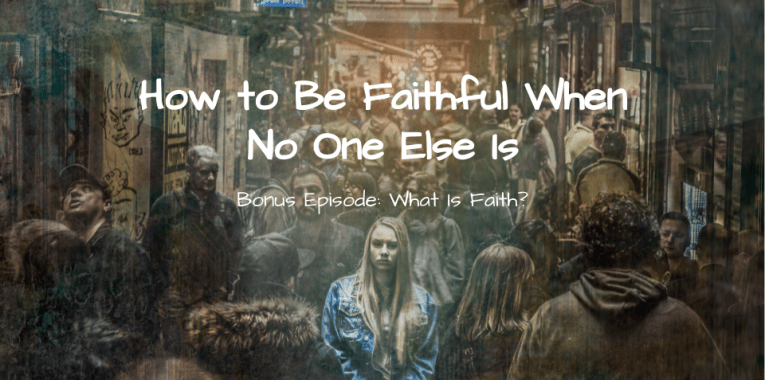
What Is Faith?

For the last several weeks, we have been working our way through the stories of Daniel and his friends. Along the way, we have been driven by a very simple question: What does it look like to be faithful when no one else is? As our culture continues to change such that followers of Jesus are increasingly feeling lonelier than we ever have been, the examples those stories have offered have been a great help. Yet for all our talk of being faithful, we have left out an important and logically prior question: What is faith in the first place? In this bonus episode of the series, we are going to tackle that together. Come with me today on a journey of discovering what faith is and what that means for our lives.

What Is Faith?

The word “faith” is a little bit like a blank canvas. It means different things to different people in different circumstances. Now, this is not at all to say it has no fixed meaning—I think it does—but the way the word is used today would not do a very good job of giving much confidence of that fixed meaning to someone learning of the concept for the first time. Indeed, the way faith is often presented in a variety of places in today’s pop culture would suggest that it is not a very substantive thing in the first place. I mean, think about the last movie or television series you watched when one character or another was waiting on something good happening in the future whose prospects didn’t look very good. What was that character told to do by a well-meaning counselor? He was told to “have faith.” When we are anticipating a particular outcome of a series of events we are told we just have to have faith that it will play out the way we want. 

Read the rest…

Habits of Faithfulness

With one more week to go in our series (and with this being the final part that I’m preaching), this week we are talking about another critically important way we can stand in our faithfulness to Christ even when we are standing alone. As we look at the story of Daniel in the lions’ den, we are going to talk about the kinds of things we do without having to think about them and what that means for our lives. Thanks for reading and sharing.

Habits of Faithfulness

I want you to think for just a minute about the sheer number of things you do on a daily basis that you feel like you could do with your eyes either metaphorically or literally closed. Given how automated many of the things you do are, that may actually be a tough list to compile. How many things in your life do you do because they are simply what you do? Surely your list includes some pretty basic things. If you use any kind of corrective lens, I suspect putting those on in the morning is automatic. Hopefully most of your personal hygiene routine runs on autopilot. The people sitting next to you are grateful for that. If you are a coffee drinker, your morning date with your coffee machine probably doesn’t require a lot of thought…which is probably good because if you are a coffee-drinker, you may not give a whole lot of thought to much of anything before that first cup starts energizing your system. 

Read the rest…

Live as You Speak; Speak as You Live

This past Sunday, as we continued in our series, How to Be Faithful When No One Else Is, we were confronted with the fact that if our words and lifestyle don’t match each other, our words will be robbed of any power they might have otherwise held. This matters because speaking the truth is something we are called to do as followers of Jesus. Let’s talk about all of this through the lens of the next episode of Daniel’s story. Thanks for reading and sharing.

Live as You Speak; Speak as You Live

Imagine for a minute that you are sitting in an audience waiting for a comedian to come out on stage. When the guy finally walks out, he looks like a huge nerd. What’s more, behind him comes a stage crew member pushing out a big screen TV. When the audience looks a little inquisitive about the screen, the supposed comedian speaks up and says, “Oh, that’s for my PowerPoint slides.” Now, without knowing anything else, how excited are you about this comedian? Probably not very much. Somewhere inside you are thinking something along the lines, “I have seen comedians before, and you, Sir, are no comedian.” We don’t really want to listen to someone we don’t believe knows what they’re talking about. We’re terribly judgmental like that. And as much as we tell ourselves stories about not judging a book by its cover, we do it anyway. It’s like we can’t help ourselves. If you are presented with someone who does not appear to have any knowledge of the subject he is preparing to address, you’re going to start tuning him out before he even gets started. Now, maybe he earns a hearing in the few seconds you give him to grab your attention, but the odds aren’t in his favor. 

Read the rest…