
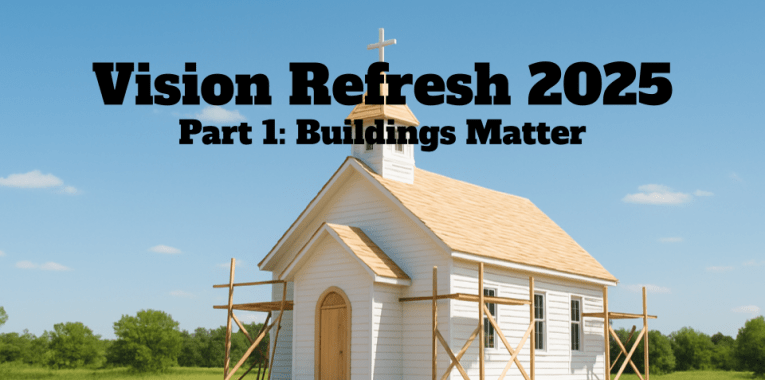
A year ago, we started out on a journey to expand and renovate our facilities here at First Baptist Oakboro. Over this week and next, we are checking back in on where we are, what God is doing, and why the work we are pursuing is still worth the effort. We’ll start today with the prophet Haggai and his call for the people of Israel to rebuild the temple. When we put God’s things first, He blesses the effort. Let’s dive in.
Buildings Matter
Have you ever hit one of those seasons when everything just feels like a rat race? You wake up, get dressed, go to work, come home, go to bed, and start it all over the next day. It feels like nothing ever really changes. You aren’t really going anywhere. You’re just doing the things that need to be done because they need to be done. You never feel like you get to the things you do just because you want to do them. No sooner do you get to what seems like it will be the end of one season than you find yourself back at the start having to run the whole thing over. It can all start to feel pointless. It can be depressing. How do we find purpose again when we get stuck like this? The answer is found in putting first things first.
One week shy of a year ago, I began preaching on a new sermon series with you. That series had two goals. The first was to celebrate the work of God in our midst both in the past and into the future. We had a lot to celebrate then. There were many different things we were able to point to that were clear markers of God’s activity of drawing people to His church and through that to His kingdom. It was an exciting season. It was an exciting season that if anything has only grown in excitement and intensity in the year since.
The other major goal of that teaching series was to call all of us to sacrificially commit ourselves as a body to the work of building a new worship space and doing some fairly extensive renovations in our old sanctuary building. The plans for the realization of that project had been started long before last October. They had been started long before I even got here by a group of people who were driven by a vision of what God would do in this church’s future. They didn’t know the timing on His activity, and some of them have gone on to be with the Lord since that group was formed, but they knew He was leading the church somewhere, and they wanted to be sure to position us for it when the time came.
Well, the time is here. It was here then, and we are still walking forward in that time together now. No, we’re not pushing dirt around outside just yet as much as I’d like to be—at least not in that particular piece of land. But we’re close. We’re closer than we’ve been in fifteen years. The momentum toward that moment continues to build, and when it finally arrives, the payoff is going to be sweet indeed. With all of this in mind, I wanted to take a few minutes this week and next to reflect together on where we are, what God is still doing, and why our commitment to this project still very much matters.
We are going to do this by exploring a couple of different ideas that are going to sound like they are completely contradictory of one another when you first hear both of them side-by-side. We’ll start with this one: Buildings matter in our pursuit of God’s kingdom. We are planning to build a building together. That’s not a neutral thing when it comes to God’s advancing kingdom. It is a positive one. And to get a sense of why this is, I want to spend some time this morning with the prophet Haggai. If you have a copy of the Scriptures handy, find your way there with me, and let’s explore God’s word together.
Now, Haggai is one of those tricky-to-find prophets hidden in the section of the Bible we typically call the “Minor Prophets.” Their ministry wasn’t somehow less significant than the “Major Prophets,” their books are just shorter. If you can find Matthew, the first document in the New Testament, Haggai is three back from there, but don’t turn far or you’ll skip over it. Malachi, Zechariah, and then Haggai. Haggai is one of the shortest collections of prophecy we have in the Bible. It consists of just two chapters. Only Obadiah, the word of judgment against the people of Edom, is shorter. And, like many of the shorter collections of prophecy, it is focused on a single theme which in this case is the rebuilding of the temple so the people can worship.
Haggai wrote in the days after the Babylonian Exile. The people had been allowed by the Persian rulers who conquered Babylon in the waning days of the Exile to go back home and set up shop in their ancestral lands. Things weren’t the same anymore, but at least they were home. The priest, Ezra, tells us about the initial wave of returnees rebuilding the foundation for the temple, but that was about as far as they got before the demands of life directed their attention elsewhere. Rebuilding the temple itself was going to be a big project.
Hurricane Helene swept through Western North Carolina one year ago yesterday. That’s sometimes hard for us to remember who live down here where the impact was minimal. I guarantee you that yesterday was a somber day for a lot of folks up there. Much has been rebuilt, but much still remains. And yet life has gone on, and folks have had to either move with it, or get left behind. The demands of life don’t care about the present circumstances of our lives. For the Jews returning to Jerusalem after 70 years in captivity, many of them returning to a homeland they had never actually called home, as much as they wanted to get their relationship with God right—including worshiping Him properly in the temple—life moved on. They had gotten the foundation for the temple laid, but now there were businesses to be started, crops to be grown, goods and services to be provided, and so on and so forth. And in the midst of the rat race of life, adding something extra like building a giant building is hard to say the least. Rather than looking up to God and pursuing Him with all of their lives, the people were stuck looking down at the immediate demands on their time. We get that. We fall prey to the same thing.
None of this was helped by the governor, Zerubbabel, and the high priest, Joshua. The day-to-day demands of leadership and worship were consuming their every waking minute too. They weren’t necessarily opposed to the idea of completing the project of reestablishing the temple and its worship—in fact, they probably wanted to do it—they just didn’t have time for one more thing. Their plates were too full for anything else to be added.
The result of all of this was that the people, while not hostile to God in their thinking, weren’t really much in the way of faithful to Him. They were mostly just going through the motions. They were stuck in the rat race. But God didn’t make us for the rat race; He made us for life in His kingdom. As a result, He sent the prophets Haggai and Zechariah at about the same time, one to cry out to the leaders, and one to cry out to the people. Now, we’ll have to look at what Zechariah had to say to the people another time (a whole bunch of it was focused on the coming Messiah), but let’s do take a look at what God’s prophet had to say to Israel’s leaders.
Start with me right at the beginning of Haggai’s prophecy here: “In the second year of King Darius, on the first day of the sixth month, the word of the Lord came through the prophet Haggai to Zerubbabel son of Shealtiel, the governor of Judah, and to Joshua son of Jehozadak, the high priest.” Now, pause there for just a second. Did you catch just how specific that date was? This wasn’t just, “God spoke to me one time, and now I’m telling you.” This was, “God spoke to me on Monday, July 25, 520 BC.” This prophecy didn’t arrive to us down through history because some random guy was just making stuff up. This prophecy is consciously and specifically rooted in history—a particular day in history, no less.
And what did Haggai say to these two leaders on behalf of the Lord on Monday, July 25, 520 BC? “‘The Lord of Armies says this: These people say: The time has not come for the house of the Lord to be rebuilt.’ The word of the Lord came through the prophet Haggai: ‘Is it a time for you yourselves to live in your paneled houses, while this house lies in ruins?’ Now, the Lord of Armies says this: ‘Think carefully about your ways: You have planted much but harvested little. You eat but never have enough to be satisfied. You drink but never have enough to be happy. You put on clothes but never have enough to get warm. The wage earner puts his wages into a bag with a hole in it.’ The Lord of Armies says this: ‘Think carefully about your ways. Go up into the hills, bring down lumber, and build the house; and I will be pleased with it and be glorified,’ says the Lord. ‘You expected much, but then it amounted to little. When you brought the harvest to your house, I ruined it. Why?’ This is the declaration of the Lord of Armies: ‘Because my house still lies in ruins, while each of you is busy with his own house.’”
Got all that? God is calling the people out for getting back to their lives without getting back to worship. They were putting their things ahead of His things. Pursuing a relationship with Him had been relegated to the back burner. God was patient with the people early on when they had gotten the foundation for the temple laid before starting to rebuild their lives there in Jerusalem, but it had been almost 20 years since that time. If they hadn’t gotten themselves pretty well established by now, they weren’t doing something right. As a matter of fact, God seems to indicate they had gotten themselves pretty well established. They were living in nice houses and the economy they had built was humming along nicely. At least mostly nicely. There were some signs of weakness, but they were managing those. The only problem with this is that those signs of weakness were His trying to get their attention. And they weren’t getting it. That’s the whole reason He sent Haggai to them. They weren’t getting the point when He went with subtle, so He had to get a bit louder.
God was saying essentially this: “If you are going to be my people, then you need to make me a part of your rhythms. But you are not going to make me a part of your rhythms until you have a visible reminder to do that. So, it’s time to stop putting off rebuilding the temple and get to work.”
And, to the people’s credit, they did. They actually listened to what the Lord said through the prophet, and got to work. Verse 12: “Then Zerubbabel son the Shealtiel, the high priest Joshua son of Jehozadak, and the entire remnant of the people obeyed the Lord their God and the words of the prophet Haggai, because the Lord their God had sent him. So the people feared the Lord. Then Haggai, the Lord’s messenger, delivered the Lord’s message to the people: ‘I am with you—this is the Lord’s declaration.’ The Lord roused the spirit of Zerubbabel son of Shealtiel, governor of Judah, the spirit of the high priest Joshua son of Jehozadak, and the spirit of all the remnant of the people. They began work on the house of the Lord of Armies, their God, on the twenty-fourth day of the sixth month, in the second year of King Darius.” On Monday, July 25, God said to get started on the temple, and by Thursday, August 18, they did.
Now, have you ever gotten started on a project that you imagined was going to turn out one way, but then it turned out not quite as grand as you pictured? While there were some Israelites in that original group of returnees who still remembered the glory of the original temple that Solomon built, and were weeping at what they had lost at the pitiful-by-comparison foundation put in place for the new temple, nearly twenty years later, there were even fewer of them left. Still, though, the stories they had told surely echoed in the hearts and minds of the people. Perhaps that was a contributing factor to their putting off the project for so long. They didn’t want to build something they knew was not going to be very good compared to the original.
After working for a couple of months, and seeing that they weren’t going to be rebuilding what Solomon had first done to the glory of God, the Lord sent the prophet Haggai to them again on Thursday, October 17, to give them some encouragement. What they were building was good and important and necessary for their spiritual growth and development as a people. But it was about more than just that. It was about getting them prepared for what God was going to do in the days ahead of them. It was about getting them in the kind of spiritual shape they were going to need to be in in order to participate fully in what He had planned.
Listen to how this went: “On the twenty-first day of the seventh month, the word of the Lord came through the prophet Haggai: ‘Speak to Zerubbabel son of Shealtiel, governor of Judah, to the high priest Joshua son of Jehozadak, and to the remnant of the people: “Who is left among you who saw this house in its former glory? How does it look to you now? Doesn’t it seem to you like nothing by comparison? Even so, be strong, Zerubbabel—this is the Lord’s declaration. Be strong, Joshua son of Jehozadak, high priest. Be strong, all you people of the land—this is the Lord’s declaration. Work! For I am with you—the declaration of the Lord of Armies. This is the promise I made to you when you came out of Egypt, and my Spirit is present among you; don’t be afraid.”’ For the Lord of Armies says this: ‘Once more, in a little while, I am going to shake the heavens and the earth, the sea and the dry land. I will shake all the nations so that the treasures of all the nations will come, and I will fill this house with glory,’ says the Lord of Armies. ‘The silver and gold belong to me’—this is the declaration of the Lord of Armies. ‘The final glory of this house will be greater than the first.’ says the Lord of Armies. ‘I will provide peace in this place’—this is the declaration of the Lord of Armies.”
So, what is all this? God is saying, “Look, I know it doesn’t look like much to you now, but keep going. You are not alone. I am with you. I am with you, and I’ve got plans working that are going to knock your socks off. You keep trusting me and building this building, and I’ll take care of the rest.”
Let me pause for a second and ask a question here: Why did this building seem to matter so much to the Lord? I mean, it’s not like having a temple was God’s idea in the first place. Yes, He gave the Israelites under Moses’ leadership plans for a tabernacle, but the difference between the tabernacle and the temple is that the tabernacle was mobile. It communicated that the presence of God didn’t exist in one, fixed location like the temple did. God allowed David to plan for (not build) a temple, and Solomon to actually build it as a concession, not as a plan. He conceded this for them and for the people because we are such physical creatures. We need that physical reminder. Of course, as Israel’s history made abundantly clear, we need more than just the physical reminder. We can ignore a physical reminder and go on our merry little way down the path of unfaithfulness and sin, but the reminder helps all the same. The point, though, is that the temple was always primarily for us, not God. He didn’t choose it Himself, but He rather met us where we were and redeemed it.
He redeemed it because it is a good thing to have a clear place where we can concentrate our efforts to worship and serve Him. Or, as we said a bit ago, buildings matter in our pursuit of God’s kingdom. No, they’re not the most important thing because the church is not the building, but the building gives us a concrete space where we can pursue Him and the advancement of His kingdom in an organized, focused fashion. Buildings matter in our pursuit of God’s kingdom.
Friends, we are on a journey to build a building. That matters. Moving that dirt around and stacking those sticks and bricks is not going to be a kingdom-neutral activity. It will be a kingdom-advancing one. This is because buildings matter in our pursuit of God’s kingdom. It matters that we are building the first really new structure in downtown Oakboro, on Main Street in a very long time. It matters that we are creating a space that will be specifically designed with worship in mind, and not a whole plethora of different activities. It matters that we are endeavoring—at great expense no less—to put our worship space and our kids’ spaces under the same roof for the first time since we started worshiping over here well over a decade ago. It matters that we are going to set ourselves up to be able to more easily host more community gatherings, further cementing ourselves as being a church that exists at the heartbeat of this community. This and more all matters. Buildings matter in our pursuit of God’s kingdom.
Building this building together matters because it will facilitate our connecting more people to the Gospel. Now, I don’t know what all of God’s plans are. I’m not a prophet or the son of a prophet. But look around. Think about where we were a year ago. Think about where we were five years ago. Think about what is happening on Wednesday nights at The Gathering Place. Think about how many are experiencing genuine, Christian community on Wednesday nights, learning to love the church. Speaking of that, think about how many kids are learning to love the church here. Did you know there were 65 kids on our campus just this past Wednesday night? Forty-two of those were teenagers! One of our awesome kids’ ministry volunteers was down at Variety Pickup this past Wednesday talking with the cashier about the games they were going to play that night, but without telling her which church they volunteered at. She said, “That sounds like a lot of kids. You must be with that First Baptist Oakboro.” We can teach kids the Gospel and to love Jesus—and we absolutely should—but if we don’t also teach them to love the church, the likelihood that they are going to persist in a relationship with Jesus goes way down. We are teaching kids that the church is the place you go where everybody loves you and you have a lot of fun. They are experiencing that week in and week out because of what God is doing through you here. And He keeps sending more and more people to experience it. Think about just how many people have come in our doors for the first time in just the last few weeks. Think about how many have taken the important step of joining officially.
Now, could God do all of this without any our having any buildings? Of course He could. He’s God. He can do whatever He wants; He can expand His kingdom by any means. But given our location, the kind of community we are in, and the cultural context around us, having buildings makes it a whole lot easier for us to do all the work He is giving us to do. Having a space that is specifically dedicated to worship is going to help us connect more people to the Gospel. Having more fellowship space in our old building is going to help us connect more people to the Gospel. Having bathrooms on the third floor over there is going to help us connect more people to the Gospel. Having renovated restrooms throughout the building is going to help us connect more people to the Gospel. Because buildings matter in our pursuit of God’s kingdom. That’s why we are doing what we are doing.
And when and as we keep following Him down this path after His lead, He will bless our efforts. This is not because we’re particularly special to deserve His blessing, but because He is a good God who always blesses the efforts of His people to follow His lead. He did the people of Israel here during Haggai’s ministry. About a month after He checked in with the people, God checked in with them again through the prophet on Monday, November 26. He reminded them of where they were before they started following His lead again, and where they were now that they had. From Haggai 2:18: “From this day on, think carefully; from the twenty fourth day of the ninth month [when they actually started rebuilding the temple], from the day the foundation of the Lord’s temple was laid; think carefully. Is there still seed left in the granary? The vine, the fig, the pomegranate, and the olive tree have not yet produced. But from this day on I will bless you.’”
That’s the third and fourth times God tells the people through Haggai to think carefully, so perhaps we should take the hint. Here’s the thought we should have: When we commit ourselves to God’s ends, when we follow His lead, when we put His things first, He will bless us in our efforts. He will make sure we can follow through on what He has called us to do. But we’ve got to keep trusting Him. We’ve got to keep following Him. We’ve got to keep putting His things first. We’ve got to stay committed to being fully the church He has called and equipped us to be. When we do that, building a building won’t be a problem at all. It’ll barely be a challenge. As we talked about just this past Wednesday night: When we set out to do what God has already called us to do, fully reliant on His power to do it, we can’t fail. As we commit ourselves fully to Him and His ways, He will take care of the rest. As we commit to the path of sacrificial generosity together, He will make sure we have all we need to do all He has set before us. We can and we will get this building built. Buildings matter in our pursuit of God’s kingdom.
Let’s step off the rat race, on to the path toward God’s kingdom, and delight together in being a key part of God’s Gospel’s advancing further into this community and beyond than ever before. Let us delight together in being God’s church. Let us delight together in creating a space where the Gospel is proclaimed, where disciples are made, and where saints are sent out to advance God’s kingdom. Let us delight together in being a people with whom anyone can connect to grow in Christ and reach out for God’s kingdom. Let us build God’s kingdom together.
 The Nexus