
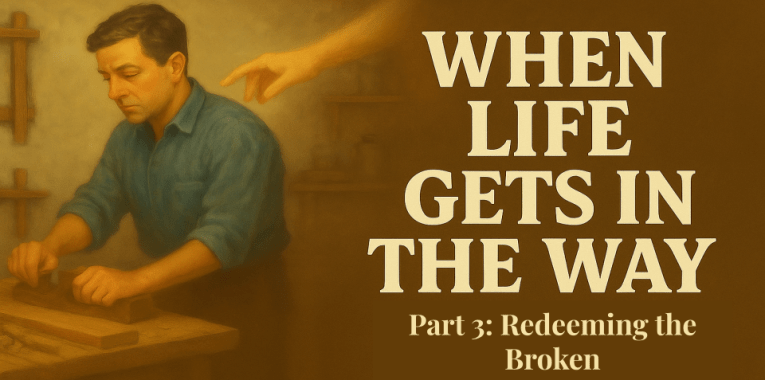
Interruptions are part of life. For the last couple of weeks in our teaching series, When Life Gets in the Way, we have been talking about the kinds of interruptions God’s plans can bring to our lives and what to do in those times. But what about when our interruptions are the cause of our own, sinful choices. What then? Today we are going to explore the story of a Bible “hero” whose choice to sin seems like it should have derailed all of God’s plans for his life. But it didn’t. Let’s talk about why and what that might mean for us.
Redeeming the Broken
People are different. Now, you can take that statement in several different ways, but what I mean is that we’re not like the rest of creation. When Moses was poetically describing the creation process, when he got to the part where God made people, he presented it differently than all the other aspects of creation. He changed the poetic pattern, which would have been a major tipoff that something was different. He said this: “So God created man in his own image; he created him in the image of God; he created them male and female.” In bearing God’s image—His personal characteristics, not His divine ones—God made us distinct from the rest of creation.
Well, one of the things about all of humanity’s being created in the image of God is that even people who are profoundly lost and pagan in their outlook can nonetheless hit on ideas that are reflective of Gospel truths. Take Japan, for instance. Japan is a place of great spiritual darkness. The island nation has been historically closed to outsiders for a very long time. It has long been a difficult place for Christian missionaries to gain a Gospel foothold that leads to kingdom-advancing success. The dominant religion of the Japanese people is called Shintoism. Shintoism is a pretty complex area of study if you aren’t already familiar with it. One of the principles of Shintoism, though, is that imperfections can be places of beauty if they are restored properly.
Commensurate with this belief, one of the more unique art forms that has come out of Japan is Kintsugi. This art form takes intentionally broken pottery and repairs it with a resin that is laced with gold or silver or platinum. The results are pretty incredible. The idea here is that flaws are not something to be hidden. Rather, once repair and restoration have happened, they can be displayed as things of beauty in and of themselves for all the world to marvel at. What a profoundly Gospel-centric concept! Finding beauty in places of brokenness is something we have been talking about for the last couple of weeks.
This morning finds us in the third part of our series, When Life Gets in the Way. What we are talking about on this journey is the fact that sometimes our nice, neat paths through life get interrupted. Those interruptions come in a number of different ways and forms, but the fact of their existence is the real challenge. I don’t know about you, but when my plans get thrown into chaos, it takes me a hot second before I can get my head wrapped around what I’m supposed to do now. Maybe you’re better at adapting on the fly than I am, but it’s still a challenge.
Well, so far, we have focused our attention on interruptions that come from God. Through Abraham’s story, we saw how God can interrupt our plans by inviting us to follow Him somewhere new. In these times, like Abraham did, we can trust what He’s planning to do. When God interrupts our lives, we can trust what He’s doing. Yet while many of the interruptions God invites us into, though disruptive, aren’t necessarily destructive of our lives, that’s not always the case. Last week, through the story of Joseph, we talked about these kinds of harder interruptions that can leave us wondering not merely what God is doing, but if He’s really as good as we have been led to believe He is. The truth is that He is, and if we will exercise a bit of patience and faithfulness, we will yet see how He plans to accomplish His kingdom-advancing plans through our lives even in the hard place we find ourselves. Or, as we put it then, even hard interruptions can place us where God can use us.
Okay, but what about when an interruption comes to our lives that isn’t because of something God is doing? What about when it’s because of something we have done? More specifically, what about when it is because of something we have done wrong, when we have sinned in some way? God can use us to accomplish His kingdom plans wherever we happen to be, no matter how far from our original path we have been forced to pivot, but what if our pivot isn’t because of something He has done or invited us into, but because we have left the path He planned for us to walk? What then? That’s what we are going to be talking about today.
One of the things that is so helpful about the Scriptures is that they present the situation of humanity honestly. They don’t sugarcoat anything. They simply set it out before us, and let us figure out what to do with it. And indeed, with the exception of Jesus, pretty much all of the “heroes” of the Bible are broken. Some of them are more broken than others, but all of them equally fail to live up to God’s righteous standards in more than one way. Some of their sinful failures are rather dramatic. And yet, each one of them is known to us as a faith hero because their brokenness wasn’t the end of their story. God had something else to say. I want to take a look with you at one such story this morning. Come with me to the Old Testament narrative of Exodus, and let’s talk a bit about Moses.
Moses is one of the handful of characters in the Scriptures who really doesn’t need much of an introduction. He was the great leader who brought the people of Israel out of slavery in Egypt, and through the wilderness to the Promised Land. He also delivered the Law to the people from God as a part of God’s establishing a covenant with Israel that was designed to lead to life if they would only live in light of it rather than living however they pleased. But the Moses we know wasn’t always the Moses we know. Of course, there’s the wild story surrounding his birth when his mother placed him in a basket, and set the basket floating down the Nile River in hopes that an Egyptian family would find him and raise him as their own so he wasn’t killed in obedience to Pharaoh’s command that all the Hebrew baby boys be put to death as a means of population control. In an ironic twist of fate (and by “fate,” I mean, God’s providence), it was one of Pharaoh’s own daughters who found him and raised him as her own son.
But that was when Moses was young. He didn’t take over the leadership of Israel until he was 80. What was he doing for the other 79 years? He spent about half of it living in the wilderness, married into the family of a priest, serving as a shepherd to his flocks. Before that, he was raised in Pharaoh’s palace. Okay, but how does one go from Pharaoh’s palace to the obscurity of the wilderness? One word: sin. When Moses was about 40, he committed a pretty grievous sin; one that would bring an interruption to his life for a very long time. Let’s check out what happened starting in Exodus 2:11.
“Years later, after Moses had grown up, he went out to his own people and observed their forced labor. He saw an Egyptian striking a Hebrew, one of his people. Looking all around and seeing no one, he struck the Egyptian dead and hid him in the sand.” The proper label for Moses’ actions here is murder. Now, perhaps a defense attorney today would argue that this was merely manslaughter, and didn’t meet the legal definition of the terrible crime, but Moses unjustly took the life of an innocent man. That’s murder. Yes, but this man wasn’t really innocent. He was not only assaulting an innocent man, he was part of an entire unjust system of oppression against an innocent people. He was a victimizer who needed to be stopped. Moses just happened to be the one to stop him. He should be celebrated for this, not condemned. And that sounds really good until you think about it. A society in which people take matters of crime and punishment—and especially when that punishment involves the death of the guilty—into their own hands is not a healthy society. It is a society teetering on the brink of chaos. The fact is: Moses was not the person who could justly carry out this sentence at the behest of the state. He was just a dude who understandably, if errantly, took matters of justice into his own hands. That made him guilty. And not just guilty of some small sin. He was guilty of one of the big ones.
And the thing about falling into sin is that no matter how hard we have worked to cover it up, and how successful our efforts seem to have been, the truth will come out eventually. In Moses’ case, the truth came out rather quickly. Verse 13: “The next day he went out and saw two Hebrews fighting. He asked the one in the wrong, ‘Why are you attacking your neighbor?’ ‘Who made you a commander and judge over us?’ the man replied. ‘Are you planning to kill me as you killed the Egyptian.’” Moses’ secret was out. Once one person knew, it was pretty spectacularly unlikely to remain unknown for long. And Moses understood this: “Then Moses became afraid and thought, ‘What I did is certainly known.’” Word of Moses’ crime spread like wildfire. His position as a member of the royal court no doubt sped along the process. Eventually word made it to Pharaoh, and he wasn’t having this at all. “When Pharaoh heard about this, he tried to kill Moses. But Moses fled from Pharaoh and went to live in the land of Midian, and sat down by a well.”
At this point in the story, we kind of want to do a double take and say, “Is this really Moses? The same Moses who would courageously stand up to Pharaoh and demand that he release the people of Israel from bondage because a God he thought was powerless said so?” And the answer to that question is, yes, this is the very same Moses. Okay, but how could this be? I mean, it sure seems like murder would be disqualifying as far as someone’s being used by God to accomplish such incredible things as God would yet use Moses to accomplish. God needs people who are pure and holy and righteous to do His work, doesn’t He? He certainly demands perfection from His people. There’s that whole, “You shall be perfect as your Father in heaven is perfect” thing. Murder most definitely makes someone not perfect.
Furthermore, Moses doesn’t appear to show any remorse for his crime at all. He simply runs away. In fact, that’s a problem in and of itself. Rather than facing the proper justice for his actions, he flees. This Egyptian was perhaps a husband and a father. He was certainly somebody’s son. They were all left grieving with no moral recourse for the crimes committed against them. Even if he wasn’t really all that innocent, he still didn’t deserve to be murdered in cold blood; nobody deserves that. Moses seems like he had to be pretty useless to God at this point in his story. So, how did he get from here to become the Moses we know?
Well, part of the answer to that question is time. Moses didn’t get arrested. He didn’t face the judgment of Pharaoh. But he did go into a kind of self-imposed exile…for forty years. Now, it wasn’t exactly a harsh sentence. He met his wife and started his family. He got and maintained steady work. But he had gone from being a resident of Pharaoh’s house to a nobody from nowhere. He was separated from any friends he had or family he could speak of. The work he wound up doing was shepherding which was not a highly regarded profession by the Egyptians. This alone would have been a pretty severe punishment given his upbringing; a mark of how far he had fallen. All of this may not seem like much, but it’s not nothing either.
There’s something else here too. This exile wasn’t merely for exile’s sake. Moses was going to school. It wasn’t by any means a traditional school as we might imagine the concept. Instead, Moses was learning the lessons of humility. He was learning who he really was. He was learning who others really were. He was learning who God really was. He was learning to put others first and to serve them selflessly. He was learning that his identity needed to be in more than what he had and what he could do.
The result of all of this was that Moses slowly began turning toward God. He turned away from himself and living life on his terms. This path didn’t get him all the way there, but in turning away from what was and toward what could be in God, he was walking a path that actually had the potential of taking him somewhere real; somewhere good. In the end, God used all of this to draw Moses to the place where He could call him to the task He had planned for him to complete from the beginning. In spite of all Moses had done, in spite of all Moses had been through, when he began turning in God’s direction, God was ready to redeem him from his past and invite him into his future.
This, of course, came in Moses’ famous encounter with the burning bush that wasn’t really burning. There, once God had his undivided attention, He would call him to the task for which he had been prepared. Look forward just a little bit in the text with me into Exodus 3:4 to see how this finally played out. “When the Lord saw that he had gone over to look, God called out to him from the bush, ‘Moses, Moses!’ ‘Here I am,’ he answered. ‘Do not come closer,’ he said. ‘Remove the sandals from your feet, for the place where you are standing is holy ground.’ Then he continued, ‘I am the God of your father, the God of Abraham, the God of Isaac, and the God of Jacob.’ Moses hid his face because he was afraid to look at God. Then the Lord said, ‘I have observed the misery of my people in Egypt, and have heard them crying out because of their oppressors. I know about their sufferings, and I have come down to rescue them from the power of the Egyptians and to bring them from that land to a good and spacious land, a land flowing with milk and honey—the territory of the Canaanites, Hethites, Amorites, Perizzites, Hivites, and Jebusites. So because the Israelites’ cry for help has come to me, and I have also seen the way the Egyptians are oppressing them, therefore go. I am sending you to Pharaoh so that you may lead my people, the Israelites, out of Egypt.’”
What came next has changed the world many times over. Nothing would ever be the same again. God would be revealed for who He really is, and the world would take notice. There was still much more to do. Moses was only going to play a role in a much larger performance, but it was an important role. It was a role he was prepared for. It was a role that God prepared him for by not only calling, but by redeeming him from the brokenness, the sins of his past. His past threatened to derail anything God might have sought to accomplish through him before it even got started, but God can redeem even our worst brokenness and use it to achieve the greatest kingdom advancement. What Moses experienced is what we can experience as well in Christ when we are willing to come to Him. No matter how much brokenness is in your story, God can redeem that and use your story, your life, to advance His kingdom in powerful ways. God can redeem our brokenness.
Now, that idea may seem simple, but it comes packaged with some pretty potent implications. Let’s talk through some of these. The first is this: redemption is always a response to repentance. Redemption requires repentance. It can’t happen without it. And repentance means we aren’t continuing to walk in the direction of our brokenness and sin any longer. God’s graciousness and kindness in His efforts to restore us from the very bottom of life are astounding, but we must actually live into them rather than resisting them by remaining rooted in our sin.
This repentance, in turn, requires a couple of things from us. It requires us first to acknowledge that we aren’t on the right track. We have to acknowledge that we have sinned in some way, that we are living out of the brokenness of sin rather than the righteousness of God in Christ. The second thing it requires is that we accept His help in walking out of our sin. We can’t just dwell in brokenness. We have to actually seek to move out of it. That’s not often an easy thing to do because even when we actively hate the brokenness we are in, we sometimes hate more the thought of being somewhere new and different and where our illusions of control have been dashed. That is, while we may hate our sin and what it is doing to our lives and through our lives to the people around us, we hate the thought of giving up our sin even more. Repentance means doing whatever it takes to actually walk away from our sin. That can seem a daunting task, but as soon as we start moving in that direction, our faithful heavenly Father will be there to help us along the way. God can redeem our brokenness.
He can redeem our brokenness no matter how bad it seems to be to us. The greater our sin is, the greater His grace looks. Now, as Paul rather emphatically insists to the Roman believers, this does not mean we should seek to sin in order to prop up the grace of God. He doesn’t need our help in that. What it does mean, though, is that even if we consider our sin to be really, really, irredeemably bad, God can nonetheless redeem it. His grace is always greater than our sin no matter how great our sin happens to be. The interruption of our sin may be profound. It may be affecting our lives in profound ways. It may be affecting the lives of the people around us in profound ways. But God can always put things back on track when we are willing to submit to Him and receive His help. God can redeem our brokenness.
Yet while we play a role in this in that we must walk to Jesus, we must be clear on the fact that redemption is found in Christ and Christ alone. We don’t redeem ourselves. We can’t pay the price for our own sins. We can’t restore our relationship with God by our own efforts. None of that. From start to finish, redemption is always and only the work of God in Christ through the Spirit on our behalf. Redemption is about how good He is, not how much work we have done.
This is a good thing too, because if it was about how much we have done, a couple of things would be the result, neither of which would be good. First, some people would be able to do the work, and some wouldn’t. This would immediately stratify our society into those who could work their way to redemption and those who couldn’t. Can you imagine what a disaster this would be? Imagine the envy, the bitterness, the animosity, the pride, and so on and so forth. It would ruin us if this were the case. The other problem here is that it would leave us always wondering if we have done enough. It would leave us forever open to that question from other people. One little mistake on our part, and someone could come and pick apart our entire claim to redemption. The uncertainty here would grow wearying and quickly. It is unquestionably the gift of God that redemption is found in Christ and Christ alone. In Him, God can redeem our brokenness. We just have to be willing to go to Him and receive the healing and wholeness that are waiting for us. God can redeem our brokenness.
There’s one last thing this means, and I want you to make sure you don’t miss this one. If God can indeed redeem our brokenness—and I hope I have made clear that He not only can, but wants to, and in fact already has in Christ—this necessarily means He can redeem the brokenness of others as well. And if you are wondering why that matters, let me spell it out for you: We need to be as gracious with the people around us when they fail as God is with us when we do. If God can redeem your brokenness, then He can redeem the brokenness of the person who hurt you; the person who lied to you; the person who betrayed you; the person you took from you something you can never get back. If God is God for you, He is God for them too.
This means a whole lot of different things that are all really important, but there are two that I want to be sure we all understand this morning. Number one, this means that when someone has hurt us, we need to forgive them. God can redeem our brokenness. If He extends this gracious redemption to us in Christ, we dare not extend anything less than this to the people around us, and especially the people around us who have hurt us. When someone has hurt us, they owe a debt to us. Forgiveness is releasing them from that debt. It is saying to them (either directly or just in our hearts and minds), “I’m not going to sit in the place of God over you because I’m not God. He has released you from this debt in Christ, and so because I am walking in Christ, and because I hope that you will walk in Christ as well, I’m going to afford you the same grace that He extended to me.” Anything less than this leaves us falling short of the love of God in Christ.
Now, if you’re not a follower of Jesus, this is a really good idea because forgiveness is the only real counter for the bitterness that will otherwise consume your soul, but you don’t have to do it. I completely understand if you don’t want to. I don’t blame you for that. You’re still better off doing it, but there’s no pressure on you. If, on the other hand, you are a follower of Jesus, this is non-negotiable. In fact, the one condition on receiving the forgiveness of God Jesus Himself put in place is that we are living in active forgiveness of the people around us. And if Jesus had said that just one time, we could perhaps try to find a way to wriggle out from under it, but He didn’t. He said it over and over and over again. God can redeem our brokenness, therefore we had better extend that same redemption to the people around us.
The second thing this means—and we’re going to finish with this—is that when someone else, and especially a fellow member of the body of Christ, has been consumed by the brokenness of sin in some way, they are not gone beyond all hope of redemption. God can redeem our brokenness. He can redeem their brokenness. And it just may be that the way He intends to extend His redemptive work to them is through you and me, that is, through the church. When a brother or sister has sinned, we are not to write that person off as a lost cause. We are to come alongside them, and with all the graciousness and kindness of Christ, restore them with gentleness and loving accountability. We are to be the means of God’s redemption, the hands and feet of Jesus restoring them in His name. God can redeem our brokenness.
Listen, the brokenness you are dealing with may seem impossible to overcome. You may feel like you are so far down that particular rabbit hole that you will never be able to climb back out of it again. You may have written yourself off as a hopeless case. But that’s not how God sees it. That’s not how God operates. He never has, and He never will. He redeemed and restored Moses after a murder. He redeemed Abraham’s cowardice and faithlessness. He redeemed Sarah’s unbelief. He redeemed Jacob’s scheming ways. He redeemed David’s lust and adultery. He redeemed Solomon’s idolatry. He redeemed Israel’s unfaithfulness. He redeemed Peter’s denials. He redeemed Paul’s hatred. He can redeem and restore you from whatever aspect of sin’s brokenness you have brought to your life because of the sinful choices you have made. You are not a lost cause. God can redeem our brokenness. He can redeem your brokenness. All you have to do is to put yourself in His faithful hands in Christ and be ready to obey His commands. He’ll handle the rest. God can redeem our brokenness, and make us beautiful vessels of His grace once again, shining brightly with the gold of His glory. Let’s put ourselves in His hands, and experience together the wonders of His grace.
 The Nexus
Excellent. Powerful last 2 minutes. Sent from my iPhone
LikeLike
Thanks!
LikeLike
Please add grantorino197269@yahoo.com to mailing list. That’s Jake’s email and he wants to receive these.
Sent from my Etch a Sketch
LikeLike
Done! He should get an email confirming his subscription. Hope they’re an encouragement to him!
LikeLike