
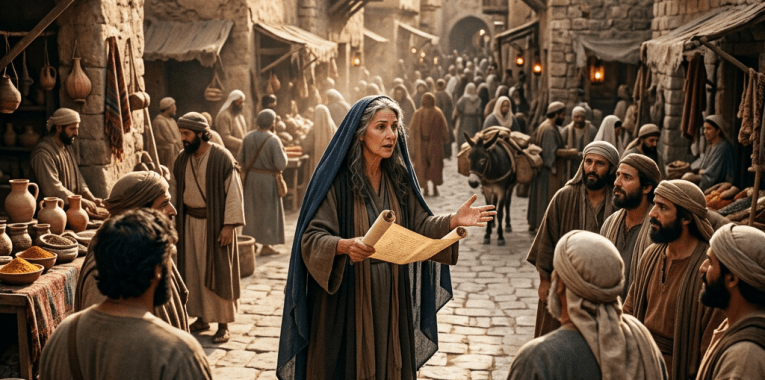
“Wisdom calls out in the street; she makes her voice heard in the public squares. She cries out above the commotion; she speaks at the entrance of the city gates: “How long, inexperienced ones, will you love ignorance? How long will you mockers enjoy mocking and you fools hate knowledge? If you respond to my warning, then I will pour out my spirit on you and teach you my words.” (Proverbs 1:20-23 CSB – Read the chapter)
How does one find wisdom? Many people might answer that question by pointing to experience. If we just live long enough, eventually we’ll accumulate some wisdom as we go. If we encounter enough different situations, wisdom will be the natural result. And that sounds like it could be true except that there are old people who are still fools, and busy people who don’t seem to have learned a thing from all they’ve done. No, the truth is that wisdom doesn’t come naturally. It must be sought on purpose. Thankfully, as much as we might be seeking it – seeking her to use the personification wisdom receives in Proverbs – she is seeking us too. We just have to listen. The last big section of Proverbs 1 talks about wisdom’s efforts to call us to her. We’re going to break this down into three parts and take a look at each in turn. Let’s dive in.
I hate it when I’m looking for something, can’t find it for the life of me, and then later discover that it was basically sitting right in front of my face the whole time. I have not ever been searching for glasses that were sitting on top of my head, but that’s only because I don’t wear glasses. Sometimes the thing we are looking for is really obvious in terms of its ability to be found, but because we aren’t expecting it to be in a certain place we can’t see it in spite of its being metaphorically right in front of us.
Solomon says wisdom is kind of like that. In this next section he introduces us for the first time to a personification of wisdom that will make a reappearance several times in the opening 9 chapters of Proverbs. Wisdom is personified as a woman who longs to be found and embraced by us. She eagerly seeks us so that we can be in a relationship with her, but if we refuse her advances, the consequences of our rejection will be pretty severe for us, and she’s not going to feel badly for us in the slightest.
The consequences of refusing wisdom’s advance is something we’ll dive into more over the next couple of posts in our series (I’m planning a look at the latest season of Daredevil: Born Again for tomorrow), but here we find some good news. If we are genuinely seeking wisdom, we can rest assured that wisdom is seeking us and wants to be found. “Wisdom calls out in the street; she makes her voice heard in the public squares. She cries out about the commotion; she speaks at the entrance of the city gates.”
Think about the language being used here. This is an intensely public search that wisdom is performing. This first part here calls to mind images of a street preacher. I’ve been near those kinds of folks before. They have a message they want you to hear, and they are going to do everything possible to make sure you hear it. They shout loudly enough to be heard over all the commotion of the street they are on. They shout over the voices of the passersby. They should over the noise of the city, the noise of traffic, and the hum of machinery in the area. They will often use some sort of a PA system turned up as far as it will go. They don’t want for there to be any chance that you miss what they have to say. In fact, if you miss it, that is completely on you, not them.
This, Solomon says, is how wisdom seeks us. Wisdom is out there in the world around us. God is the source of wisdom and He embedded His wisdom in the very fabric of creation. If we go searching for it with humbly and sincere hearts, we are going to find it. It is so discoverable, in fact, that it is not just followers of God who have had the corner market on wisdom throughout human history. Various pagan teachers down through human history have offered up wisdom to their own followers. They didn’t necessarily point their followers to the truth of who God is, but because His wisdom is soaked into the world around us, and because they were genuinely seeking wisdom, they found a great deal of it which they then shared.
After emphasizing wisdom’s public availability, Solomon goes on to relay her message, and at least at first, it’s not what we might expect. She doesn’t offer a kind of “come to me all you who are weary and burdened,” like Jesus gives in Matthew 11 and we talked about this past Monday. Instead, she jumps straight to haranguing people for ignoring her in spite of her making herself so easy to find. “How long, inexperienced ones, will you love ignorance? How long will you mockers enjoy mocking and you fools hate knowledge?”
Have you ever known someone who was stuck on stupid? They just kept going back to some foolish choice that was causing them harm. You saw them doing it, you called them away from it, they assured you they wouldn’t go that way again, but the next time you turned your back on them, they made a beeline for it anyway. If wisdom was really so easily and publicly available as she presents herself here, why isn’t everybody a whole lot wiser than it seems they are? Why do we see so much folly in the world around us? Why do we embrace so much folly in our own lives?
That’s a really good question. The famous psychologist and talk show host, Dr. Phil, would have all sorts of…interesting…people on his show. Crazy cases make for the most entertaining viewing, so he brought on people who had gotten themselves in a host of wild situations. After letting them tell their story about how they had done this or that and it had led to their facing all kinds of difficulties, Dr. Phil would ask a simple question: “How’s that working for you?” The idea was that if they wanted to keep experiencing the same outcomes that had landed them on his show, they were on the right track. But if they wanted a different, a better set of outcomes, they were going to have to start making some different choices.
Wisdom’s cry to those who might listen is simple: “How’s that working for you?” How long are you going to keep making the same foolish choices that are causing you to experience such awful life outcomes? How long are you going to keep refusing to heed my call and hear my voice? How long are you going to arrogantly think you know everything you need to know about how to navigate life all by yourself. All by yourself has resulted in nothing but frustration and misery for you. Why don’t you try another approach, namely, mine?
And we should be clear about the note of judgment laden in these words. Those who choose a path other than the wisdom of God, hate knowledge. They love ignorance. They secretly delight in not taking the right path through life. They are proud of their folly. Why else would they keep choosing it? If you are dealing with some matter of deal in a way that has become chronic, and in spite of all the opportunities to leave it behind and offers of help in doing so, you just keep going back to it, at some point along the way you are going to have to acknowledge the fact that you love your sin more than you hate its consequences. How long indeed?
But in spite of our resistance to it, the pathway to wisdom is still there for us to walk. And if we will just walk it, we will be able to find the wisdom at least part of us desires to have. “If you respond to my warning, then I will pour out my spirit on you and teach you my words.” If we want to gain wisdom, we have to be willing to actually receive it. That’s the first step to becoming wise. We must actually want to become wise. We must want to become wise more than we want to remain in our folly. When we reach that point, the road will stretch out before us clear and straight and smooth. That doesn’t mean there won’t be any bumps along the way, but the bumps aren’t going to be ones that appear naturally in the road. They’ll be the ones we put there, sabotaging our advancement in our desire to taste our folly just one more time.
All of this, then, just brings us to a decision point: Do we want to be wise? Or perhaps I should phrase that like this: Do we want to be wise, really? If so, wisdom is there, waiting to receive us and train us in her life-giving ways. If not, well, we’ll talk more about that next time.

