
“But you are to proclaim things consistent with sound teaching. Older men are to be self-controlled, worthy of respect, sensible, and sound in faith, love, and endurance. In the same way, older women are to be reverent in behavior, not slanderers, not slaves to excessive drinking. They are to teach what is good, so that they may encourage the young women to love their husbands and to love their children, to be self-controlled, pure, workers at home, kind, and in submission to their husbands, so that God’s word will not be slandered. In the same way, encourage the young men to be self-controlled in everything. Make yourself an example of good works with integrity and dignity in your teaching. Your message is to be sound beyond reproach, so that any opponent will be ashamed, because he doesn’t have anything bad to say about us.” (Titus 2:1-8 CSB – Read the chapter)
I’ve been thinking a lot about the church this week. I mean, more than normal. Being a pastor, I’m thinking about the church all the time, but this week has been a bit different. I’ve got some ideas rolling around in my head this morning, and I’m going to take just a minute to start to flesh some of them out here. I had thought about writing about the new Punisher special from Marvel on Disney+, but there just wasn’t much to say there. This idea, though, has been nagging at me for a couple of days now. It will probably be explored even further as my sermon for next Sunday, but this will just give you a bit of a preview of coming attractions. I’m thinking today about what makes a church strong and impactful over time. The answer is Jesus, of course, but it’s also more than that. Let me explain what I mean.
I will never forget the experience of witnessing a pastor unintentionally present himself as utterly clueless as to the reasons for the state of his church. That doesn’t sound very charitable, so let me take another run at that. Southern Baptist churches are typically grouped into local associations. These are just groups of churches that are in the same geographical area, and who are ostensibly committed to working together to accomplish more ministry than any of them could accomplish on their own. The most active churches in a given association are typically the smallest ones because they are the ones most in need of that kind of help and support. Big churches with big staffs and big budgets (often bigger than the budget of the association) don’t need the association and often act accordingly.
Associations like this meet as a group a few times a year, and they generally try to shift around the location of these meetings so no one church bears the burden of hosting, but also so that certain pastors always have to drive a long way, while others get a much shorter commute. Years ago, I went to one of these meetings. My church then was located at one end of the unusually large area the association covered, and the host church was completely at the other. It was more than an hour drive to get there. The church was even more rural than my church was. Had I not studied maps before going, I wouldn’t have stood a chance of finding it. Not even my GPS knew where it was.
When I got there, the building was not large. The parking lot was not paved. The back third of the sanctuary consisted of a tiny kitchenette and four diner-style booths. In other words, that was their fellowship hall. The rest of the sanctuary was about six rows of pews. Everything about the room looked old and tired. And there were no bathrooms accessible from that room. To get to those, you had to go back out the front door, around through the grass, down a hill, to the back of the building. The men’s room was on one side, dug out of what was essentially the crawlspace. The women’s room was on the other side. There was no sign anywhere telling you this or which way to go around the building to get to the side you needed. Also, the lights didn’t work in the bathrooms. And it was dark. And drizzling rain. When the pastor got up to welcome everyone to the meeting, he riffed a bit, complaining that they just couldn’t get anyone to come to the church and he didn’t understand why.
I suspect the members of that church loved Jesus and loved each other, and I suspect the pastor was genuinely committed to advancing the Gospel, but I could have told him after having been there for only a few minutes why no one was coming to his church. Unless he was an exceedingly dynamic preacher (respectfully, I didn’t get that sense), and his congregation was extraordinarily gifted in hospitality and outreach, nothing about the church said to the visitor driving by on a Sunday morning that if they stopped in, they were going to have a good experience. In fact, as rural and hard to find as the church was, unless someone was going there intentionally, no one was going to find it in the first place.
That was a dying church, and to be blunt, its long-term prospects did not look good.
The church I pastor is in a season right now in which, frankly, it is thriving in a number of different respects. To be clear: I don’t make that as a boastful statement. I am quite certain that I have had the least part of its being where it is. God gets all the credit and glory, of course, but there are also some truly tremendous members here who are being the church in ways that are having an ongoingly profound impact. They are the ones who welcome guests so well that most of them come back. They are the ones who make the community we experience together on Wednesday nights such a powerfully attractive force for guests, and especially young families. They are the ones who are serving so faithfully in so many different ministries, making possible all of the various things we are doing. Then there are the various other members of our staff here who all love Jesus and are making possible so much of the growth we are seeing. I’m just a cog in a whole system in which all the various parts are playing their part well.
That being said, the church I have the privilege of pastoring is growing. Fast. There are a whole variety of reasons for this. Our location in the geographical center of town certainly helps. We are going to start building soon, and I suspect that will accelerate things. We are well connected at the local school. Honestly, my wife is one of our greatest secret weapons for growth. She is the secretary at the local school and is highly, highly respected and beloved by parents, students, teachers, and staff alike. When parents find out what church she is connected with, they are inclined to visit. When parents who don’t know that visit anyway and witness their kids’ excitement at seeing her here when they walk in, they are inclined to come back.
We also have a remarkable community time that happens on Wednesday nights. It is loud and chaotic and low-expectation and intergenerational and exceedingly family-friendly. So families keep coming. And their kids. On an average Wednesday night, 45% of the crowd is under 18. Of that 45%, about half is under 13. Kids under 13 don’t tend to get dropped off at church. Their parents come with them. That means a lot of young couples are coming to church here each week.
I actually had a conversation with one the other night. They have never been here on a Sunday morning before because they are active at another church, but one with an aging, shrinking congregation. And they have a young child. They expressed that while they really do love their church and are serving actively in it, they really want to be in a community with a vibrant and active kids’ program. In fact, the reason they are coming at all on Wednesdays is because they reached out a few months’ ago to ask if their little one could participate even though they don’t go here because their church doesn’t have any real kids’ activities during the week. They are planning on winding down their service where they are and making a transition here soon.
I never want to take members from other churches. Ever. But I also understand parents wanting to have their child in a church with the kind of kids’ program that will encourage not only their faith growth and development, but will also help them learn that church is the place you go where you have a lot of fun and everybody loves you. If you aren’t in a church that is actively teaching that message to your kids, you need to find a new church that will. And then you need to get actively involved there with them so they learn from your example how important the church is and why it matters so much.
Those kinds of conversations are fun to have as a pastor. I had an experience the next day, though, that was very different but also just as impactful. I went to go visit one of our most senior members in the hospital. She’s not doing very well. You can join me in praying for her to improve enough that she can give her testimony at the church to share just how blessed she is and how much the church means to her and why it is so very vital to be in church, but she is nonetheless nearer her journey’s end than its beginning. I can tell you without the slightest reservation that this saint in God’s kingdom loves her church. She’s been actively involved in this church for more than 75 years. She started coming here with her late husband after they got married in secret a week before telling their parents when she was 19 and he was 18.
In its 110-year history, this church has never had a split. It has never faced any significant conflict. It has never really had too rocky of a relationship with any pastor. It had a whole bunch of pastors in fairly short order early in its history, but that’s just because it couldn’t afford to pay them. It has added to its facilities twice, and is on the cusp of doing so again. There has been incredible stability over a very long period of time. It is a genuinely welcoming community (and, no, I’m not just saying that because I’m the pastor; that’s the consistent feedback I hear from guests including the guests who only visit once and don’t come back). These are all the kinds of characteristics that are a huge part of why it is thriving like it is right now.
Yet if we are enjoying today the fruits of this harvest (and let me assure you that we most certainly are), we are able to do that because of the labor saints like this godly woman put in over so many long years. If we are standing, we are standing on the shoulders of giants. If we are thriving, it is because of the work those who came before us did. We are the beneficiaries of their faithfulness.
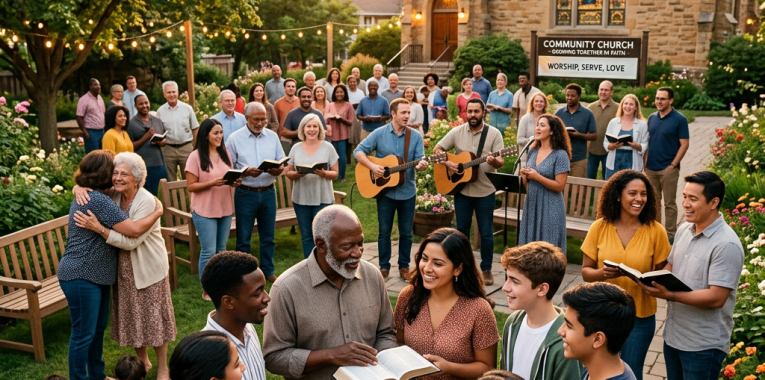
The apostle Paul imagined a church community very much like this one where multiple generations all worshiped and served the Lord together, each one pouring into the other in the ways God specifically designed them for. Older generations pour into younger generations, giving them encouragement and wisdom. Younger generations pour into older generations, serving and helping them with things that are harder for them to do than they once were. Both of them pour together into the youngest generations who benefit from the wisdom and experience of the older ones as well as the energy and enthusiasm of the younger ones. All of this is just as God designed it to be: one, big, happy, kingdom-focused family.
If your church is experiencing something like this, savor it and do whatever it takes to protect and strengthen and extend it. If it isn’t, start now the work necessary to build it. Prayerfully discern who God specifically made your church to be, and begin taking the steps necessary to move in that direction. The next generation of the faith depends on it, and the salvation of the community God put you in does as well. Experiencing the wonder of being the body of Christ is an experience unlike just about any other in this world. I hope you’ll do all you can to have it.

