
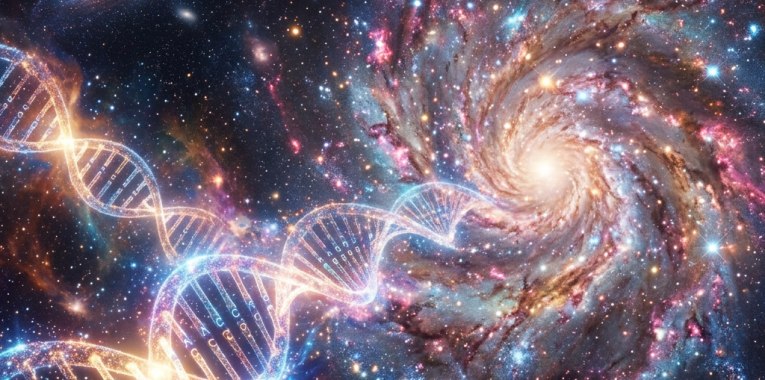
“The Lord founded the earth by wisdom and established the heavens by understanding. By his knowledge the watery depths broke open, and the clouds dripped with dew.” (Proverbs 3:19-20 CSB – Read the chapter)
When Charles Darwin first proposed his ideas about human origins, our understanding of the complexities of life was pretty rudimentary. Of course, we didn’t think that at the time. The mid-19th century through the early days of the 20th century were marked by incredible confidence in human knowledge—a confidence we now recognize as a rather wild overconfidence (even as we fall into the same trap ourselves about our own knowledge). What we have come to understand since is that life is vastly more complex than Darwin could have imagined. Not only that, but the universe itself is complex almost beyond all description. To borrow the phrase that is commonly used to describe it, we live in a finely tuned world. It takes a great deal of wisdom to manage such a world. Fortunately, that’s the nature of the God we serve. Let’s talk about it.
I love learning interesting facts about the natural world. There is just about an endless supply of them too. And we are constantly discovering new amazing facts all the time. We live in a world that is ripe for discovery. Every time we think we must surely have learned all there is to learn, we turn an intellectual corner and find a whole new trove of things we didn’t know. Someone could argue this is all just a grand accident, but the harder you press on that point, the sillier it seems to be. Self-styled intellectual skeptics will often look down on the “simple” folks who cling to their divine explanations of the world and its workings, but the more we learn about the world, the harder that conclusion becomes to ignore.
Today we are often sold an image of the ideal scientist as a courageous explorer who is simply following the evidence wherever it may lead without any trace of bias. That’s a nice thought, but sweet idealism of theory here rarely meets up with the hard road of reality. The truth is that everybody brings a set of biases to everything they do. Skeptical scientists bring their naturalistic biases to bear just like believing scientists bring their theistic biases to their craft. The goal is not to achieve some sort of bias-less exercise of science. That’s a pipe dream. It is better to answer a different question altogether: Which set of biases are more likely to yield outcomes that best align with reality?
There are certainly historical examples of believers reading the Scriptures with the blinders of faulty assumptions about the world and its workings firmly in place and by those drawing incorrect conclusions about the nature of the world and its workings that are shielded from warranted criticism by the religious implications that have gotten attached to them. The debate over heliocentrism versus geocentrism as the proper model for doing cosmology is perhaps the most classic example of this. Of course, the reality of the debate – including the infamous conflict between the church and Galileo – isn’t quite like the just-so-stories associated with it often go, but we’ll leave that alone for now.
Today, though, the group that seems to be running into the walls of reality more and more often is the one that has limited itself to operating only from within the limits of naturalism. The modern heirs of Darwin’s evolutionary model for explaining how and why the world is the way it is once fancied themselves as the only honest scientists in the world. They became intoxicated by the heady draughts of naturalism’s apparent ability to explain everything that their unsophisticated forebears once comically relied on God to understand in the early days of naturalism’s ascent to power, but the hangover from their rager has lasted far longer than it should have.
Naturalism has two mechanisms for explaining why and how the world is the way it is: chance and necessity. Either the world had to be this way for some unexplained reason, or else we just happened to wind up here by complete accident. Given the obvious insufficiencies of necessity as an explanation, most naturalists lean toward chance. And, when our knowledge about the details and intricacies of the world were fairly rudimentary by comparison to what we know now (which will, no doubt, seem rudimentary by the standards of future knowledge), Darwin’s chance-rooted model seemed like a winner. When our knowledge grew a bit more complex, so did the evolutionary explanatory pathways, but they still seemed to work.
Yet when the structure of DNA was elucidated by Watson and Crick, and we became aware that life wasn’t the result of a mere chemical accident but was the composition of an impossibly vast amount of information, the structure started to fracture some. Its most ardent acolytes quickly rushed to patch up the foundation, doing their best to hide the cracks, but they could only do so much. And as more and more information started pouring in about the sheer complexities of life, and even more about the incredible fine-tuning of the universe, what once seemed like an impenetrable fortress, started to appear more like a house of cards. To thoroughly mix metaphors on you, while the old emperor may still be parading around various industries and institutions, more and more people are willing to acknowledge that perhaps he’s not wearing quite so many clothes as they once thought he was.
The truth is that the world as we know it today reflects an incredible amount of design. And, yes, design is the right word. The odds of chance creating the many multitudes of complex structures we find everywhere we look both in organic life and in the inorganic natural world are so vanishingly small that it’s laughable that anyone would still hold to some form of it as an explanation for anything. Those folks who are still committed to such a path have a faith in naturalism that should put the weak faith of many believers to shame. They are more and more becoming what they once lampooned believers as being: blindly devoted adherents to a way of life that doesn’t make any sense given how much we know about the world today.
What is becoming more and more clear all the time is just what Solomon declares here. “The Lord founded the earth by wisdom and established the heavens by understanding. By his knowledge the watery depths broke open, and the clouds dripped with dew.” He knew what He was doing. He built in layer upon layer of incredible design and engineering. He created it all to be absolutely ripe for endless discovery. The more we learn, the more we discover there is to learn. It is all a well that simply refuses to run dry. And the thing is: He didn’t have to make it this way. He could have made it all much simpler. But He didn’t. He made it gloriously intricate and wonderfully complex. He made it so that we can delight in exploring to our heart’s content and beyond. Everywhere we look there are more amazing aspects of creation to discover and for which we can give Him glory.
We shouldn’t be afraid of science at all. We shouldn’t be nervous that some discovery is going to come along that will finally make belief in God unreasonable because naturalism can sufficiently explain the world and everything in it. That hasn’t come anywhere close to happening in the last 200 years, and in the last few years we are moving with increasing speed away from that sense that such an explanation will ever be found. The more we learn about the world, the harder it is becoming to avoid the conclusion of design by a Designer who is wise and understanding and possessed of all the knowledge in the world.
God made the world and left His fingerprints all over it. It is our joy and to His glory for us to explore and find them in every way and place we can. And when we do, we can delight in the goodness of our God and share in that delight with those folks who can’t yet see it because of their worldview blinders. That’s our call as followers of Jesus. As Paul said, what can be known about God is clear through the things He has made. The more we study those things, the more we will know Him, and the more we will be able to help others know Him as well.
 The Nexus