
“So the word of God spread, the disciples in Jerusalem increased greatly in number, and a large group of priests became obedient to the faith.” (Acts 6:7 CSB – Read the chapter)
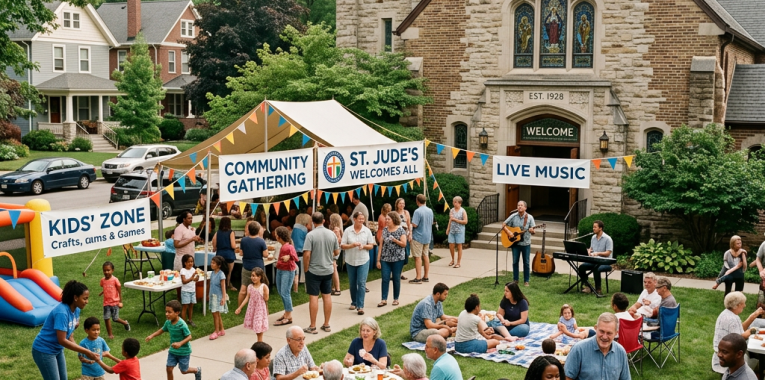
The neighborhood church is making a comeback. There’s just something good about a church that is an integrated part of its community. People know the church, and the church knows the people. When a need arises, everyone works together to meet it. Neighborhood churches aren’t necessarily big, but they are impactful. And they grow. It has been a few weeks, but today we are continuing with the fifth part of our conversation about the things that are contributing to the growth we are seeing happen in real time at my church, let’s talk about community rhythms.
Let’s start with what may be an uncomfortable question: If your church disappeared tomorrow, would anybody outside the church know about it? More specifically, would anybody in your community know about it?
Almost fifteen years ago now, I was sitting at my desk when the phone rang. I only had a secretary then for a few hours a day and a few days a week, so I took the call. It turned out to be a woman calling to ask about our vacation Bible school program that summer which was just around the corner. After telling her all about the program, she asked where we were located. In response, so that I could give relevant directions, I asked where she was coming from.
Now, you need to know that the community we were in at the time was small. Really small. The town had a post office, two gas stations, and that was about it. Oh, and three churches, one of which was ours. It was one of those everybody-knows-everybody communities. Everybody knew where everything was…because there really wasn’t much to know. My little church was at the geographical heart of the community, right behind the main gas station/convenience store, and across the street from the post office.
As it turned out, the woman lived in that community. In fact, she lived about 60 seconds from the church. Maybe 90 if there was traffic. When I asked if she knew where Church Road Market was, she peeked right up and said, “Yes, I know right where that is!” I said, “Great, we’re right behind there.” She promptly replied, “Oh, I didn’t know there was a church behind there.”
That moment was a wake up call for me. My prideful self wanted to react with a bit of scorn. Other than Church Road Market, there were a total of nine buildings on that road. There was one house between the church and the community hub, but it was set back off the road a bit and hidden by trees. Meanwhile, the church with the parsonage next to it was a long, clear stretch that you literally couldn’t miss. After all, it was a church. It wasn’t some kind of a modern church building that didn’t really communicate “church” when you looked at it either. It was a church. How on earth could she not know it was there?
But the truth of her words weighed enough to keep that reaction at bay. Here we were, located at the heart of our small, close-knit community, and someone who lived less than five minutes away didn’t even know we were there. If we had disappeared, she wouldn’t have had any idea. She wouldn’t have been impacted by that at all. How many others in our community were the same way? As long as all I interacted with were other church people, it seemed like everyone knew who we were. But as soon as I got outside of that bubble, things changed very quickly.
Two ideas clarified in my mind that day that have been at the back of most of the ministry decisions I have made sense. The first was this, no church has the right to expect people to know it’s there. When you drive past the same area over and over and over again without really paying attention to it, you don’t really notice what buildings you drive past. I suspect you have been on a drive before and had one of those moments of realization that you had no memory of that last portion of your drive. You couldn’t have described any part of it or any of the things you passed if your life depended on it. Just because your church happens to be in a community doesn’t mean that anybody in your community is going to know…or care.
The second idea was this: So far as it depended on me, I was going to make sure I never had another conversation like that one again.
Every church has a community. What that community is doesn’t always look the same, but every church has one. Your church exists in an area with its own rhythms and patterns. There are expectations for how people will behave, where they will go, and what they will do. Your community may be large—large geographically or large population-wise or both. Your community may be small in either of those ways as well. It could be a closely connected community, or a loosely connected one, but there is something that defines it.
Given all of this, you need to make sure that you are an integrated part of your community. In my community, there are several different ways of doing that, and we try to cover a whole lot of those bases. For starters, there are the big community rhythms. We have a weeklong Fourth of July carnival each year with live music every night, a massive parade on the Fourth, and a big fireworks display just before midnight. It draws thousands of people to the area. Our little town of just over 2,000 people will be swamped by as many as 30,000 visitors or more for the parade and on the night of the Fourth. Our people are involved in that event at every level.
We have an annual tree lighting ceremony and Christmas parade, and a Veterans’ Day parade as well. We are involved with those. I typically help plan the tree lighting ceremony. We provide the sound system for it as well as the emcee. There is always a community worship service the Sunday before the Fourth. I regularly preach that, and we have hosted it at our building multiple times. The town holds a National Day of Prayer event every year. I always organize that, drawing in as many other local pastors as I can.
Our church hosts an annual community Trunk or Treat event that draws around 2,000 people each year and involves several other churches and businesses. The town hosts the largest Cruise-In gathering in the state once a month from March through October. While we haven’t done it since Covid, our youth used to always sell ice cream out in front of our youth building which is located right in the middle of the action.
We have church members who are active in serving with the local Meals on Wheels organization. Our Board of Commissioners meetings always see at least one or two church members in attendance. We have members volunteering with the Zoning Board and the Historic Preservation Committee. There is a local business advocacy group that meets monthly and which I have attended with a handful of others members for years. We have all served on the board of that group at different times.
We have a K-8 school in our community. We have multiple members and attenders on staff there and actively involved with the school’s PTO. We have a close relationship with the school, hosting events and donating supplies or equipment for various events they have there. Over the years I have been here, I have been intentional about cultivating relationship with local business leaders and organizations and ministries and other church leaders whether they are from my same denomination or not.
This is all what being integrated in our community looks like. If you want your church to grow in ways that are healthy and sustainable and which are making a Gospel impact on your community, you need to figure out what being an integrated part of your community looks like and get on getting integrated.
What things does your community celebrate and how can you involve yourself in those celebrations? What are the leadership structures in your community and how can you support those and even get involved with them? What other churches are trying to do the same thing you are and how can you work with them so that together you all accomplish more? What non-church ministries are seeking to serve your community and how can you support and resource them to expand their reach and impact? If you don’t have a local aid ministry seeking to meet the practical needs of your community you can support, you need to find out what those needs primarily are, and you need to get involved in meeting them yourself. Build a network of churches and business leaders who are working with you to make a difference. Do you know who your neighbors are? Whether those neighbors are businesses or individuals, how many of them are connected to or otherwise involved with your church? If they are involved other places, that’s great. If they aren’t involved anywhere else, get them involved with you.
Essentially, you need to make your church essential. This won’t happen overnight. It will take a lot of work and intentionality. You may put forth a whole lot of effort in this direction and at first see very little in terms of obvious return on your investment of time and energy. Don’t get discouraged. What you are doing by these efforts is expanding the scope and impact of God’s kingdom in your community. As you do this, you will eventually start to gain the attention of the people around you—both those who are like-minded in their efforts and those who are not. Those who are will start to work with you as you celebrate your mutual successes together. Those who aren’t, may very well start to turn in your direction because when they taste and see that the Lord is good because of what you have done to make yourself essential, they will want to join in the party.
This is what the early church experienced in Acts. They made themselves essential in Jerusalem. There were numerous challenges to overcome both internally and externally. They had to organize themselves and reorganize themselves in order to sustain the growth they were experiencing in all the ways we just identified. But in the end, because of their faithfulness and commitment to their community, “the word of God spread, the disciples in Jerusalem increased greatly in number, and a large group of priests [you know, the guys who were the most opposed the church, its leader, and everything it stood for in the beginning] became obedient to the faith.”
If you do all of this, your church will grow. It will grow in faith and obedience. It will grow in character and missional passion. It will grow in reputation and impact. And it may very well grow in number too. Either way, you will be being faithful to the mission God has given you as a local body of Christ, and that is the real goal you are pursuing to His glory anyway. So, make yourself essential in your community. Everyone will be glad that you did.


This was excellent. Sent from my iPhoneOn Aug 7, 2026,
LikeLike
Thanks!
LikeLike