
“So remember your Creator in the days of your youth: Before the days of adversity come, and the years approach when you will say, ‘I have no delight in them.'” (Ecclesiastes 12:1 CSB – Read the chapter)
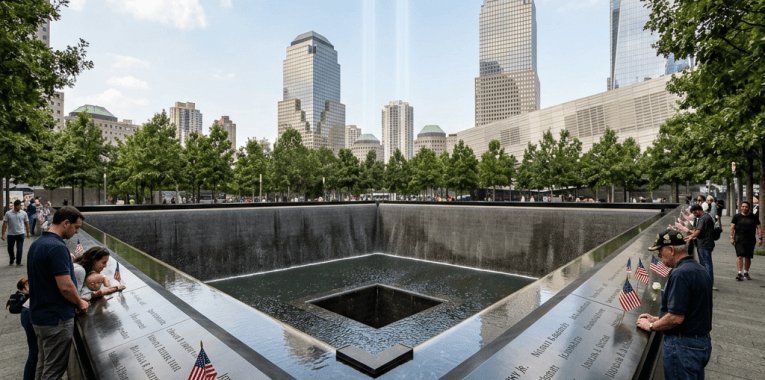
Today is a somber day. Twenty-five years ago today, evil men driven by an evil interpretation of a bad religion murdered nearly 3,000 Americans in cold blood by flying planes into the World Trade Center towers and the Pentagon. They hoped for even more. The mantra coming out of that day was that we would never forget what happened that day. We would remember so that we understood that evil was real, that there are those in the world who wish us harm for reasons we consider entirely irrational, but which makes perfect sense to them, but also that the worst of times will sometimes bring the absolute best out of people. And yet, 25 years is a long time. There is a whole generation that doesn’t remember because they weren’t old enough or even alive to have experienced it…to know where they were. So, let’s reflect a bit today on that very thing. When 9/11 happened, where were you?
I was a freshman in college. I was pretty well getting settled into college life at Truman State University. I hadn’t yet gotten fully connected to the campus ministry I would be a part of, but I was bouncing back and forth between two great ones. I was plugged in at my church. The drum line had become a family away from family early on in the marching band season. And the first class for my chemistry major, Quantitative Analysis, was absolutely kicking my tail.
Happily, on Tuesdays, I didn’t have class until 11:30. What that meant for me, an early riser, is that I had lots of time after an early breakfast to study and do homework. On this particular morning, I had been working on Quant work, and wasn’t really paying attention to anything else. I didn’t have a smartphone to ping me with the latest news as those wouldn’t even exist for another seven years (and it would be another few years after that before I got my first iPhone). I didn’t have a TV in my dorm room, and never went out to the common room. Basically, I had been a hermit that morning.
But by 10:30 or so, I was a hermit in need of help. So, I loaded up my work, and headed out for Magruder Hall, the science building, to visit my professor, Dr. Lamp. Dr. Lamp was great. He was a good teacher and a genuinely caring man. He was always willing to help and was really patient to explain and re-explain things until I sort of understood them. I didn’t ever really understand them, but I could at least successfully regurgitate enough of what he taught to do okay on the tests. It took a lot of work, though.
As I exited my dorm, Missouri Hall, through the door facing southwest, an acquaintance of mine, Jeff, was walking in. He asked me if I had heard that America was under attack. I think I mostly just laughed off the ridiculous notion. America attacked? How silly. Of course we hadn’t been attacked. I think I said something vaguely intrigued, but noted that I was on my way to get some chemistry help, and I’d turn the TV on when I got back.
When I got to Dr. Lamp’s office, he had his radio on listening to the news reports about the morning. I said that I had just heard we were under attack, and asked if it was really true. With a great deal of soberness he told me it was, and kept listening. Still mostly clueless to the reality of what was happening, I pulled out my notes and set about asking him the questions I had. Much to his credit and as a testament to his great patience, he actually helped me until I seemed to have it down. Then I headed back to my dorm.
By then, there were some other guys gathered in the common room glued to the TV. By this time, both towers had come down and the news anchors were doing their best to process what was happening to avoid dead air while at the same time wrestling with their personal shell shock at what they were witnessing.
I went over to my 11:30 class, but I’m pretty sure it was cancelled. After lunch, I went to my Calculus class. Once we were all settled, the professor, a Christian, observed that some things were more important than a math class. He told us class was going to be dismissed so that we could go and process the news of the day in whatever way we needed to.
Other than watching news footage for the rest of the day, I really don’t remember anything else that happened then. My next clear memory comes from three days later when they held a nationally televised memorial service to grieve together as a nation in the National Cathedral. I remember it because Billy Graham was the main speaker and the kid sitting next to me watching in the common room asked me who Billy Graham was. I remember being shocked that anyone didn’t know who the most famous evangelist in the world was.
That’s the extent of what I remember from those early days. It’s not much, but it is vivid. What are your memories? That day changed everything. It was one of those absolutely pivotal events on the other side of which nothing in the world would ever be the same again. In some ways, there are things that are better. Our nation began taking the threat of radical Islam a great deal more seriously than we did before. We began a multi-decade campaign to cut the heads off the Hydra so that something of that magnitude could never happen again. In that, we have largely succeeded. There have been attacks since then, of course, but nothing on that scale.
In other ways, though, many things are worse. Culturally, one of the strongest responses to the tragedy was the rise of the New Atheism. And although that movement was fairly short-lived, the worldview damage it wrought on the West paved the way for a much more radical secularization of the culture than existed before then. It didn’t cause the secularization, but it did give cover for it to advance at a far more rapid pace than it was before. The problem here is that a secular worldview didn’t have the sufficient worldview resources to meaningfully resist the advance of radical Islam for long. History has borne this out across Western Europe, but also in a growing number of places in our own nation.
Now there is a mayor of New York City who is Muslim, who has made multiple statements downplaying the horror and tragedy of that day or drawing lines of equivalence between the barbarity of radical Islam and various actions of the West, who has members of his administration who actively defended the terrorists involved in the attack, and who fully intends to make himself a part of the ceremony today in spite of a loud chorus begging him to stay away so as not to take away from the solemnity and significance of the event for those who were there or who lost loved ones in the attack.
We also have a progressive political culture more generally that has worked diligently to make sure students born since those attacks are fed a narrative about it that doesn’t match very well with reality to the extent that when Bin Laden’s letter to America circulated on TikTok a few months ago, people liked and agreed with his assessment by the tens of thousands. When large segments of our culture are so cluelessly online that they blindly thumbs up the critical assessments of American life and culture from the man who engineered the largest single attack on innocent American civilians ever, we have a problem.
Those who experienced 9/11 will never forget it. That much is absolutely true. We will never forget where we were, what we were doing, and a host of little details about the moments around the time we learned of the attacks and saw the horrors on television for the first time that would have otherwise been lost with so many other details from the past. But there is a whole generation alive now with another on the way that doesn’t have any of that. They don’t remember. They can’t remember on their own. They won’t remember unless we tell them.
Unless we consciously and intentionally set the memory before them, it will be lost. This means that as hard as it might be, we have to talk about it. We have to tell our stories. We have to insist on the annual memorials. We have to demand that the places we now consider sacred remain sacred. But we can’t stop with only remembering the event itself. We have to remember why it happened. We have to remember who it was that did it. We have to remember what they believe and that they have not lost their determination in the 25 years since to see our way of life utterly destroyed before the triumphant rise of theirs. We have to remember that if we try to confront their strong (not good, but strong) worldview beliefs with weak worldview beliefs, they will continue to advance and achieve their aims even if their methods have adapted to the world as it is now. Again, just ask Western Europe about this.
There are some things we simply must remember because unless we do, we stand to lose a great deal. Solomon put God and His ways definitively on that list at the end of his assessment of the purpose of life in Ecclesiastes. The 9/11 attacks go on that list as well. So today, remember what happened. Remember where you were. And if you weren’t yet when it happened, then ask somebody who was and listen to their story. Let us remember together and commit to learning the right lessons so we don’t go that way again.


At the time I was attending a meeting in Groton CT. Getting home to New Orleans was a real challenge. Ended up taking a train from Providence RI that went thru NYC. Could see the smoke rising as we came in. Was in Penn Station that Friday for a layover when Bush gave his speech from the rubble. During the moment of silence the place went eerily quiet for a busy train station. Had left RI Friday morning approx 0800 & got into New Orleans Saturday night after 2300, then there was the drive home to Waggaman. Definitely “no place like home.”
LikeLike
Those stories are all so important. Thanks for sharing yours!
LikeLike