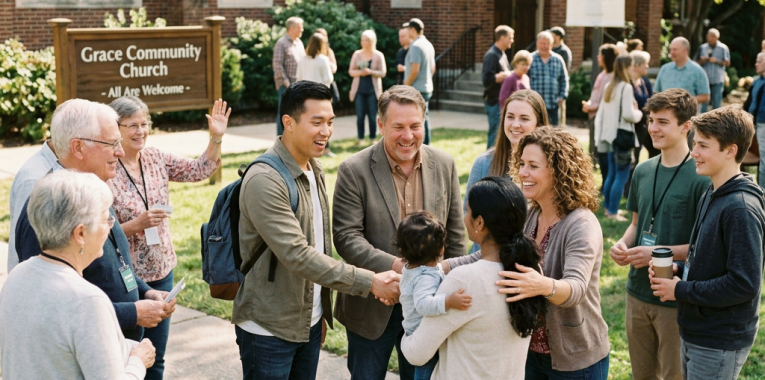
People greeting outside Grace Community Church beneath a Come As You Are sign

Creating a Welcoming Culture

“So he told them this parable: ‘What man among yo, who has a hundred sheep and loses one of them, does not leave the ninety-nine in the open field and go after the last one until he finds it? When he has found it, he joyfully puts it on his shoulders, and coming home, he calls his friends and neighbors together, saying to them, “Rejoice with me, because I have found my lost sheep!” I tell you, in the same way, there will be more joy in heaven over one sinner who repents than over ninety-nine righteous people who don’t need repentance.'” (Luke 15:3-7 CSB – Read the chapter)

Have you ever been in someone’s home before where you knew you weren’t wanted? Maybe they didn’t say it out loud, but from the way they greeted you to the way they spoke to you once you were inside to even the state of the house, you knew. They made it abundantly clear. For people who have been a part of a church for very long, it can become an extension of their home. The other members are all brothers or sisters and they are one big family together. Because of this, when someone new comes in the door for the first time, it’s like they are walking into our home. How we receive them communicates whether or not we really want them there. And if we want our churches to be growing churches, we had better think long and hard about that reception. Today we are looking at the sixth ingredient in a growing church. Let’s talk about creating a welcoming culture.

Read the rest…

Digging in Deeper: Romans 12:13

“Share with the saints in their needs; pursue hospitality.” (CSB – Read the chapter)

One of the things the church offers the world that really isn’t found anywhere else in the same way or at the same level is community. The community available in the church is good. Really good. In a world where multiple governments have declared loneliness an epidemic, the church offers a real solution to this problem. But as good as community in the church is (or at least can be), it’s not easy. It’s not easy for a variety of reasons, mostly connected to sin. We need help to get it right. As Paul continues offering bullet point commands for kingdom living, these next several commands all speak to getting community right. Let’s take a look.

Read the rest…

Morning Musing: Hebrews 13:1-3

“Let brotherly love continue. Don’t neglect to show hospitality, for by doing this some have welcomed angels as guests without knowing it. Remember those in prison, as though you were in prison with them, and the mistreated, as though you yourselves were suffering bodily.” (CSB – Read the chapter)

At last we come to the big finish. After twelve chapters and seven months, we are at long last on the final stretch of this incredible letter. With all of his main points now made rather thoroughly, the author closes things out with a kind of lightning round of miscellaneous advice and commands. There really isn’t a consistent theme to any of these, but there is deep wisdom in them all the same. He starts here with the rather appropriate exhortation to love, given how rooted in love is the new covenant. Let’s talk this morning about love in action.

Read the rest…

Irreducible Complexity

With one more week to go in our series, Being Useful, we are starting to get a lot more clarity on what the picture of a life that is useful to Jesus looks like. And what does it look like? Love. This week and next we are going to wrap up this powerful series by talking about the role love plays in the church and in the life of a follower of Jesus. Don’t miss a single part of it.

Irreducible Complexity

Some of the fiercest and most significant debates happen in places where nobody sees them.  These are often inner-disciplinary debates among scholars on a single topic.  And the stakes for these are a lot higher than it would seem.  For instance, a debate among mathematicians about the best way to solve certain kinds of math problems may look from the outside like a bunch of geeks arguing about esoteric philosophies that have nothing to do with the daily lives of normal people.  But, the winning side may very well have their ideas appear in textbooks—do they even use textbooks anymore?—and curricula for elementary students and, all of a sudden, a whole new way of thinking about math will be planted in the culture.  All of a sudden, what was once abstract academic jargon begins to have a profound impact on the lives of regular people who are far removed from the ivy-covered campus buildings of elite universities.  Hello: Have you tried helping your kids with their math homework lately?  Case in point. 

Read the rest…