
“So he told them this parable: ‘What man among yo, who has a hundred sheep and loses one of them, does not leave the ninety-nine in the open field and go after the last one until he finds it? When he has found it, he joyfully puts it on his shoulders, and coming home, he calls his friends and neighbors together, saying to them, “Rejoice with me, because I have found my lost sheep!” I tell you, in the same way, there will be more joy in heaven over one sinner who repents than over ninety-nine righteous people who don’t need repentance.'” (Luke 15:3-7 CSB – Read the chapter)
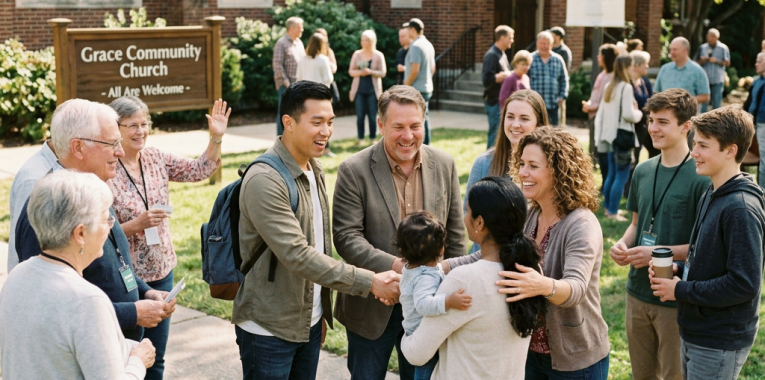
Have you ever been in someone’s home before where you knew you weren’t wanted? Maybe they didn’t say it out loud, but from the way they greeted you to the way they spoke to you once you were inside to even the state of the house, you knew. They made it abundantly clear. For people who have been a part of a church for very long, it can become an extension of their home. The other members are all brothers or sisters and they are one big family together. Because of this, when someone new comes in the door for the first time, it’s like they are walking into our home. How we receive them communicates whether or not we really want them there. And if we want our churches to be growing churches, we had better think long and hard about that reception. Today we are looking at the sixth ingredient in a growing church. Let’s talk about creating a welcoming culture.
One of the holy grails of church growth is the returning guest. Almost anybody will visit a church once. We can all sit and endure an hour’s worth of misery or boredom or awkwardness. But when somebody comes back a second time, that means they saw or experienced something that was truly positive. Now, yes, it could simply mean that God is really working on them and they don’t know where else to go, but if their experience was bad enough, they’re going to find somewhere else. Better yet, they’ll find a way to ignore God’s Spirit and go back to what they were doing before.
When we have been going to a church to the point we are comfortable there, it’s easy to forget that going in the doors for the first time is scary. This is something I try to remind my folks of fairly frequently, and it’s a line I regularly use when inviting someone to church who hasn’t been before. Rather than trying to ignore the elephant in the corner, I shine a light on it. I’ll say, “Listen, I know that it takes a lot to visit a church for the first time. We church people forget just how terrifying that can be.” I want them to know that I understand that tension in advance and to neutralize it as an excuse to not come.
And if you’re a church person thinking this can’t be the case, think again. When you walk into a church for the first time, you don’t know what to expect. I mean, you have probably checked them out pretty thoroughly online first, so you have at least some idea, but maybe the website is unintentionally misleading. Maybe it’s not a good website and didn’t give you much information. When you walk in those doors, you don’t know the people. You don’t know the behavioral expectations. You don’t know what the worship is going to be like. You don’t know where the bathrooms are. You start to question whether or not you have dressed appropriately to match the culture. You don’t know what they might ask you to do that will out you as a guest.
Fun story: I visited a church one time as part of a seminary class aimed at giving us different worship experiences. During the welcome, the pastor not only shined a spotlight on us as a group of guests, he invited us to stand up and one-by-one share a word of welcome with the church. Even if I was an extrovert, that would have been awful. I’m not an extrovert. At all. I wanted to crawl in a hole and hide there the rest of the service. I literally don’t remember anything else about that visit except that moment. You could not pay me to go back to that church a second time.
Because of all this, the welcome experience a church provides for its guests matters a great deal. No, you don’t understand. It matters more than you could possibly imagine. When someone walks in the doors for the first time – better yet, when someone drives onto your campus for the first time – they know whether or not you actually want them there (we’ll talk more about that next Friday). Before they even get to their seat for the first time, they have a pretty good sense of whether or not they are going to come back for another visit. This means we need to gear a great deal about our churches to making sure their experience is positive from that first moment.
This, of course, begs an obvious question: How? Well, Thom Rainer has a book called, Becoming a Welcoming Church, that is a great place to start. If you haven’t read it, it’s worth the $8.07 to have Amazon deliver it to your mailbox. Here’s a link for that. I’ve actually taught a seminar on the book before I am that convinced it is worth your time. I’m not going to repeat every word of that here by any means, but let’s do hit some highlights.
You need to have a good website. It needs to be modern, not cluttered, and informative. Your service times, address, and phone number should be somewhere prominent. It needs to be kept up to date. When someone gets on your website and sees information that is weeks or even months old, that communicates inattentiveness that may translate to how you will treat them when they arrive. As the one who primarily keeps my church’s website up-to-date, I can tell you that this doesn’t take long. There are plenty of platforms that make it very, very easy. A few minutes a week is really all you need most of the time.
In addition to accurate information, your website needs a first-time guest page. That page should give them directions to the church. It should tell them what to expect when they arrive. They should be able to read that and know what to wear, what the service will be like (especially the worship time), how long it will last, and what you have planned for their kids. It should communicate that their kids will be safe with you. You should have some sort of a summary of what you believe so they know that snakes aren’t coming out at some point during the service. And, I would add that simply referring them to your denomination’s full doctrinal statement is not enough. They don’t want to read a tome, they just want a quick summary that tells them you’re not weird; that tells them you’re neither super woke nor hyper conservative.
That’s all before they arrive. When they actually pull up, you should have clearly marked guest parking (which your website informs them about). That parking should be close to the main entrance to your sanctuary. You should not let members park there for any reason. Your grounds need to be neat and well-kept. If the church looks dumpy from the outside, they are going to assume it will feel dumpy on the inside. On that note, you need to make sure your facilities are clean, especially your kids facilities. To the extent you can get rid of your church’s “old church smell” do that. And I know you know what I mean by that because you’ve smelled it before. There are still some areas of my church’s campus that have that smell, but we are about to fix that in a very big way.
You need greeters. Not an army of greeters (unless you have a very big church in which case you’re probably already doing all of this anyway), but a reasonable number given the size of your welcome area. At least two greeters serving at a time would probably be wise because then one is always free to accompany a first-time guest to their seats while the other continues welcoming people. Greeters and bulletin hander-outers are not necessarily the same thing. Those greeters should be trained to be welcoming. A grumpy greeter sends a clear message.
If you have been at your church for long, you know where everything is. Navigating the building or the campus is like second nature. New people don’t have that. Being new is a disorienting experience that interferes with our natural sense of direction. Even if you think your church is simple to navigate, your guests don’t. This means you need signage. Things like where the worship center is should be easy and obvious. More importantly than that, they should be able to find the bathrooms without any trouble.
Having some sort of a welcome gift for first-time guests is a good idea. This communicates that you thought about them and that you really are glad they are there. This doesn’t have to be much and can take all sorts of different forms, but something here is generally better than nothing. We have a welcome table with coffee on it. The table is clearly marked with a banner. On that table are gift bags labeled with a logo sticker, and our greeters are trained to make sure every first-time guest gets a bag. And while this sometimes happens when they walk in the door, it also happens when one of our members delivers one to them at their seats. This gives us the opportunity to engage them in conversation for a bit and tell them we are glad they are there.
These are all some basic things to keep in mind before your guests even get to their seats. There’s more to this, but I want to stop this a bit short and address something even more fundamental. Being a welcoming church has to go beyond these kinds of window-dressing things. You can do all of these things, do them well, and still leave guests with a bad taste in their mouths. You don’t need to merely do welcoming things like this, you need to have a welcoming culture.
A welcoming culture has to extend beyond the greeters, beyond the signage, beyond the guest parking and slick website and clever gifts. If the visitor makes it through all of that and is feeling good but sits in the sanctuary as if he is on an island while everyone else floats around him in their fancy boats, utterly refusing to stop and invite him to join them on their ships, everything else the church has done will have been for naught. It won’t matter. He will leave thinking, “Those people didn’t really want me here. They didn’t care about me. I’ll find a church that does.” Or worse yet, he’ll conclude the church isn’t for him at all. Getting this right isn’t just about growing a bigger church. It’s a Gospel matter of life and death.
The welcoming culture you create must become something that pervades the entire church body. Every single member must think of themselves as an individual welcoming crew. They need to make sure they are not merely greeting but welcoming visitors within the orbit of their normal seat. You need a handful of more extroverted folks who take it upon themselves to go around the room, seeking out people they don’t know to let them know how glad they are to have them there. You need the church as a whole to be clear on the vision God has given the church, and sufficiently excited about it that they actively share it with newcomers.
Jesus told a parable about God’s passion for the lost. When He discovers that a sheep is missing, He stops everything to find that lost sheep so He can bring it home. And when He does, He throws a party. Every single guest who walks through your doors is a potential lost sheep that God has brought home. You need to be at least as excited about their being there as God is, and you need to communicate that with them in ways that are welcoming and winsome (don’t be overbearing and desperate…that can drive away guests as quickly as a cold shoulder). And that communication needs to come from the entire body, not just an officially designated greeters for whom that’s their job.
Getting to this point won’t happen overnight. Depending on the current state of your culture, it may take a few months to even a few years to fully get the ship here turned around and heading in the right direction. But if you will put in the effort to make the relevant changes – both physically and in the church’s whole mentality toward guests – you will start to see the payoff come over time. Do it in conjunction with all the other things we’ve talked about, and your church will grow.

