
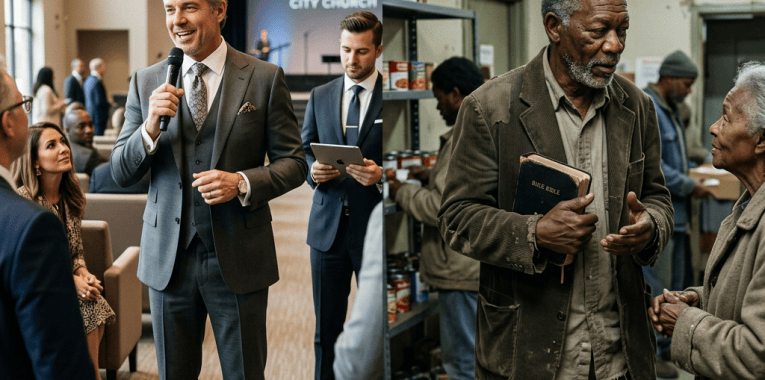
Split scene of a church speaker and a man holding a Bible in a pantry

Neither (Religious) Poverty Nor Riches

“But you are not to be called ‘Rabbi,’ because you have one Teacher, and you are all brothers and sisters.” (Matthew 23:8 CSB – Read the chapter)

The average pastor in America (or anywhere else in the world, for that matter) works hard in a little church in total obscurity. He loves his people and they love him. He spends a lot of time working on multiple messages for each week. He visits people in hospitals and in their homes. He meets people for coffee or a meal at least once a week. He does a fair bit of counseling, some of it formal, much of it informal. He has to be reasonably well-versed in managing both people and finances. He has to remember the names and faces and stories of a lot of people in one shot. He probably spends less time with his family than he should, and he definitely doesn’t give himself and his needs (spiritual or physical) the attention they deserve. But he loves the Lord and is utterly in awe of his call to do all of this whenever he has time to stop and think about it. He will one day reach the end of his journey and hear from his Lord, “Well done good and faithful servant.” This is all how God designed pastoring to work at least in this particular cultural context. Sometimes, though, it doesn’t. Let’s talk today about a couple of reasons why and how to avoid them.

REad the rest…


People of various ages and backgrounds sharing a meal at long tables in a church community dining room

Unpacking a Growing Church

“For just as the body is one and has many parts, and all the parts of that body, though many, are one body – so also is Christ.” (1 Corinthians 12:12 CSB – Read the chapter)

Across the country right now the average church is not growing. It is plateaued at best. Many are stagnant as a prelude to dying. I have a member who travels regularly for work all across the state, but never more than day trips. He has returned several times with stories of seeing more and more churches with for sale signs in their front yards. Over the last 10-15 years, one of the fastest growing interest movements within the church is the church revitalization movement. A big part of the reason for this is that a whole bunch of church leaders have realized all at about the same time that the church isn’t in great shape. There are some significant signs of life in recent days, but many churches are still limping along at best. It seems worth noting, then, when a church is experiencing the opposite of all of this. Well, my church is experiencing the opposite of all of this right now. I thought we might spend at least this Friday exploring some of why I think this may be.

Read the rest…

Digging in Deeper: Exodus 28:15-21, 29-30

“You are to make an embroidered breastpiece for making decisions. Make it with the same workmanship as the ephod; make it of gold, of blue, purple, and scarlet yard, and of finely spun linen. It must be square and folded double, nine inches long and nine inches wide. Place a setting of gemstones on it, four rows of stones: The first row should be a row of carnelian, topaz, and emerald; the second row, a turquoise, a lapis lazuli, and a diamond; the third row, a jacinth, an agate, and an amethyst; and the fourth row, a beryl, an onyx, and a jasper. They should be adorned with gold filigree in their settings. The twelve stones are to correspond to the names of Israel’s sons. Each stone must be engraved like a seal, with one of the names of the twelve tribes. . .Whenever he enters the sanctuary, Aaron is to carry the names of Israel’s sons over his heart on the breastpiece for decisions, as a continual reminder before the Lord. Place the Urim and Thummim in the breast piece for decisions, so that they will also be over Aaron’s heart whenever he comes before the Lord. Aaron will continually carry the means of decisions for the Israelites over his heart before the Lord.” (CSB – Read the chapter)

How do you figure out what God (or the gods, if you prefer) wants? That has been a question plaguing humanity since time immemorial. And we have come up with all sorts of ways to answer it. Some have been fairly simple and direct. Others have been entirely more complicated. Many have even crossed the line into being downright nefarious. The goal, though, has always been the same: to figure out what God wants so that we can live in light of that. For Israel, part of the answer to that question was the breastpiece. Let’s talk about this next part of the priestly garments.

Read the rest…

Keeping the Main Thing the Main Thing

A little something different for you this Friday. I had the chance to see Disney’s new movie, The Haunted Mansion, last weekend, really enjoyed it, and will plan to review it next Friday, Lord willing. Today, though, I wanted to share with you a bit of inside baseball. Yesterday I was invited to deliver a message to our local Baptist association’s monthly pastor’s gathering. It gave me the chance to say to a bunch of pastors some things I think a bunch of pastors needed to hear. I shared with them some thoughts on how to go about keeping the main thing of the church (the Gospel) the main thing of the church. What I had to say may not be what you expect. Read on to find out what three suggestions I had with the help of Paul’s first letter to the Corinthian church.

Keeping the Main Thing the Main Thing

Karl Barth was one of the giants of Christian theology in the 20th century. That doesn’t mean he was always right—he very often was not—but in terms of the people who shaped Christian theology in a profound way and whose influence absolutely cannot be ignored when taking stock of how the world thinks about God today, Barth sits on a very short list. Now, in spite of that, I’ll be the first to admit that my knowledge and understanding of Barth’s theology is pretty limited because his influence tended to be much stronger outside the evangelical world, but neither was he simply a theological liberal. He carved out his own space on the theological map. 

Read the rest…

Digging in Deeper: Hebrews 13:7, 17

“Remember your leaders who have spoken God’s word to you. As you carefully observe the outcome of their lives, imitate their faith. . . .Obey your leaders and submit to them, since they keep watch over your souls as those who will give an account, so that they can do this with joy and not with grief, for that would be unprofitable for you.” (CSB – Read the chapter)

There are several passages like this scattered across the New Testament. Given the position in which I serve, I pretty unfailingly feel really uncomfortable talking about them with other people. As someone who Paul would have (hopefully) identified as one of these leaders, it feels terribly awkward to me to imagine myself standing in front of my congregation and telling them, “you should submit to and obey me.” And yet, passages like these are nonetheless in here, and we have to deal with them. Let’s talk about what this means both for church members and also for church leaders as there’s a little something for everyone here.

Continue reading “Digging in Deeper: Hebrews 13:7, 17”