
“For just as the body is one and has many parts, and all the parts of that body, though many, are one body – so also is Christ.” (1 Corinthians 12:12 CSB – Read the chapter)
Across the country right now the average church is not growing. It is plateaued at best. Many are stagnant as a prelude to dying. I have a member who travels regularly for work all across the state, but never more than day trips. He has returned several times with stories of seeing more and more churches with for sale signs in their front yards. Over the last 10-15 years, one of the fastest growing interest movements within the church is the church revitalization movement. A big part of the reason for this is that a whole bunch of church leaders have realized all at about the same time that the church isn’t in great shape. There are some significant signs of life in recent days, but many churches are still limping along at best. It seems worth noting, then, when a church is experiencing the opposite of all of this. Well, my church is experiencing the opposite of all of this right now. I thought we might spend at least this Friday exploring some of why I think this may be.
I’ve pastored two churches in my nearly 18 years in ministry. When I got to the first one, I was fresh out of seminary and honestly didn’t have any idea what I was supposed to be doing. I knew I had to preach and teach. Other than that, I took the first year I was there to just observe and learn the people and the rhythms. I also went to a few different conferences and read a whole lot of books. I listened to a few different podcasts, although the number of church growth-related podcasts available now is many times greater than were available then. The church and I were both learning something together: could I figure out how to be a pastor when only a few months before I was teetering on the brink of going another direction and staying in the academy?
There were two things I knew that I wanted to do then, and eventually I embraced a third. Eighteen years and a second church later, I am a firm believer that these three things are necessary for any church to do that wants to break from stagnancy and experience some real movement in a growing direction. There are a few more ingredients that I think have been and continue to be essential to what my church is experiencing right now (and my previous church was experiencing when we left), but these three are foundational.
The first of these was Wednesday night dinner. I grew up at a First Baptist Church that at one point was fairly large and connected to the community and was doing all the things a large, First Baptist Church should be doing. One of these was that we ate dinner together on Wednesday nights. We had a large fellowship hall and a commercial kitchen that was run by paid kitchen staff. We didn’t have home-cooked meals, we had more like a cafeteria experience. I don’t remember the food at all. But I remember years and years and years of going every Wednesday night to eat with friends and the larger church family.
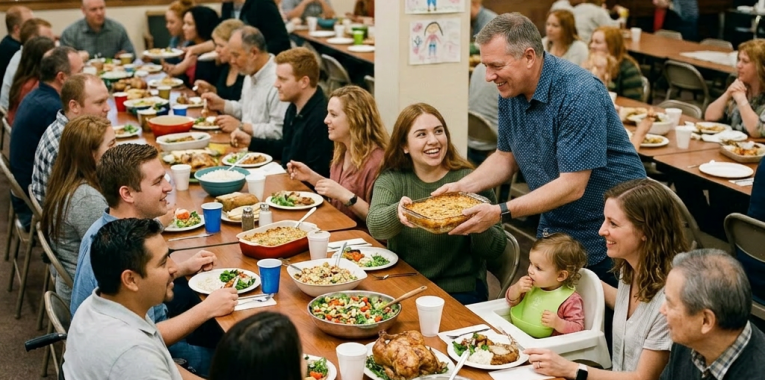
I remember that there wasn’t any kind of an agenda to the meal. It was just dinner. If someone came to eat and then left, while someone might eventually invite them to stay for adult Bible study, but otherwise, they were free to go. The meal wasn’t a reward for sitting through the spiritual stuff. It was just a meal. Together. As a church family. And that’s what it felt like. Even though there were a lot of people there (I wouldn’t begin to guess how many, but it always felt fairly full because all the people I knew and loved at the church were always there), it always felt like one big happy. People were talking and laughing and sharing stories about their week. They were checking in on each other while they broke bread together. There were kids everywhere, playing together, and running around all over the church (how little supervision we actually had on those nights is actually shocking to me now as a parent and pastor, but we never really got into any trouble, so I guess it all worked out).
In short: I loved it.
That time had more to do with shaping my love for the church than just about anything else I experienced growing up. It was that memory, that experience, that led me to point my first church in the direction of eating together every single week. We had a small kitchen, and no paid staff, but we did have a fellowship hall large enough to seat everybody who was interested in coming, and we had a handful of different groups who were willing to take on preparing and serving the meal in rotation, so off we went.
And at first, it was fun, but it wasn’t magical. It was just dinner each week followed by Bible study. But over time – and not very much time at all – something changed. Eating and sharing life together like that became part of the church’s rhythm. People looked forward to that time. They wanted to be there themselves and they wanted to invite their friends to come. The room got louder during dinner. There were more kids running around. The community tightened and drew together, but in a way that was constantly open to new people showing up and integrating into the family. There was life happening.
That time became absolutely essential to the growth that we started experiencing over the final 3-4 years we were there. Without that time, that growth would not have happened. So, when God moved us here, the very first thing I did was to lead them to start eating together as a group every single week. Although they had been meeting for Bible study on Wednesday nights as all good and faithful Baptist churches should (I kid), they only ate together about monthly, if that. I said, “We’re doing it every week and we need dinner teams to help with the effort.” I cashed in a whole bunch of my new pastor capital on the effort, and the church followed.
Things started small, but just like before, that time became more and more important. People looked forward to it each week. They invited their friends to it each week. And it grew. And grew. And what started with 50-60 people soon swelled to more than 100.
Then Covid happened. We started meeting together live for Bible study a few months after we started back together with in person worship, but dinners were a definite no-go for a while. There just wasn’t a way to avoid risking spreading germs all around the room while we all ate and talked with no masks. After a few more months, we started planning to tentatively restart our shared meal, but then the delta variant emerged, and so we waited. A few months later, we were ready to fire things back up again, and the omicron variant emerged, so we waited some more.
When we were finally able to start eating together regularly again, it was a small group who gathered each week. But that core group of church members knew how important that time was. They remembered well from before we had to stop, and so they kept coming. And they kept inviting people. And it grew. More kids and youth started coming. And they started inviting their friends, who invited their friends. Then some of the kids’ parents started coming. And it kept growing. And soon what started with 50-60 on the restart grew to more than 100, then more than 110, then 120, then 130.
Now, each week we are feeding somewhere between 130-150 people with an average of almost 60 kids and youth. This is in a church with an average worship of 160. We had an average worship attendance of 140 last year, and 120 the two years before that.
So, is the moral of the story here that if you eat together regularly, your church is going to grow? No, but that’s sure not going to hurt. What we do isn’t going to work in and for every church. That said, it has been a key ingredient to growth in two different churches with two different congregations and two different cultural contexts. I am aware that this kind of a program is only going to work in churches of a certain size. Our fellowship building is only so big, and increasing its size is not going to be in the cards anytime soon. (We did feed 220 this past Wednesday night, but that was an exception to the rule and definitely more than we could feed on a regular basis.)
Okay, so then what is the moral of the story here? Your church needs a regular time of large group, agenda-less fellowship. A meal is the easiest and most natural time for that, but if it can take a different form in your church, so be it. The time together is what matters. You need time like this to build a cohesive and attractional community. You want new people to experience the fellowship and love you have for one another, and to be included in those virtues right out of the gate. You need a way for members and visitors to be able to build relationships that go beyond what’s happening in the church. This can happen in home small groups, but not at scale. If that’s the approach you are taking, then you need to have regular opportunities for multiple small groups to get together to broaden their relational horizons and avoid the siloing effect.
Your church is many things, but it is first and foremost a community of believers who are growing together in the grace of Christ. If it isn’t that, then the Gospel proclaiming that is an unavoidably essential element of what makes a church a church and not just a club isn’t going to happen with any kind of effectiveness. You need to be doing things that strengthen that community with diligence and intentionality. It won’t happen on its own.
There are other pieces of this puzzle, and we’ll talk about more of them in coming weeks, but this first one really does sit right at the heart of what can take a stagnant church and turn it into a thriving one. What could this look like in your church?

