Growing is hard. Sometimes it hurts. It means things won’t or even can’t be the same as they were before. But growing is also necessary. Things that aren’t growing are slowly dying. This is true about our bodies. It’s true about organizations. It’s true about the church. When the church is growing, we often experience growing pains. This week and next we are talking about a couple of key foundation points that can help us navigate those challenges should they come.
Practicing for the Real Thing
Do you remember having growing pains when you were a kid? Those were awful. I remember weeks when my legs would just hurt. I hadn’t done anything. There was nothing that I could do to stop it. It didn’t really keep me from doing anything. But they hurt. I’m not sure about a precise medical reason for growing pains, but I can offer a layman’s explanation that seems to make a lot of sense. When you are getting taller, everything has to stretch. Skin gets pulled tighter as it expands. Bones get longer. Blood vessels are lengthening to match. Lung capacity is expanding to push oxygen to all the new boundaries of your body. Everything is getting yanked and pulled and stretched out. I don’t know about you, but I feel that kind of discomfort when I try to touch my toes. Now, imagine a period of several months where your whole body is doing that whether you want it to or not. But instead of the stretch ending after a few seconds, it just keeps going.
We are now officially into the season of Advent. For the next few weeks, we are going to be working through a new teaching series looking at just why Jesus came to Earth and what that means for us. In this first part, we’ll answer the question and reflect together on the glorious nature of this powerful truth. Here’s a sneak preview: the reason Jesus came is you. Let’s talk about it.
Why He Came
I want you to think for a second about a time when you heard a dramatic conversion story. Those can be really powerful. I once knew a chainsaw artist who specialized in making eagle’s nests. He carved some pieces for a prayer garden one of the Boy Scouts at our former church made as his Eagle Scout project. They were pretty amazing. In talking to him a few times, I learned that he had never done any art of any kind, let alone chainsaw art, before he became a follower of Jesus. He was mostly just interested in doing drugs. Almost as soon as he accepted Jesus, though, he felt a calling to art, and had been making it ever since. Maybe you’ve seen the movie, The Jesus Revolution. It tells the story of the rise of Chuck Smith who would go on to pastor the Crystal Cathedral church in Orange County, CA. The movie also features the conversion story of Greg Laurie, the pastor of Harvest Christian Fellowship, and a prominent speaker and author. Like my chainsaw artist friend, Greg was into all kinds of drugs before becoming a follower of Jesus. The experience that pushed him over the edge in the direction of the Gospel was when he was driving down the road with some buddies who were all high on LSD, and they saw a glowing vision of heaven in the distance on the side of the road. It wound up being a sign for a funeral home. The experience literally scared him back to the straight and narrow path from the broad path leading to destruction he had been sliding down. Do you know who else had a pretty dramatic conversion? The apostle Paul. And his story is one that I’d like to give a bit of our attention this morning.
This week, as we continue working through the story of the church, we are taking a step with the disciples in a bit of an uncomfortable direction. Just when they thought they had really hit their stride, God called Peter to go and share the Gospel with a group of people who were the very last people in the world He expected to ever be sharing the Gospel with. Yet He obeyed, and the whole church learned a very important lesson we are still trying to learn today. Read on to find out what this is.
An Inclusive Identity
Do you know what one of the most polarizing words in modern English is? “Christian.” That word is the cause of not a little angst on the part of many people both in the church and out. There are some in the church who don’t like the title because of the cultural connotations it has come to have. In the same vein, there are a lot of folks out there who hear the word and associate a whole host of negative adjectives with it: judgmental, small-minded, exclusive, bigoted, intolerant, homophobic, unloving, uncaring, and the list goes on. Then, of course, there are the folks who wear the title like a banner and are kind of judgmental toward all those who don’t. But, have you ever wondered where the word “Christian” came from? Some of the Bible scholars in the room may know that it was not what Jesus’ followers originally called themselves. They preferred the much simpler and, frankly, more descriptive title “disciple.” So how and when did the name change start to happen? Better yet, what does it actually mean to be a Christian? I mean, if we’re honest, there are a whole lot of different kinds of people who believe and do a whole lot of different kinds of things who all claim the title as descriptive of them. A little clarity here would surely be helpful.
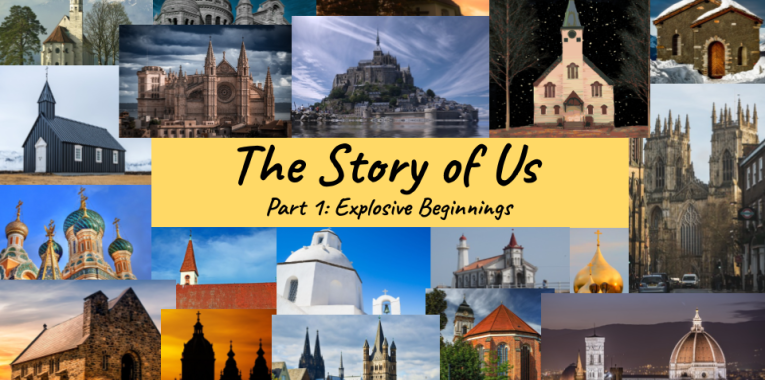
This week we are kicking off a brand-new teaching series. Over the next few weeks, we are going to be journeying through the first part of the story of the early church in Acts. We will be looking together at how the church got its start and what that means for churches today. This is an incredible set of stories that you will not want to miss a single part of. In this first part we are talking about the church’s explosive start and what exactly it was that fueled it. Read on and find out for yourself.
Explosive Beginnings
One of the things we so often miss when we go to the Scriptures is the humor. We start reading and even in our heads put on our “Bible reading voice” and make it sound all dry and boring. The truth, though, is that it is anything but boring, and it is often very funny. Our passage last week as we challenged our graduates (and, really, all of us) is a perfect example. You can’t help but to appreciate the humor of Moses’ doing his best to wiggle out from under the thing God was calling him to do (and which He was abundantly clear was going to end successfully if he would just go do it). But one of the passages that has long been the funniest to me comes right at the beginning of Luke’s historical record of the early church we call, “Acts.”
This week we wrapped up our journey through the beautiful story of Ruth. We got to hear from one last character in the story who gave us a bit of a bird’s eye view of the whole thing. This allowed us to see that what would have been experienced by the people in the story as nothing more than ordinary life working itself out ordinarily was really God’s accomplishing His extraordinary plans through ordinary means. God does this through the Scriptures and He is still in the same business today in our own lives. Let’s marvel at all of this together. Thanks for reading and sharing.
A Story of Serendipity
Have you ever experienced something that was perfectly serendipitous? It was one of those moments when everything just fell into place like you wanted. Everything worked so perfectly that it almost seemed like someone else was pulling the strings. Sometimes we’re aware of that kind of thing happening in a moment, but more often we don’t see it until we look back with the clear vision of hindsight. I can point to a few different circumstances like that in my own life including the ones surrounding the time I first met my lovely bride. If we lived in a world that was perfectly fair, I would never have gotten the chance to even meet her. Thankfully, we don’t live in that world. We live in a world presided over by a God who is just and good and righteous and who has incredible plans for us that He works out in ways that are delightful, surprising, and which often feel very serendipitous.
For the last three weeks, in a series called, “A Love Story,” we have been together experiencing a story that has just that sort of serendipitous feel to it. And I say, “experiencing,” not, “telling,” because that’s the better word for it. Each week we have encountered the next part of the story of Ruth through the eyes of one of the characters who were in it. We started with Naomi and her realization that even when things are bitter, God is still with us. From there, we rejoiced with Ruth in the fact that when we are picking up the pieces, God won’t leave us alone. Just last week we marveled with Boaz in the truth that risks of faith are rewarded with gifts of life. It all works out to some pretty incredible truth from a tiny, little story.
This morning, as we wrap up our journey and Ruth’s story, we are going to experience things from yet one more perspective. We are also going to answer the question you may have wondered about as to why the series is called, “A Love Story.” The big idea of each part of the story so far has been good, but it hasn’t had anything to do with a love story. Before we leave this morning, my hope is that you will have a much better understanding of just why this love story is so powerful. This week, we are going to be in the final chapter of Ruth’s story. If you have a copy of the Scriptures handy, find your way to Ruth 4. Follow along as we take one last dive into the story to see how the ways God works that seem perfectly serendipitous can really serve to reveal the good plans He was patiently unfolding all along.