
“Friends, do not avenge yourselves; instead, leave room for God’s wrath, because it is written, ‘Vengeance belongs to me; I will repay,’ says the Lord. But ‘If your enemy is hungry, feed him. If he is thirsty, give him something to drink. For in so doing you will be heaping fiery coals on his head.'” (Romans 12:19-20 CSB – Read the chapter)
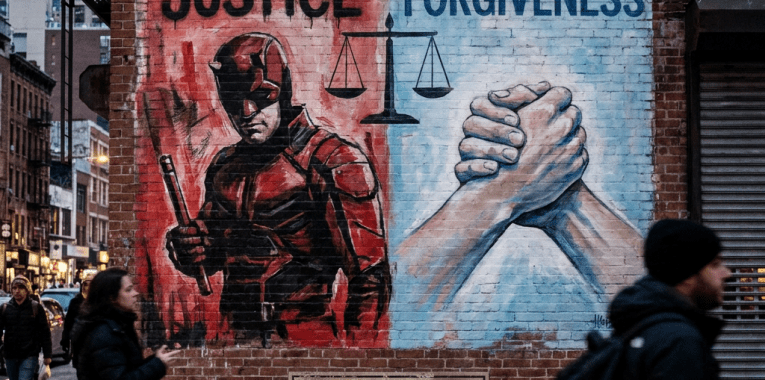
Everybody loves the idea of love. We love the good feelings we associate with it. We love the idea of doing good things for someone we really care about. We love having someone support us and express their concern for us. And that’s a good thing because those are good things. But real love, the love of Christ, is bigger than that. It is harder than that. Being committed to someone else’s good sometimes means doing the hard thing to help them get back on the track of that good even when they have drifted from that path. Sometimes it even means actively taking steps to stop them from doing evil. This requires commitment on the part of the one who is doing the loving; commitment to the point of sacrifice. After all, to express the ultimate love for us, Jesus sacrificed His own life on the cross so that we might live. Marvel’s most recent small screen offering, the second season of Daredevil: Born Again, puts all of this on display in a really powerful way. Let’s talk about it.
My love for all things Marvel is no secret. One of the things that has been largely absent from Marvel is any kind of genuine reference to spirituality, especially anything remotely resembling Christianity. There was a brief nod to the idea that Jesus is a god in Thor: Love and Thunder, but only one of many from across a wide universe of gods. Really, in the world of Marvel Comics, gods are a dime a dozen, so why give any credence to the idea that there might be one above all of them who is worthy of any kind of real devotion?
We already know, for instance, that the Celestials created the universe, so we don’t need Him for that. There are multiple different after lives, some good and some bad. Jane Foster died of cancer and went to Valhalla where Heindall was waiting to greet her. We’ve got Mephisto on the loose making deals and stealing people’s souls for some version of Hell.
This kind of pan-theology in the MCU makes the approach they have to take with a character like Daredevil in order to stay even remotely true to his comic book origins pretty interesting. Daredevil is a committed Catholic and is pretty unashamed in acknowledging that his faith shapes his approach to using his powers to help people. He allows it to draw lines he will not cross no matter what the consequences to himself might be. Those lines really come into play in really interesting ways in this season of the series.
There’s way more going on in this series including setting up future villains than I’m even going to try to summarize. The season opens with Kingpin, Wilson Fisk, secure in his position as the mayor of New York City. His anti-vigilante task force is terrorizing would be Good Samaritans and anyone else the Mayor deems a threat to his agenda. They essentially function as Fisk’s personal militia. The authority they wield, including a judicial system to prosecute the “criminals” they arrest is wildly unconstitutional, but there isn’t anyone to stop them.
Most of the season features Daredevil, Matt Murdock, working with Karen Page, his love interest, and a few courageous allies to find some kind of a way to build a legal case that will allow them to put a stop to Fisk’s reign of terror, all while avoiding getting murdered or otherwise disappeared by the Task Force.
Complicating all of this is our heroes’ efforts to find and deal with another traditional Daredevil nemesis, Bullseye. Bullseye was hired by Fisk’s wife at the beginning of the last season to murder Matt and Karen’s law partner and best friend, Foggy Nelson. Both of them are hellbent on revenge, especially Karen, whose journey of grief has been particularly intense.
The complicating factor here is that Matt’s commitment to justice means that he wants to see Bullseye properly convicted for his crimes. Because of the threat Bullseye represents to his wife for using him as a political pawn, though, Fisk merely wants him dead. So, Matt has to simultaneously save Bullseye from Fisk while wrestling with his own grief and anger over the fact that he murdered his best friend in cold blood.
The way the writers develop and manage this tension makes the season work incredibly well. Everything about this season was better than the first. You’ve got to be prepared for lots of bad language and excessively graphic violence (although no scene was quite as bad as last season when Fisk murdered of the former chief of police by crushing his skull with his bare hands…all of which was shown on camera), but the acting, writing, storytelling, and production values are absolutely top notch.
Ultimately, it’s Matt’s commitment to justice and not mere vengeance that wins the day. He and Karen get the opportunity to deal with Bullseye personally and directly. And, in his own personal anguish over being used as a tool of murder by other powerful people, he wants them to do it. He begs them to just kill him in order to right the scales of justice. Matt and Karen spar over that decision pretty vigorously, but ultimately Matt opts for forgiveness and justice, and gently reminds Karen that this is what makes them different from Fisk.
The writers have them wrestle movingly with the question of what we should do to stop powerful but evil people who seem to be beyond normal means of justice. To put that another way, can we take the path of vengeance when justice seems to be out of reach? This is a much weightier theological question than its appearance in a series based on a comic book would make it seem. One particular answer is what drove Dietrich Bonhoeffer to join the plot to assassinate Hitler that ultimately cost him his life.
By the end of the season, Matt’s forgiveness opens the door for Bullseye to play a key role in helping to stop Fisk. Fisk loses badly in his own corrupt court and goes on a murder-rampage through the courthouse before finally being confronted by Matt, who by this time has publicly revealed himself to be Daredevil for the first time. Although the two fought earlier in the season, this final confrontation doesn’t end with fists, but words.
Fisk and Matt both know he has lost, and by publicly revealing his identity, Matt has sealed his own fate (the season ends with him in prison). When Fisk first protests that he intends to keep fighting because of his love for the city (a twisted and corrupted love that could be the subject of its own exploration), Matt offers a different pathway: grace. Continuing to fight will only get Fisk killed at this point. But grace seems so weak and beyond the pale to him, that he can’t fathom it at first. Matt’s offer of grace winds up being worse for Fisk than the fighting would have been because of the humiliation of it in acknowledging that his own strength proved too weak in the end to accomplish his plans.
The whole thing is a beautiful enactment of what Paul writes here at the end of Romans 12, quoting from Proverbs 25. “Friends, do not avenge yourselves; instead, leave room for God’s wrath, because it is written, ‘Vengeance belongs to me; I will repay,’ says the Lord. But ‘If your enemy is hungry, feed him. If he is thirsty, give him something to drink. For in so doing you will be heaping fiery coals on his head.'”
This is kind of thing is what makes the Gospel so hard. Loving with the love of Christ means trusting in and entrusting ourselves to the justice and righteousness of God. It means responding to those who hurt and abuse us with kindness and compassion, gentleness and patience, because that’s what Jesus did. It means forgiving those who have wounded us without mercy. It means showing them the goodness of the Gospel when the only thing we really want to do to them is avenge our pain. Accepting the Gospel means trusting that God’s justice will prevail in the end, even if the timing on that end is not what we would prefer. In the meantime, our job is to reflect His love and grace toward those around us. And if we would protest that they don’t deserve it, the response is that of course they don’t; that’s what makes it grace.
The Gospel is hard. We should make no bones about that. It means saying no to ourselves over and over and over again when all we want to do is say yes. But for as hard as the Gospel is, it is also good. Really good. It’s the best thing there is, in fact. The goodness of the Gospel doesn’t always manifest in the ways or at the times we want, but it always shines through just the same. The goodness of the Gospel will be the thing left standing when everything else falls apart. If we will wait for it patiently, that goodness is something we will yet experience.
Matt trusted in that goodness and his journey this season ended in a prison cell. But there’s more story to tell. There’s another season coming. Our trusting in the goodness of the Gospel may not seem to end here and now the way we want it to. But if we will keep on trusting, there’s more story to tell. And we know from the promise of Jesus Himself, the longer story will end very well indeed.

