
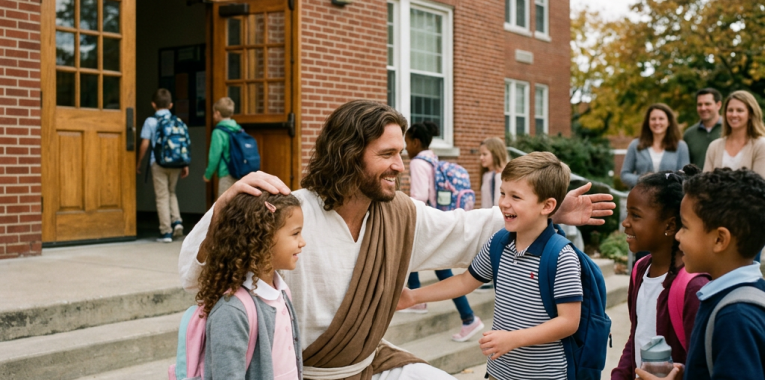
“Jesus said, ‘Leave the little children alone, and don’t try to keep them from coming to me, because the kingdom of heaven belongs to such as these.'” (Matthew 19:14 CSB – Read the chapter)
For the last couple of Fridays now we have been talking about various things that have resulted in the church I pastor being in the position that it is. We are growing. There is life and momentum and excitement everywhere you look right now. New families are connecting regularly, and most of them are young and with young kids. It really is a fun season. But it isn’t a season that has arrived overnight. Things have been slowly building in this direction for several years. There have been several decisions the church has made along the way that have contributed in important ways toward what we are experiencing. Exploring some of these with you is why I’ve started this series. We have looked at two so far – eating together and clarifying our identity – today, let’s take a look at a third one: getting into our local school.
I know I’ve mentioned this before along the way of this journey, but I didn’t have any idea how to grow a church when I got started in pastoring. I was not connected with a church growth network of any kind. I didn’t know any of the pastors around me and I’m enough of an introvert that I don’t build relationships very quickly. I just knew I needed to preach and teach regularly and love on the people in the church. I also had a really positive experience with the church growing up (including watching that church split after I went to college), so I was intentionally seeking to do some of the things that I remembered from then.
Fortunately, the state association my first church was a part of was really healthy. We were connected to the Baptist General Association of Virginia, or the BGAV for short. I faithfully attended local and state level meetings of the BGAV number one because doing so was literally in my job description and I am few things if not a rule follower. But, number two, they regularly put on events and training seminars that were addressing topics related to church growth that I knew I needed to know.
I do not remember exactly when I heard this particular piece of advice, but I definitely remember hearing it. In one of the meetings I went to after having been on the ground there for a couple of years, a pastor was talking about his experience of seeing his church go through period of rapid, sustained growth. He pointed to a variety of different things they did, but the one that stood out to me the most was that they were actively involved with their local school. His clear and direct advice was that if your church had a school nearby, then you needed to be intentional about forming a relationship with that school.
Schools often lie at the heart of their community. Many have been where they are for many years, educating generations of students. And while our culture is far more mobile than it used to be, a great number of people still don’t leave the community where they were born and raised. This means their kids wind up going to the same school they did. This creates a kind of institutional loyalty that gives well-led schools the ability to have an enormous impact.
The other thing about schools is that they are in the business of educating children. This means they have access to children in their most formative years. For eight hours a day, five days a week, nine months out of the year. And, having that kind of access to children and teenagers means that schools have access to their parents and families. Well, the Holy Grail of church growth, is attracting families with kids. If all a church attracts is old people, unless they have a line toward a constantly steady source of new old people, eventually that church is going to die. A healthy and growing church needs families with kids. Those kids represent the church’s future, yes, but they are also an essential part of its present.
What all of this means, is exactly what that pastor told those of us gathered in that meeting all those years ago. If you have a school near your church, you need to be intentional about developing a relationship with that school. That’s just what I did in my first church. We had a school right up the road that was most decidedly an institution in our community. It was an elementary school when I was there, but it had once been K-12, and I had many folks who had graduated high school there. Everybody knew and loved that school. So, we turned that love into action.
I sought out a meeting with the principal, and went into that meeting with a simple question: How can we bless you? I asked what things they needed that we as a church could do. Then, I set about finding volunteers who were willing to do those things. Before too long we had our people in that school pretty much five days a week. When a parent dropped their kids off at school, it was a member of the church who opened the car door for them and greeted them with a smile. When a teacher needed someone to read to a student, it was typically one of our members who was there to do it. When the younger students needed help opening their things at lunch, it was one of our members who was there to do it for them and to give them a hug as well.
The impact of all of this…was not immediate. But I will never forget when a family came to visit with us on a Wednesday night for the first time, and as that nervous mom walked into the fellowship hall with her two young daughters, one of them saw the woman who was there loving on her in the cafeteria multiple days a week and ran across the room to give her a hug. The member immediately greeted her by name and with great joy. Guess where that family started going to church.
When God moved us to where we are now, the local school that is equally an institution as the school in our previous community had been closed the year before due to a district attempt at consolidation. The members of the community were so incensed about this that the launched an immediate campaign to vote out the School Board members who had voted for the move and successfully replaced them with new members who came in with a clear mandate: reopen our school as soon as possible. As it turned out, as soon as possible meant that it was reopening just in time for our kids to start going there.
That August, when they were still trying frantically to get everything ready to go (they were essentially putting the finishing touches on the plane while it was soaring through the air that year), I reached out to the principal to schedule the same meeting that I had scheduled several years ago with the other principal. I told her the same thing and asked her the same question: our church wanted to be there for them to the extent we possibly could be.
We soon had greeters opening car doors for students every morning. We were collecting recyclables like cardboard and egg cartons that the school used to do hands-on learning projects (they couldn’t afford to buy anything fancier than that at the time). We put readers in place. We were there for a variety of other needs as well. And the impact of this…was not immediate.
Then came Covid, and most of what we were doing in and at the school changed. That was hard, but by that time, we not only had our students in the school (including all three of my own boys), but we had staff members who were also members of the church. Personally, I joined the PTO in a leadership position and started building relationships from there. I chaperoned all of my kids’ field trips and built more relationships both with other parents, but also with students. Our staff members did their work consciously as members of the church. They weren’t in anybody’s face about it, but their connection was nonetheless known, and as they did (and still do!) what they did with excellence, students and parents both made the connection. We also were intentional about allowing the school to use our facilities for a variety of events and meetings as they needed.
The goal here was simple: I wanted everyone in that school and who had students at the school to know who our church was and to have positive thoughts when they thought about us. I wanted us to be known as the church who loved on their kids, as the church who supported and encouraged the staff, as the church who was always there when a need became known.
Today, all but one of the PTO board members are connected to the church. In fact, sometimes PTO meetings just look like we are having a church meeting instead of a PTO meeting because so many of the parents involved are our people or are otherwise connected. We have four different staff members who are connected with the church in one way or another. We count children on Wednesday nights by the dozens now, and nearly all of them go to the school. Even as my own kids have aged out, reducing the amount of time I’m personally in the building, this next generation of families are all actively involved, and they are involved as church members. Those students who are part of the family invite their friends. When those friends come, they see their other friends and have great experiences, and then their families start coming. It’s a cycle I have seen repeated over and over again, and we keep growing all the while.
Jesus told His disciples to let the little children come to Him. The disciples had been trying to shoo them away because they were a potential distraction from Jesus’ important teaching work. But Jesus stopped their efforts immediately and invited the children near. He always had a special place in His heart for children. As a church, we can’t do any less than that.
Even if you don’t have any families involved at your local school, reach out and start building a relationship. Offer love and support and care with no strings attached. Commit to being as involved in the daily needs of the school as you can possibly manage. Love on the staff, love on the students, love on the families. Do all of this, and you probably won’t see anything happen at first. But if you will keep doing it, over time your investment will start to pay dividends; your gardening will start to bear fruit. And when your church starts to thrive with life because of it, that will be very sweet fruit indeed. Of course, if you do this well and successfully, it is going to require you to make some ministry adjustments, but we’ll talk about that next time.
 The Nexus