
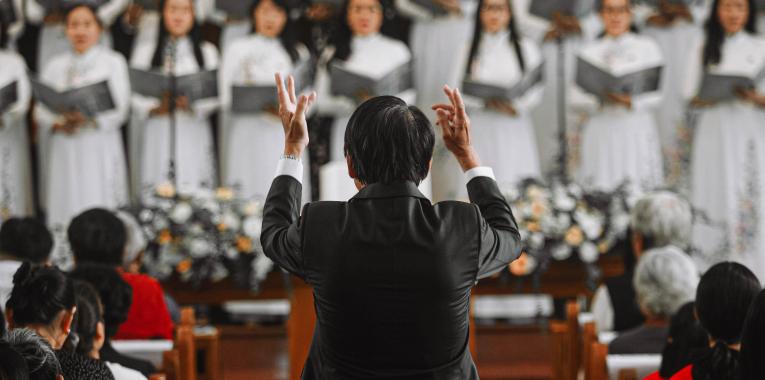
“Let the word of Christ dwell richly among you, in all wisdom teaching and admonishing one another through psalms, hymns, and spiritual songs, singing to God with gratitude in your hearts.” (Colossians 3:16 CSB – Read the chapter)
I’m going to a concert this Sunday evening. It should be a good time. I know the music of the headliners fairly well, or at least their radio hits. One of the others I listened to a bit when I was in college. The other two I haven’t heard of at all. The ticket was a gift and the company will be good, though, so I plan to enjoy myself. I’ll probably sing along with all the songs I know. I usually do that at concerts. I don’t have much self-awareness when I’m doing it either. I figure the music is loud enough that if I can’t hear myself, I shouldn’t be bothering anybody else. That’s what I do at a concert. I wonder: Do you ever sing that way in church? Admittedly, I usually do there too. I”m in fairly small company in doing that, though, and that’s really not a good. Allow me to make a case today for why you should sing more in church, and, if you are a pastor or worship leader, why you should encourage that more than you probably do.
This past week, I was doing some studying for our Wednesday night Bible study in Matthew. Like we talked about last time, we are studying our way through the various woes Jesus speaks over the religious leaders of the Jews after spending more than one day verbally sparring with them. The fifth and sixth of the seven woes Jesus speaks both point to the importance of walking our talk. Jesus calls out the religious leaders for failing to keep their inner spiritual lives up to the same standards of righteousness that they pursued on the outside where everyone could see.
“Woe to you, scribes and Pharisees, hypocrites! You clean the outside of the cup and dish, but inside they are full of greed and self-indulgence. Blind Phrarisee! First clean the inside of the cup, so that the outside of it may also become clean. Woe to you, scribes and Pharisees, hypocrites! You are like whitewashed tombs, which appear beautiful on the outside, but inside are full of the bones of the dead and every kind of impurity. In the same way, on the outside you seem righteous to people, but inside you are full of hypocrisy and lawlessness.”
Jesus’ point here is fairly obvious. We need to do the work to keep our internal lives in the same shape as our external lives. If we maintain a good front while crumbling on the inside, we are just being hypocrites. Nobody likes a hypocrite, including Jesus. Jesus loves hypocrites and died for them so they could leave their hypocrisy behind with the help of His Spirit working in them, but He didn’t like them. What I am going to invite the group on Wednesday night to consider this next week, though, is this: What are some things we can do to keep the inside of our cups clean?
We are going to talk about a variety of different things we can do, but there’s one thing I got kind of excited about thinking through. It came out of an idea that has been germinating for a few weeks since I went to a preaching conference last month. One of the breakout sessions was about leading from the pulpit through worship. The session really didn’t have anything to do with preaching or leading from the pulpit, but it was probably the most engaging and helpful session I attended. It was all about inviting us to think about the kinds of music we sing, and making a case for giving intentional attention to singing good, theologically-sound, and God-glorifying songs during our worship services.
It seems odd when Jesus was hitting the scribes and Pharisees for being overly committed to external religious activities instead of the more inwardly focused ones that they needed to bring their insides in line with their outsides to offer up what is an external religious activity as a means of accomplishing that goal, but hear me out. Religious activities aren’t the problem in and of themselves. They become a problem when we give them too much attention, or rely on them as a substitute for the kind of inside work we need to be doing rather than a supplement to it.
The truth is that religious activities, pursued rightly, can be incredibly helpful for ministering to our internal spirits and pointing us in the direction of the kind of deep and abiding spiritual growth we need to properly reflect the righteousness of God. And singing in church is one of the more important of these even as it is often one of the most neglected.
In my church we use a blend of music in our worship. Our music director works hard to give the congregation a variety of different musical styles and genres because there are different worship music preferences. For all the variety, though, we sing a lot of hymns. One of the reasons we sing hymns is that good hymns teach good theology. You may not have thought about hymns in those terms before. I know their musical accompaniment isn’t always the most exciting or even engaging, but with a hymn, the music is really just a vehicle for the lyrics. ideally the music is good and catchy, of course, but the lyrics are the real point. The music is a means for our minds to grab hold of the lyrics and remember them.
In his letter to the church in Colossae, the apostle Paul commanded them to “let the word of Christ dwell richly among you, in all wisdom teaching and admonishing one another.” Now, what comes after that is Paul’s counsel for the best way to see that happen. And seeing this happen is really important, because the word of Christ dwelling richly among us is how we grow in our faith and practice. Teaching and admonishing one another in this direction with wisdom is vital to the effort.
So then, what did Paul consider the best way to see this pursuit of mutual growth in the church happen? “Let the word of Christ dwell richly among you, in all wisdom teaching and admonishing one another through psalms, hymns, and spiritual songs, singing to God with gratitude in your hearts.” In other words, church music is one of the best ways to see this happen. One of the best ways we are to let the wod of Christ dwell richly among us so that we are being built up into the people and the church God made us to be is through singing good, sound spiritual songs to one another.
Take the hymn we introduced this past week. It’s from a new hymnal put out by Keith and Kristyn Getty that is filled with great new and old hymns for churches to use in worship. This one is called “My Labor Is Not in Vain.” Consider some of the lyrics.
My work in Christ is not in vain
My labor will not fail
For when I took in Jesus’ name
His purpose will prevail
The tasks that you have set for me
I may not understand
Yet I will follow where you lead
I trust your sovereign hand
Think about just those first two verses. What a powerful reminder these are of just what the title of the hymn declares: My labor is not in vain. That idea is itself rooted in Scripture, specifically, Paul’s glorious declaration in 1 Corinthians 15:58: “Therefore, my dear brothers and sisters, be steadfast, immovable, always excelling in the Lord’s work, because you know that your labor in the Lord is not in vain.”
If you singing those words often enough that they become ingrained in your heart and mind, what kind of an impact do you think that is going to have on your thinking about the work you do for the Lord? And when the Lord’s work gets hard, and you get tired, and you are feeling ready to just throw in the towel, there’s always the fourth verse.
Take heart, my soul, and persevere
Just as your Savior did
For soon you will be home at rest
Your work complete in Him
And consider the reminder of the chorus gets sung four or five times every time the song is sung.
So may all I do, be it great or small
Bring glory to your name
In your grace alone I will carry on
Your promise to me remains
My labor is not in vain
Now, think about this for a second: when the congregation is singing this hymn together, to whom is it being sung? There are worship songs and hymns that are sung to God to be sure, telling Him how great we think He is. There are others that are sung to us, though, reminding us of who He is. This one is sung from one member to another, encouraging us forward in our commitment to the path of Christ in spite of the challenges that path brings. The lyrics here remind us that God is sovereign, that His purposes will prevail in the end, that we are called to seek and save the lost, that He called us to follow Him in His sacrificial work, that we can trust Him even when we don’t understand everything, that His promises are trustworthy, that sometimes following Jesus is hard, that the burdens of this world aren’t forever, and so on and so forth.
Do you think any of those kinds of Scripture-rooted reminders are important for believers to have? Are they important things for us to remind one another about? Do you think that hearing those kinds of things from one to another on a regular basis to the point that the song (and the words) resonates in our hearts and minds even when we aren’t in the church singing together would help keep us encouraged and walking in the right direction?
There’s a reason Paul commanded us to teach and admonish one another using songs like this one. That is, when we worship together, and when the songs we sing in worship proclaim things that are true about God, we are teaching one another and admonishing one another in the word of Christ so that it can indeed dwell richly among us. When you sing in church, you are proclaiming words that the people next to you hear, and those words encourage them in their faith journey. At the same time, they are proclaiming those words for you to hear as well, and they will encourage you in your own faith journey. This is one of the reasons worship – and especially worshiping with good music that is Scripturally sound – matters so much. It is why it is a religious exercise that we need to have as a regular feature of our lives.
When you are in church, you need to sing. You need to sing loudly and with joy. You should have a smile on your face. Don’t just zone out and mumble along to whatever they put on the screens. Don’t selfishly decide that you don’t like singing and so will just kind of skip over that part of the service. Sing those songs. But don’t just sing them. Think about what it is you are singing. Let the words roll around in your heart and mind. If you see or hear something that seems really profound, go back and look up the words and sing the song again. Learn the song so you can sing along with more confidence the next time it is used.
When you do that, you are ministering to the people next to you. You are contributing directly to their spiritual growth and development. God is using you to call them toward greater faith and faithfulness, toward a richer and deeper understanding of who He is, toward a stronger awareness of their frailty and His holiness, and on and on the list here goes depending on the words to the songs. As a member of a particular body of Christ who has made a formal commitment to the growth and development of that group of people, you need to take this ministry with the seriousness it deserves. By your singing, you are making disciples.
On the other side of this, if you are a pastor or worship leader, you need to think really long and hard about the kind of environment you are creating in the worship gathering. Are you creating a concert environment that encourages people to be spectators, or a corporate worship environment that encourages people to be active participants in the work of teaching and admonishing one another so that the word of Christ can dwell richly among the body? If you turn the lights down low, focus on excellence to the discouragement of amateurs (this does not mean you shouldn’t still pursue excellence to the glory of God, but worship, not excellence, should be your first concern), and generally make it feel like a concert, people will eventually treat it like a concert. I’m weird at concerts. Most people don’t sing along like I do. If you make your worship setting like a concert, most people won’t sing along and this whole ministry that God commanded us to take up won’t be happening. Make sure you are doing everything possible to encourage people to sing, and then to give them songs that are worth singing. God commands it and you need it.

