
“If we confess our sins, he is faithful and righteous to forgive us our sins and to cleanse us from all unrighteousness. If we say, ‘We have not sinned,’ we make him a liar, and his word is not in us.” (1 John 1:9-10 CSB – Read the chapter)
I had the chance last night to see the band MercyMe in concert along with Jeremy Camp, Tim Timmons, and Sam Wesley. It was a great show. Timmons and Wesley I hadn’t heard of, but that’s apparently because I haven’t yet seen the movie I Can Only Imagine 2 in which both feature prominently in the story. Wesley is actually the son of the lead singer of MercyMe. None of the actors who played them looked even remotely like the actual people, which is always funny to me. One of MercyMe’s biggest hits over the years is the song “Flawless.” The song offers listeners the assurance of forgiveness thanks to the incredible grace of God. The idea is that like John writes here in his first letter, God’s grace in Christ Jesus will cleanse us from all unrighteousness so that we are flawless. God’s grace, won for us by Jesus on the cross, is indeed an amazing thing. But it comes with a catch. Since I didn’t preach yesterday, let’s take a few minutes to talk about this catch this today.
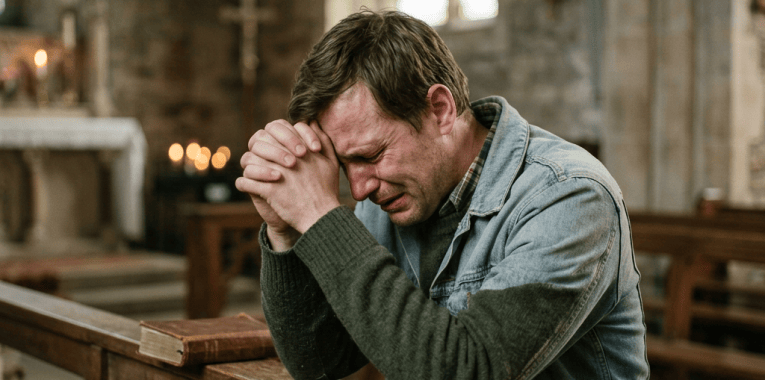
Let’s jump straight to the point, and I’ll unpack things a bit from there. The catch here is repentance. In order to receive the grace Jesus won for us on the cross by sacrificing His own perfect life for our lives that are filthy with sin we have to repent of those sins and go to Him for forgiveness. Repentance is the key. Repentance is the thing that demonstrates our willingness to receive the gift He longs to give us. Repentance is the thing that allows us to receive His forgiveness and the cleansing that comes along with it. Repentance is what makes our confession genuine. Without repentance – real repentance – we’re just wasting everyone’s time.
When we seek forgiveness without real repentance, what we are saying is that while we want God to let us out of the consequences of our sin, we aren’t actually admitting that we really did anything wrong. We are confessing that somewhere inside our hearts and minds is the idea that God is really the unreasonable party here. What we did wasn’t bad enough to warrant any kind of divine punishment, much less divine attention, and yet God in His infinite impatience and unreasonableness has decided that we need to be punished anyway. So, we’ll play His little game and go to Jesus with everybody else so that we can get this grand assurance of no more punishment and then get back to living however we please.
When John the Baptist was doing His ministry, His main message was that the Messiah was coming and the people needed to repent of their sins to prepare themselves for His arrival. Something about John made the people listen in a way they hadn’t before. I would argue that it was the presence of the Holy Spirit in his message that got their attention. Whatever the precise recipe for his success, though, people responded. They came out in droves to hear his powerful condemnation of sin. Under the conviction of the Holy Spirit-fueled message (but not under the conviction of the Spirit Himself since He hadn’t yet been sent to us in full by the Father and Son), the people repented and were baptized as a sign of their seriousness.
During this whole revival movement the scribes and Pharisees came out to be baptized as well. They might as well have. Everybody else in the nation was participating in this Jewish revival, and they were the religious leaders of the Jews. It would look bad if they didn’t go out and get baptized like all the rest of their people. But while they were there for baptism, there was no repentance in their hearts. They already believed themselves to be sinless in their pursuit of the righteousness found in the law. John called them out loudly and publicly, calling them a “brood of vipers.” His condemnation was prophetic as it demonstrated their eventual rejection of Jesus when He was revealed to them.
Without repentance on our part, forgiveness on God’s part is not possible. The problem here, though, isn’t with God. It’s not like God is sitting there on His throne petulantly refusing to give out His goodies to those who don’t demonstrate they are sufficiently sorry for their sins to meet His muster. The problem is with us. The reality of the situation is that God has declared that in Christ, the forgiveness of sins and the cleansing from all unrighteousness is available freely to all who would receive it. Period. There are no conditions on this except for our going to Him with genuinely repentant hearts to receive it. Literally anyone can have it no matter what. The problem is that when we don’t have a genuinely repentant heart, we don’t actually go to Him to receive even if we tell everyone else and even convince ourselves of the delusion that we have.
Unless we have adopted this mindset and heartset of repentance, though, we’re like Harry and Marv, the goons from the original Home Alone movies. In the second movie when they are going through Kevin’s house of horrors, there’s a scene when he taunts them to follow him up the stairs. Remembering the paint cans they took to the face when they did that in the first movie, they respond by trying to fake him out. They stop on the stairs like they are coming up, but don’t actually go anywhere, laughing hysterically as the paint cans they expected swing harmlessly past them. We think we’re so cute to put on a show that fools everyone – including God – but we don’t realize there’s the cast iron pipe of judgment swinging down next to really take us out.
Or, to put it like John does here in v. 10, when we don’t actually repent of our sins, what we are confessing is that we don’t think we have really sinned. The problem with that is that we did sin. We do sin. Just like God has said. That’s why Jesus went to the cross. If we don’t have sin, then God was wrong, and Jesus went to the cross in futility and on false premises. If we say we have not sinned, then somebody is a liar here. It’s either God or it’s us. I’m going to go ahead and place my bets on the it’s-not-God space on the cosmic roulette wheel.
So then, how do we actually get this right? Well, we start by acknowledging our sin. And this can’t be the I’m-sorry-you-were-hurt-by-this, politician’s apology. That’s not repentance at all. That’s an admission that we don’t think we did anything wrong, but we’re sorry you took our actions in the wrong way and were therefore offended by them. That kind of apology actually puts the onus of the problem on the other person. They really should be apologizing to us for the offense of misinterpreting what we did so badly as to cause this whole kerfuffle. That’s a “we have not sinned” apology, and we just talked about what that kind of apology makes us.
If you are going to genuinely repent of your sin, you have to honestly acknowledge that you sinned. You didn’t just make a mistake. You didn’t just hurt somebody’s feelings. You didn’t just have a momentary lapse in judgment. You sinned. You willingly and intentionally violated the character and command of God in an act of open rebellion against His sovereignty and authority as Creator and King of the universe, and the one who has the rightful position to be able to declare your actions as wrong and reprehensible. You did what was evil in the sight of the Lord and you have incurred guilt for that. What’s more, those actions on your part likely hurt another person. It may not have been a direct impact, but you at the very least contributed to the hurt someone else is experiencing or will yet experience.
This kind of acknowledgement is neither fun nor easy to make, but it is absolutely essential to the process. Unless and until we agree with God that we did something wrong, we’re never really going to be able to receive His forgiveness because at the end of the day, we don’t think we need it. I have occasionally been given gifts I didn’t expect, didn’t need, and didn’t really want. I have always tried to be gracious and grateful to the givers in these instances, but typically those gifts go on a shelf to never be used again, and eventually to the trash when an acceptable amount of time has passed. If God’s forgiveness goes on the metaphorical shelf of your life, never to be used again, then it’s really not doing you any good, is it? If you want to live in the forgiveness of Christ, then confess your sins honestly, specifically, and completely.
The next step toward repentance is to accept the consequences of your sin with humility. When you break the law and get caught doing so, there are going to be consequences for your crime. Depending on the nature of the crime the consequences may be small or large, but there will come a cost. You can try to fight to bring the cost down as much as possible, or you can try to push the argument that you didn’t do anything wrong at all and shouldn’t face any consequences. But when the case is closed, and you are found guilty, consequences will be assessed.
In the same way, when you commit a sin that hurts another person, there are going to be relational consequences because of it. You can try to avoid those, but generally the only way that is going to happen is by avoiding taking responsibility for your sin or by bailing on the relationship altogether. The only way to avoid taking responsibility without bailing on the relationship is to try to convince the person you hurt that you either A. didn’t really mean it, or B. that it wasn’t really as bad as they took it to be. Good luck with that. Bailing on the relationship won’t fix anything either, it just makes you a coward. Worse, it makes you a relational coward. If you walk down that path, you’ll eventually find yourself on an deserted island, unable to have meaningful relationships with anyone in your life.
Well, what is true legally and relationally is also true with God. When you have committed a sin, the consequence of that sin is separation from God. He is perfect in righteousness and unapproachable in holiness by sinners. Sin cannot exist in His presence. So, as long as you remain in your sin, you will remain separated from Him. If you remain in your sin beyond the point that repentance is no longer possible, then that separation will become permanent. But, the cost for being reconciled to God out of your sin is to return to Him the thing that was taken when you sinned, namely, your life. But if you return your life to God to be reconciled to Him, you won’t have it anymore – that is, you’ll be dead. And no relationship is possible when you are dead. What this means is that if you are trying to reconcile with God on your own, you’re damned if you do and damned if you don’t. The only hope you have is Jesus and the free forgiveness He offers because of His sacrifice to pay the price for your sin on your behalf. Until you get to the point that you are able to humbly accept the actual consequences of your sin, you won’t get to the point that you can actually receive the gift Jesus offers to help you avoid them. Or, to put that another way, unless you genuinely repent, God’s got nothing for you.
The third and final part of genuine repentance is a commitment on your part to not doing whatever it is you are repenting of again. Several years ago, I got a speeding ticket. It was in a little town that really didn’t have anything going on except for busting people who sped through it on the way from one populated area to another. But, I missed a speed limit change sign and was accurately and honestly clocked going nine miles over the legal limit. Busted. I didn’t want the points on my license, so I dutifully made my court date a few weeks later and appeared before the judge. She was very nice, I had been very polite to and cooperative with the officer, and so it was a quick assignment of online driving school, and the case was considered dismissed. I really didn’t have to say anything beyond acknowledging that I had sped and thanking both the judge and the officer for their graciousness to me. What I didn’t do was apologize for speeding. Nor was I asked to do so. If I had, it would have been an empty apology because I would have known full well that I was going to speed again. That’s not because I’m a fast driver – I’m not. But because the likelihood that there were eventually going to be circumstances in which I sped again was high, what I was really sorry for in that moment is that I got caught.
If you hurt another person, and then later went to them to apologize for it in hopes of restoring the relationship, but had every intention of doing whatever it was that hurt them again, your apology would be empty at best. At worst it would be an outright deception, meaning you would later have something else to apologize for. You certainly wouldn’t be repenting in any meaningful way. Real repentance happens when we not only own our actions, and accept the consequences of those actions with humility, but when we go on to commit with accountability to not doing whatever it was that we did again. Without that, there’s no real repentance going on. There’s just the hope of avoiding consequences for a sin we plan to commit again. What we need to do in that case is to go away and come back when we really mean it, when we are actually ready to be done with our sin. Because we can’t have Jesus and our sin. That is an either-or proposition, not a both-and one.
Sin is bad stuff. It causes real pain to the real people around us. It will eventually bring real consequences to our own lives that we won’t like. We can’t always avoid the kind of relational consequences it brings to our immediate circumstances, but in Christ, we can find real forgiveness and be reconciled to God. And, when our repentance is genuine, the possibility of being restored fully with the people we hurt by it always exists. God’s healing mercy and love are pretty powerful. But none of that is possible without repentance. Real repentance. Like MercyMe sang last night, the cross will make you flawless, but getting there requires that real repentance. Until you’re ready to do that, don’t bother. You won’t get anywhere. But when you are, He is indeed faithful and righteous and will forgive you of your sin and cleanse you from all unrighteousness. If that sounds as good to you as it does to me, then let’s get to repenting.

