

It is necessary and often good to talk about the challenges facing a marriage. Until we properly understand the nature of the problem, we don’t know what it is we are trying to solve. However, unless we have a positive vision and understanding of what marriage was designed for in the first place, we’re not going to be able to point things in a direction that can help prevent future challenges. Last time, as we started our new teaching series, The Journey of a Lifetime, looking at what the Scriptures have to say about marriage, we identified the problem: sin. This week we are going to look at what marriage was designed for in the beginning so that we can walk away from the problem in the right direction.
More Like Him
I’m going to show you an image of something, and I want to see if you know what it is? For some of you, this is probably going to be really easy, but a few of you might not have any idea. In fact, I’m going to show you a couple of different images for us to talk about. Let’s start with that first image. What is the thing sticking up out of the container here? Be honest with me now: How many of you knew this was a potato masher without being told or without cheating by reading the answer in your copy of my manuscript before the service even started? How many of you genuinely didn’t know what this thing was and wouldn’t have known without being told? Everyone else apparently is just confused.
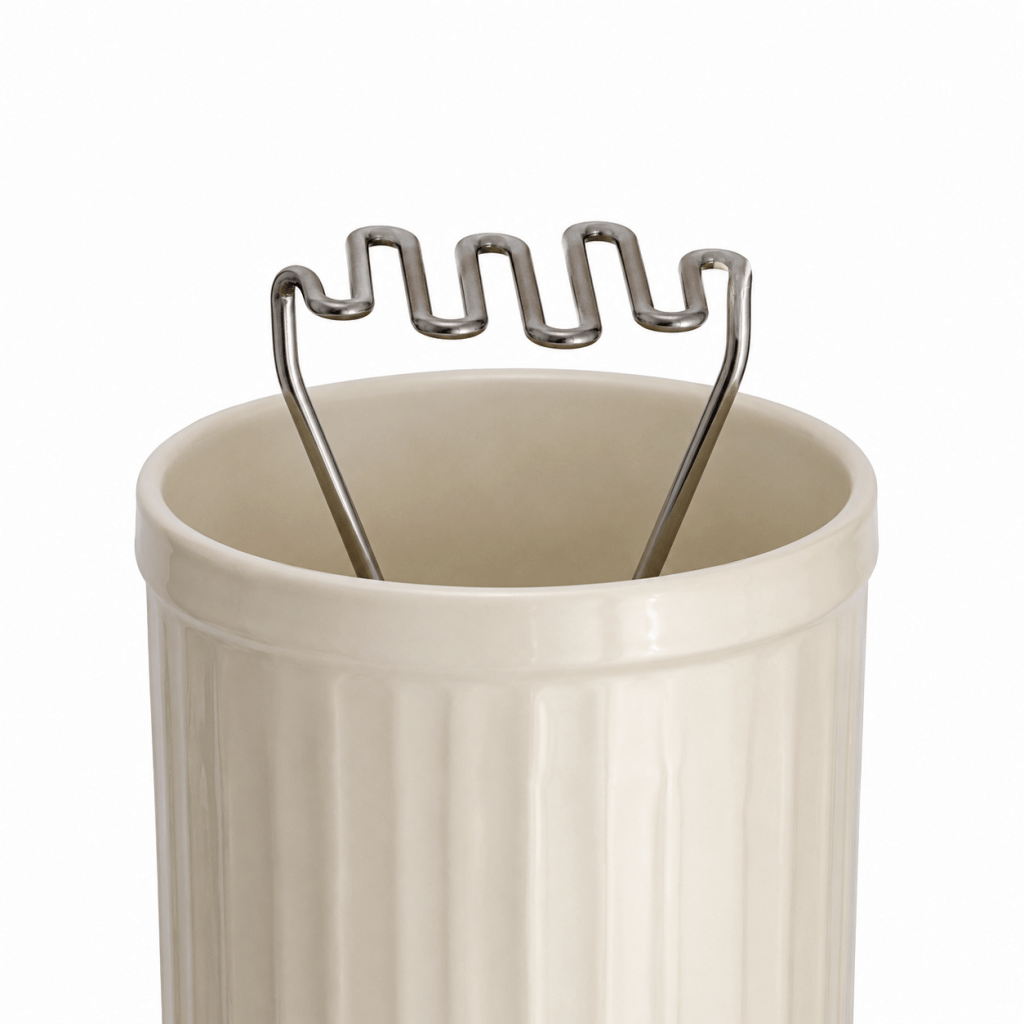
Yes, this is a potato masher—a common kitchen tool. But if you just saw this particular kitchen tool without any background knowledge or context, you could be forgiven for not having any idea what it is. I mean, it’s just a squiggly piece of metal. There could be all sorts of different things this might be used for. But if while you were wondering that I told you that it was used for mashing potatoes, then unless it happened to have a fancy name that didn’t make any sense (like a froe—that’s spelled F-R-O-E, and I’ll let you look that one up later to find out what it is), you would have a pretty good idea of what it is.
Let’s look at another image here. It’s almost the same image, but has one key difference.
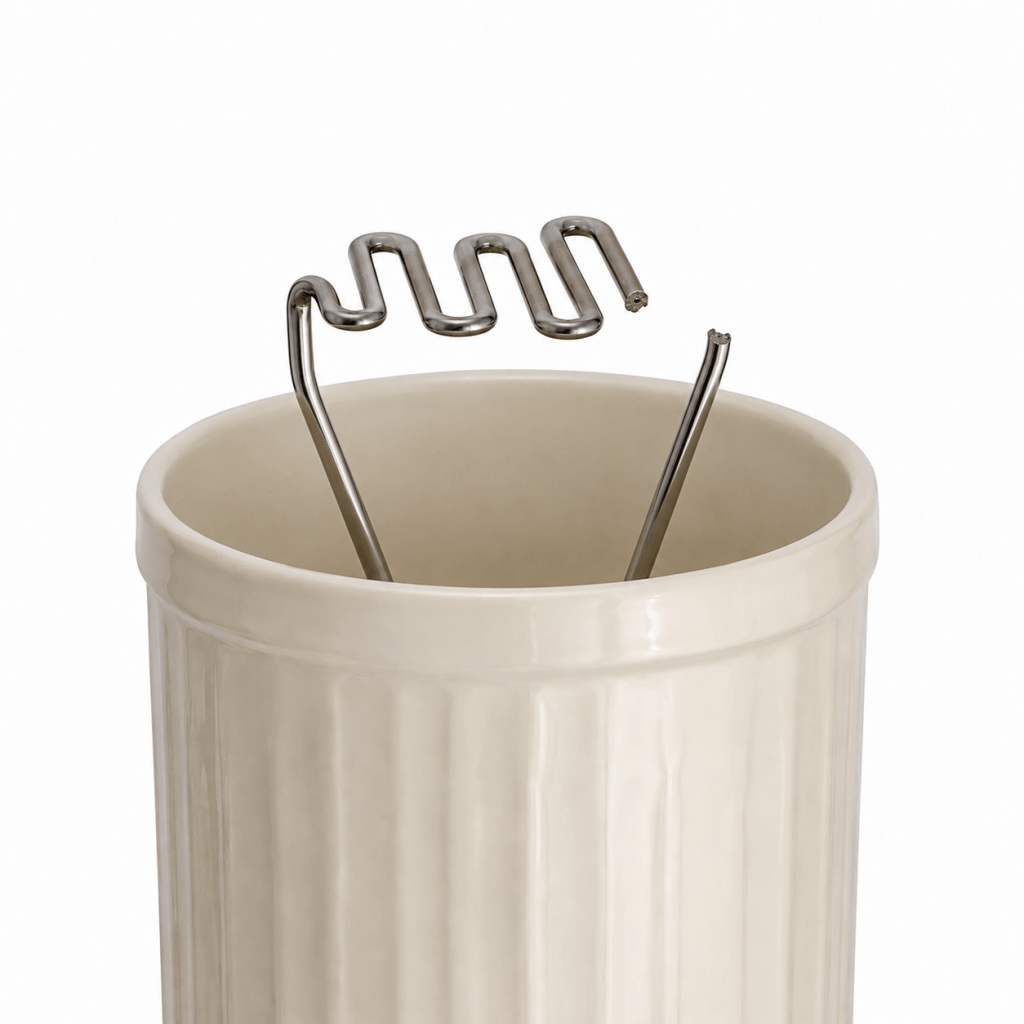
What is wrong with the potato masher in this picture? It’s broken, right? Even if you didn’t have any idea what this tool happened to be, a quick glance would tell you that it is broken. That’s simply intuitive. Now, sure, it could have a really counterintuitive design such that it looks broken even when it’s not (it doesn’t, of course), but that’s besides the point at the moment. The point is that we can look at it and clearly see not only that but how it is broken. The problem is obvious. It’s missing part of the masher. But unless and until we know what it is for, knowing how to use it properly—let alone what it is—is another matter entirely.
This morning we are in the second part of our series, The Journey of a Lifetime. Over the course of these five weeks, we are looking at the institution of marriage from the standpoint of the Scriptures because everybody who is on this particular journey needs some wisdom for the road every now and then. When it comes to what the Scriptures have to say about marriage, there’s a lot. Some of it is direct and clear. Some of it is more indirect and takes a bit of work to uncover. All of it is worth our time to study so that we can make sure that our relationships are falling in line with the wisdom and character of Christ to the absolute fullest extent of our abilities.
Now, nothing we talk about in this series is going to function like a magic wand that will make all of your marriage problems go away. That kind of thing doesn’t exist. But anytime we take the wisdom of God in the Scriptures and seek to adjust our lives to it (rather than trying to adjust the Scriptures to our lives for the sake of convenience as we’re often tempted to do), those efforts will put us on a path toward healing and the kind of wholeness we all long for. That’s the goal of this series: to help all of us see more clearly what God’s intentions for this crucial part of our lives are so that we can better align ourselves with His desires.
Last week, we started things out by talking about the problem. And, I chose the definite article and the singular noun there on purpose. We could spend weeks talking about all of the various problems we deal with in our marriages and trying to run down the precise cause for these so that we can fix them. But while the specific challenges you are facing in your particular relationship are unique to your particular relationship, no matter what the precise issue is, there is one thing and one thing only lying at the absolute heart of the problem: sin. When the first man and woman ate the fruit from the tree God commanded them not to eat from, rejecting His sovereignty in favor of a delusion of autonomy, sin entered the world, and one of the things it started doing right out of the gate was to make relationships marked by the kind of intimacy God intended for them to have impossible to achieve anymore on our own. Instead, as God told the woman in Genesis 3:16, relationships, but especially the marriage relationship, would be marked by a Tom-and-Jerry-like chase in which each partner is after the other to establish dominance and a position of strength so they can get what they want. When it comes to challenges in our marriages, the primary problem is sin.
Far from being a hopeless sentence, though, if the primary problem is sin, then the primary solution is the Gospel. When we submit ourselves and our relationships to the power of Christ expressed through the Gospel, we will put ourselves on the path toward experiencing once again the kind of beautiful intimacy God intended for us to enjoy together.
That was last time. As we just saw, though, knowing what the problem with something is is good, but it doesn’t tell us how to get it right. In order to understand that, we have to have a better idea what it is for. To put that another way, if the ultimate problem in our marriage is sin, if we are really going to get marriage right, we need to know what it is for, not simply how it is broken. In order to get our minds wrapped around that, we need to go back just a bit further in the story than where we were last week. If you have your copy of the Scriptures handy, join me right near the beginning of the whole thing in Genesis 2 in a passage that Jesus Himself pointed to as foundational for understanding marriage properly.
When we think about the creation narrative in the Scriptures, we typically limit our thinking to Genesis 1. This is for obvious reasons. The sub-title most Bibles give that whole chapter is something like “Creation.” That’s a little on the nose, but not without just cause. The story told there is about God’s creating the world and everything in it. Now, that narrative is not intended to be a scientific treatise detailing the mechanics of the whole process, but rather establishes that God is responsible for all of it along with some important patterns and themes that become crucial for getting a great many other things right in the Scriptures as a whole.
But Genesis 1 isn’t the only creation story in the Scriptures. It’s simply the most cosmic of them. When we turn the page on that version of the story, we find another version of the story that is entirely more earthy in its presentation. That it is still a creation story we know thanks to the first verse of the section in Genesis 2:4: “These are the records of the heavens and the earth, concerning their creation.” As a creation story, then, there are patterns and themes here that are just as crucial for us to understand if we are going to get the rest of the story right as there were in chapter 1. I want to focus on a couple of these in particular right near the end of this version of the story with you this morning, but let’s take in a bit more context before we get there. If you are with me in Genesis 2, find v.4, and let’s get rolling.
“These are the records of the heavens and the earth, concerning their creation. At the time that the Lord God made the earth and the heavens, no shrub of the field had yet grown on the land, and no plant of the field had yet sprouted, for the Lord God had not made it rain on the land, and there was no man to work the ground. But mist would come up from the earth and water all the ground. Then the Lord God formed the man out of the dust from the ground and breathed the breath of life into his nostrils, and the man became a living being.”
No longer do we simply have the declaration that God made us in His image and that was that. God got His hands dirty carefully molding us into shape. Then He got right up in our faces to breathe the breath of life into us so that we were alive. While the rest of the animals of the world were similarly shaped, they don’t get nearly the kind of intimate treatment we did. God made us. There was an intimacy to our creation that He did not invest in anything else. As it was declared in chapter 1, we were made in His image; first the man, and then the woman.
But there’s more. We were made to work the ground so that creation could flourish. That work sin would render futile like we talked about last time, but that we would work was itself without the stain of sin always a part of God’s plan. Notice there were two things missing at the beginning of this version of the creation story: rain and a caretaker. God made both. Then He made a place for us to begin the work of stewarding creation to His glory.
“The Lord God planted a garden in Eden, in the east, and there he placed the man he had formed. The Lord God caused [not simply the rain allowed] to grow out of the ground every tree pleasing in appearance and good for food, including the tree of life in the middle of the garden, as well as the tree of the knowledge of good and evil. A river went out from Eden to water the garden. From there it divided and became the source of four rivers. The name of the first is Pishon, which flows through the entire land of Havilah, where there is gold. Gold from that land is pure; bdellium and onyx are also there. The name of the second river is Gihon, which flows through the entire land of Cush. The name of the third river is Tigris, which runs east of Assyria. And the fourth river is the Euphrates.”
Now, there are geographical details here that are mostly lost on us today. We have a general sense of where all of this was—somewhere in the Middle East—but nothing more specific than that. Sacred and secular anthropologists alike know that human civilization started there. The precise location of all of this, however, doesn’t matter. It would obviously be interesting to know, but it doesn’t affect any of the outcomes of the story.
God gave us not only a place to work, but made specific what our call was and laid down some ground rules for us. Verse 15 now: “The Lord God took the man and placed him in the garden of Eden to work it and watch over it. And the Lord God commanded the man, ‘You are free to eat from any tree of the garden, but you must not eat from the tree of the knowledge of good and evil, for on the day you eat from it, you will certainly die.’” We could spend a whole lot of time another day examining this statement, the possible reasons for it, and its implications. There’s a book called Biblical Critical Theory by Christopher Watkin that actually does a pretty good job of it, and which you are welcome to borrow from my library if you are really interested. It’s a bit of a long read, but it’s well worth the effort. Not many scholars have the ability to write readably; Watkin does.
So, this is all what is going on that informs the themes more important for our purposes today. God created the world and everything in it and put us here to work it to His glory. At this point, though, there’s not quite yet an “us.” There’s just a “him.” And stewarding creation is a big job. What’s more, it’s a lonely job. There’s one more thing as well. God’s command to us on our creation was to be fruitful and multiply. You can’t be fruitful and multiply by yourself.
Because of all of that, when God looked down at everything He had created, for the first time He saw something that wasn’t good. We should clarify here, though, that this wasn’t like an unexpected discovery on God’s part. He knew just what He was doing and the order in which He was doing it. This was about establishing something important, namely, that we weren’t made to be on our own. As creatures created in His image, and given that His image is inherently relational because God exists as a perfect community of Father, Son, and Spirit, we were created with the need for relationships—relationships that weren’t possible yet because it was just the man.
Before God completely solved the issue, though, He had to demonstrate potential solutions that weren’t actually. I have to think this wasn’t just for the benefit of the first man so much as for our benefit reading this later through the lens of history. In any event, “the Lord God said, ‘It is not good for the man to be alone. I will make him a helper corresponding to him.’” Some translations phrase that “a helper who is like him.” God was going to make the man another creature who could meet his relational needs; who could complete him in the places he was still incomplete on his own.
And I should clarify that by “helper,” God was not talking about giving the man some sort of a servant or someone who was to be considered inferior to him in any conceivable way. The word translated “helper” is also used of God in a variety of other contexts in the Old Testament and He is obviously not inferior to us in some way. The word refers to one who is able to do for someone what they cannot do for themselves. A helper in this sense is one who meets a need that cannot otherwise be met. One commentary writer uses the phrase “indispensable companion,” and goes on to observe that “the woman would supply what the man was lacking in the design of creation and logically it would follow that the man would supply what she was lacking, although that is not stated here.”
Well, the initial wave of “solutions” to this problem was the animal kingdom. “The Lord God formed out of the ground every wild animal and every bird of the sky, and brought each to the man to see what he would call it. And whatever the man called a living creature, that was its name.” This, by the way, implies authority and even ownership. Creation was created not simply for our sakes, but for our possession. It was given to us. Far from meaning we can do with it whatever we please, this fact makes our careful protection and preservation of this gift all the more imperative. Yet although the man did the work God gave him carefully and faithfully, he did not find the one creature that was going to be able to meet his relational needs; a helper that properly corresponded to him. “The man gave names to all the livestock, to the birds of the sky, and to every wild animal; but for the man no helper was found corresponding to him.” This is, of course, because that helper hadn’t been created yet; something God was about to fix.
“So the Lord God caused a deep sleep to come over the man, and he slept. God took one of his ribs and closed the flesh at that place. Then the Lord God made the rib he had taken from the man into a woman and brought her to the man.” And the man was like, “Meh…pretty good. What else have you got, God?” No! Of course he wasn’t! He looked at this brand-new creature, this final crown jewel of all creation, and he broke into song. “And the man said: This one, at last, is bone of my bone and flesh of my flesh; this one will be called ‘woman,’ for she was taken from man.” In other words, “God, this one at last is like me. She’s perfect. She’s everything I ever needed that’s not you. She corresponds to me. She is the helper I’ve needed all this time. You got this one just right, God.”
And here the story breaks, and Moses speaks into the action with his voice. He adds an editorial note here about marriage. Now, why would he do this? Nothing has been said at all about marriage this whole time. Because God was giving the woman to the man to be his wife. Our heavenly Father was the first person to give his daughter away. In light of this, Moses, led by the Holy Spirit, wanted future readers to understand the nature of this gift and what God intended for us by it.
Look with me at what he says. “This is why…” Pause right there for a second. What is why? What’s “this”? All of the context that has led us up to this point. It was no good that the man was alone. There was not any helper for him that properly corresponded to him in all of creation. So, God made a special one and brought her to the man so the two of them could be completed together as husband and wife, each the helper that corresponded properly to the other. Because that was the relationship God was creating here, “this is why a man leaves his father and mother and bonds with his wife.”
Obviously the first man and woman did not have a mother and father, so they didn’t have anyone to leave. They didn’t have any other relationships that were going to have to be refashioned in light of this new one that was forming. They could simply bond with each other. Moses wasn’t talking directly about them, but about the pattern God was creating. We, on the other hand, do have mothers and fathers. And when we are young and growing, we are connected to them. They provide what we need that we otherwise cannot access for ourselves. And what do we need? Physical sustenance. Relational support and definition. Wisdom for developing into the people God made us to be. Character and identity formation. Basically everything. But at some point, unless someone has been called by God to celibate singleness, we find another person with whom we will bond to see these needs otherwise met. And when this happens, we have to break the relationship we once had with our parents; we have to cut those ties so we can be bonded to this new person. This doesn’t mean those former relationships are merely cast aside. Rather, they are refashioned in light of our new reality. Failure to do this leaving will make the new relationship impossible to form properly. We have to be committed to seeing this cleaving happen and so do our parents. If either party does not follow through on this, again, that’s going to cause all sorts of issues in the new relationship. That’s not how God designed things here to work.
So, in marriage, this new thing God made here to bond the man and woman together in a way that completed them both, God was giving the pair a way to experience the kind of community He enjoyed among Himself as Father, Son, and Spirit. Now, marriage isn’t the only way to experience this life-giving community. Otherwise, people who are called to singleness—like the apostle Paul—wouldn’t have access to it, and that wasn’t God’s intention. Marriage is a special way to experience it that most people are called to, but we can also experience it through the church. That’s why the body of Christ matters so much—especially for followers of Jesus who are single—and it’s why as a church we dare not forget about the single brothers and sisters in our midst whether their singleness is for a season or a lifetime call from God.
What marriage does offer those who are called to it, though, is what Moses notes at the end of v. 24. When the man and woman cleave from their other relationships to form this new bond with one another they become one together in a unique way. “And they became one flesh,” is the way Moses described it. God designed marriage for two people to experience a unique kind of intimacy that is only remotely approached by our own relationship with Him in Christ. The husband and wife remain distinct individuals, yes, but they become one unit in a multitude of ways—physically, emotionally, relationally, spiritually, economically, and so on and so forth. All of this is great by itself, but more than just that, it is intended to be a reflection of the relationship God desires to have with each of us.
Describing this unique intimacy further, Moses concludes his editorial note here in v. 25 by noting that “both the man and his wife were naked, yet felt no shame.” Can you imagine being naked and without shame? This characterized their physical state, of course. Indeed, as we saw last time, when they ate the fruit God told them not to eat, they both became aware of their physical nakedness and were immediately ashamed of it and tried to hide themselves from each other. But the man and his wife shared a much deeper nakedness than that. They were incredibly vulnerable with each other, sharing their deepest and most heartfelt passions, being utterly transparent about all of their hopes and dreams and desires. And they did so confident they would receive no judgment or condemnation from the other for anything they shared.
Friends, this is exactly the kind of relationship with God we have available to us in Christ. Each of these different things God built into marriage from the start are all reflections of the kinds of things He wants to have with us. We don’t need marriage to experience them, but in marriage, when we are getting things right, we have an open avenue to doing so, drawing us deeper into this relationship He desires with us. Not only that, but we also give the world around us a picture of what God desires to have with us. So, marriage done well not only draws us into a deeper relationship with Him, it invites others to experience that as well.
What becomes clear the more we reflect on all of this is that God gave us marriage as a blessing to us, yes, but more so to be an invitation to become more fully who He made us to be. On this side of the cross, now, we understand that this all happens in and through Christ alone, but marriage is still intended to be a pointer in this direction personally and publicly. In other words, God made marriage to make us more like Him. God made marriage to make us more like Him.
Now, is there more to marriage than this—even things that God built into it? Yes, there are, creating the context for our keeping His command to be fruitful and multiply being chief among those, but this thing about making us more like Him comes first. This is primary. If we understand marriage in any other terms, we are not going to get it right; we are not going to experience the fullness of what He intends for us by it. When we understand that the whole thing is about drawing us in to be more like Him, we will see everything about it—both the blessings and the challenges—through the proper lens, and that will make everything else make more sense. It will give us the encouragement we need to keep pursuing Him through this particular context even when it’s hard. It’ll give us the motivation we need to persevere to get it right for our own benefit and for the benefit of those around us. God made marriage to make us more like Him. How exactly do we do that? That’s what we’re going to be talking about for the next three parts of our series. For now, this is the foundation we need to build what comes next: God made marriage to make us more like Him.

